Bac water is short right now. That is the headline. What actually matters is what people start doing when they cannot get the real stuff.
If you are handling research peptides, the diluent supply just got unreliable. Genuine Hospira bacteriostatic water is on shortage. The simple places to get it disappeared, and a lot of what shows up instead fails when someone actually tests it.
Scarcity by itself is not the whole problem. The problem is the shortcuts that come with it. People grab sterile water instead, trust whatever off-brand vial looks clean, or keep using an opened vial long after the clock should have run out.
This is a straight rundown on the shortage, the substitution risk, and why the clear vial on the counter does not tell you much.
What actually changed
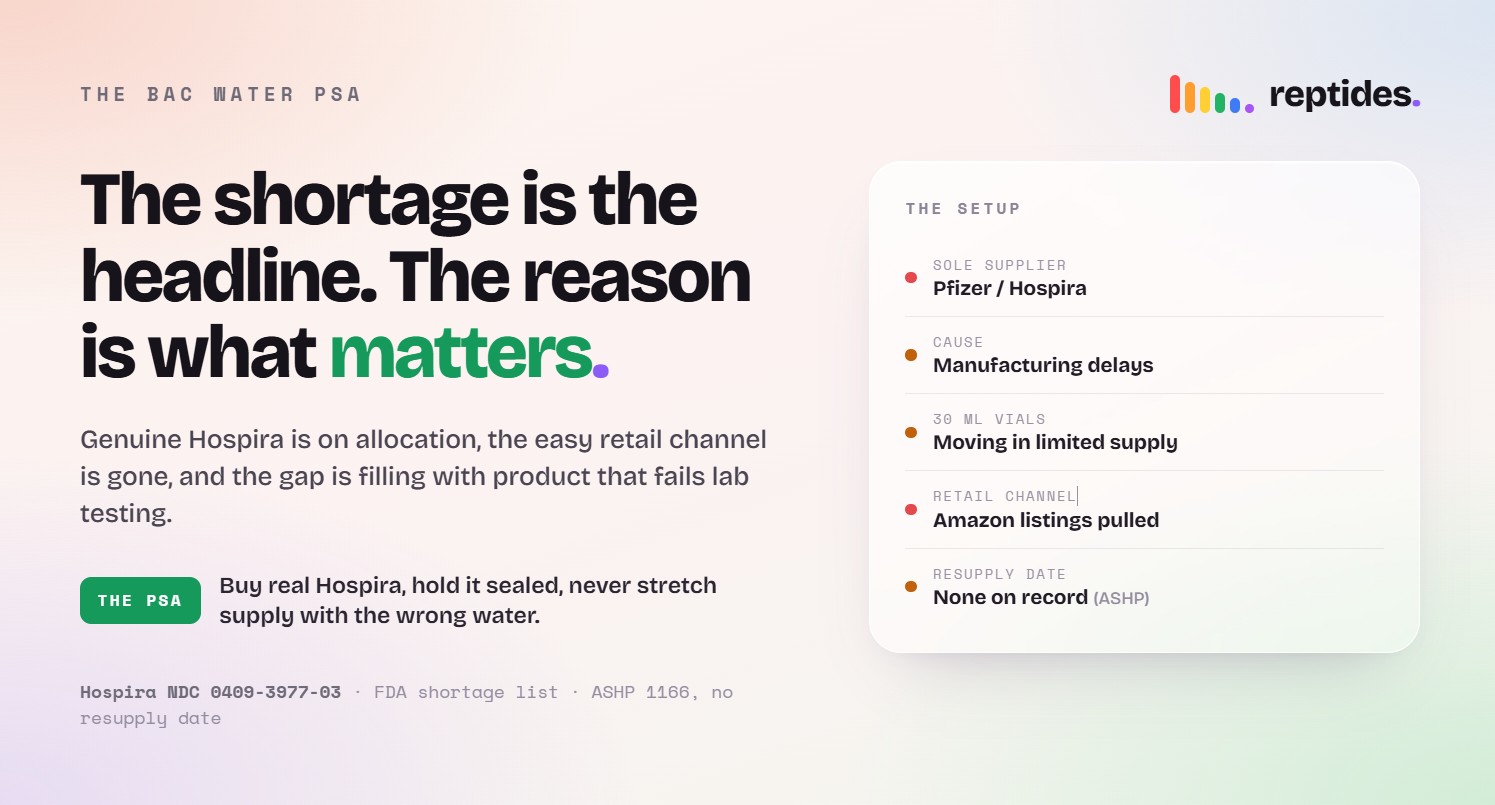
Hospira bac water is listed as in shortage on the FDA database. Pfizer is the only listed supplier. Manufacturing delays are the stated cause, and the 30 mL vials are in limited supply with no firm date for when that changes.
This is not brand-new noise either. ASHP has carried the item on and off its shortage list since 2021, mostly around the same production problem. The current bulletin still lists Hospira NDC 0409-3977-03 in limited supply and no resupply date. So any clean back-in-stock date floating around should be treated as downstream chatter unless the primary shortage source says it too.
Two things followed. Prices jumped. Some of that is real scarcity math. Some of it looks like plain markup. At the same time, the easy retail channel mostly shut down. Through 2025 into 2026, bac-water listings largely vanished from Amazon. No big public statement from Amazon, just fewer listings. A lot of the commentary comes from vendors who sell bac water themselves, so take the clean "Amazon banned it" version with that incentive in mind.
What is not fuzzy: bac water is labeled Rx only under federal drug rules. FDA has already gone after unapproved injectables sold on Amazon before. Its March 2025 warning letter hit specific fat-dissolving injectable products on the site. It did not name bac water, but it shows the basic enforcement posture: regulated injectables were never a natural fit for a frictionless marketplace aisle.
Testing explains why the retail channel closing matters. One survey checked bac water sold on Amazon for benzyl alcohol content and pH. Out of 11 products, only two passed. The test did not include sterility or endotoxin checks, just the basic formulation. Still, failing the preservative level is not a tiny label problem.
So the real product got scarce and expensive at the same time the main easy retail lane went away. That is exactly the setup where bad product moves in, because bac water is easy to fake and almost nobody tests what shows up. A clear vial tells you nothing.
Why this matters
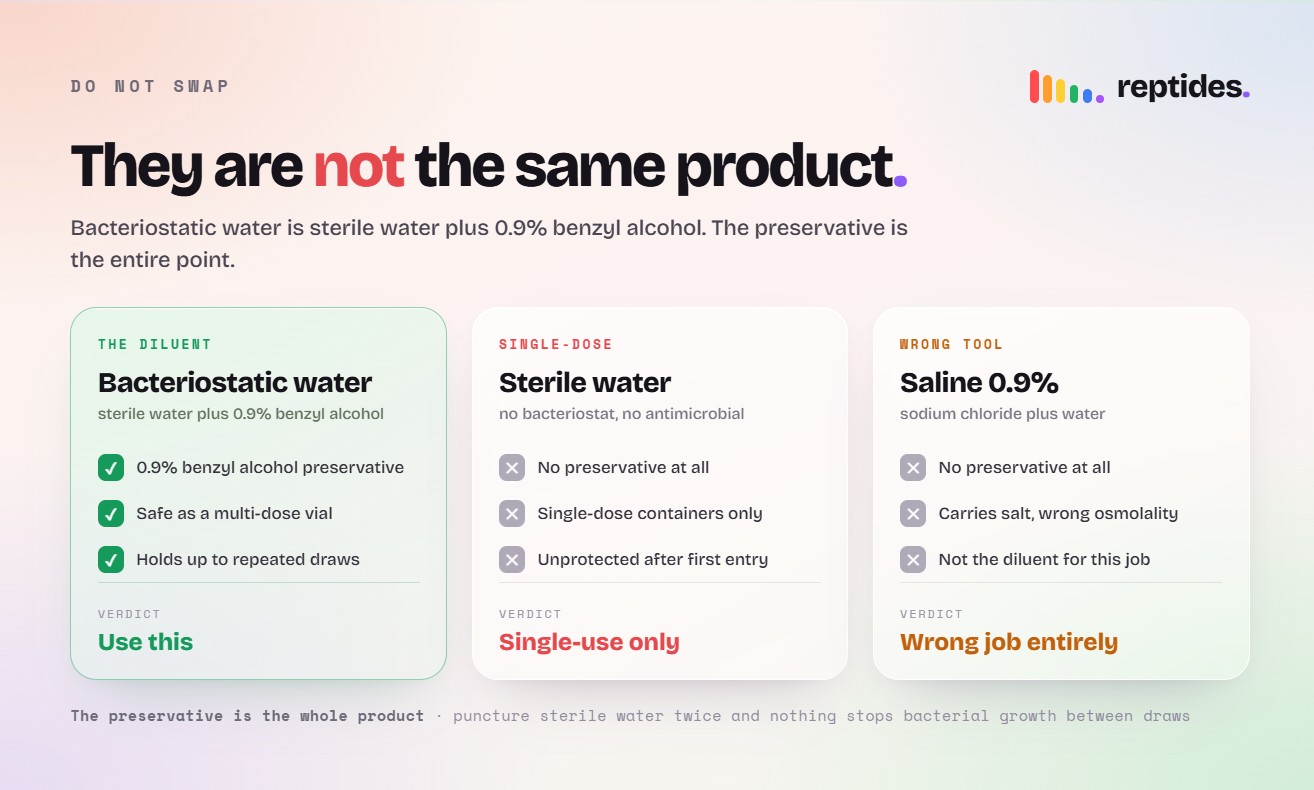
Scarcity pushes people into three bad moves. The first is swapping in plain sterile water for injection. They are not interchangeable.
Bac water is sterile water plus 0.9% benzyl alcohol. The benzyl alcohol is the preservative that lets a multi-dose vial be entered more than once under proper sterile practice. That is not a side feature. It is the whole point of the product.
Plain sterile water has no preservative at all. The label says no bacteriostat, no antimicrobial agent, no added buffer, and single-dose containers only. Once it is punctured more than once, there is nothing in the vial doing the job benzyl alcohol does in bac water.
Saline is not a substitute either. It has sodium chloride in it, a different osmolality profile, and a different purpose. The preservative is what makes bac water bac water.
The spec is the product. If the vial does not have the preservative, it is not bac water in the way people mean bac water.
Off-brand is not a coin flip
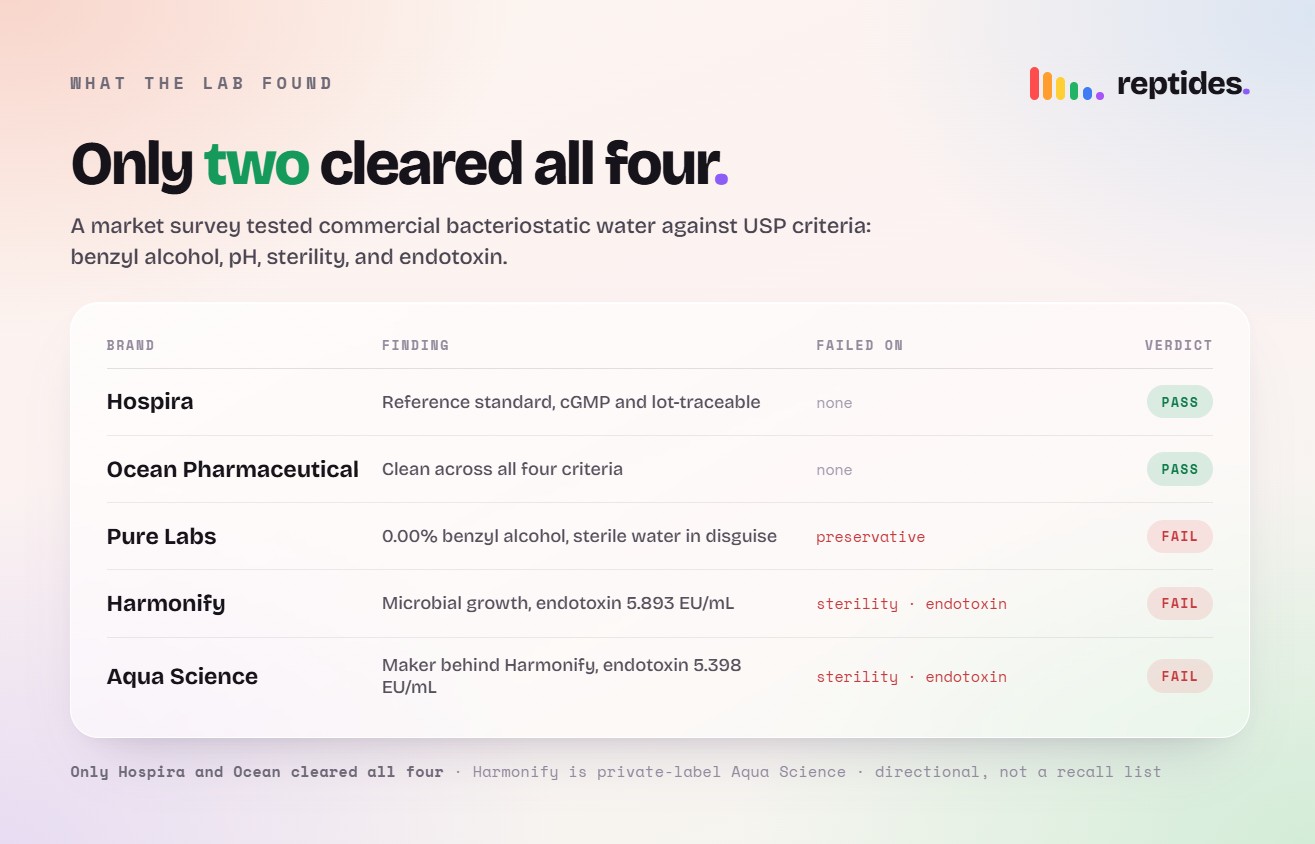
One PTDS market survey checked several brands against USP-style criteria: benzyl alcohol percentage, pH, sterility, and endotoxin. Only Hospira and Ocean Pharmaceutical passed all four.
- Pure Labs came back with 0.00% benzyl alcohol. That is sterile water sold as bac water, with no preservative doing its job.
- Harmonify and Aqua Science failed sterility outright, with live microbial growth, and both had high endotoxin readings well over the limit: 5.893 and 5.398 EU/mL against a 0.25 EU/mL limit. They trace to the same manufacturer, and a separate test caught Aqua Science failing endotoxin again.
- Generic BAC0129 had pH way outside range at 8.84.
- Lambda passed the chemistry numbers but failed endotoxin at 0.765 EU/mL. That is the trap: chemistry can look fine while pyrogen load is still out of spec.
Hospira had one high endotoxin reading on a single vial too, but it passed on retest and the survey treated the first read as likely method variation. That is a different pattern from repeated off-brand failures paired with sterility problems and a second-lab endotoxin repeat.
These are not small differences. Sterility failure means microbial growth in the vial. Endotoxin failure means pyrogens even if the liquid looks normal. Zero benzyl alcohol means no preservative protection for multi-dose use. Clear liquid in a sealed vial does not prove anything.
Important caveat: this is a single-author market survey, not a regulatory action or peer-reviewed panel. It should be treated as a strong warning signal, not the final word. But the shape of the warning is clear. Hospira is the benchmark because it is manufactured under proper controls with lot traceability the mystery-vial market usually cannot show.
Sealed keeps for months. Open is still a clock.
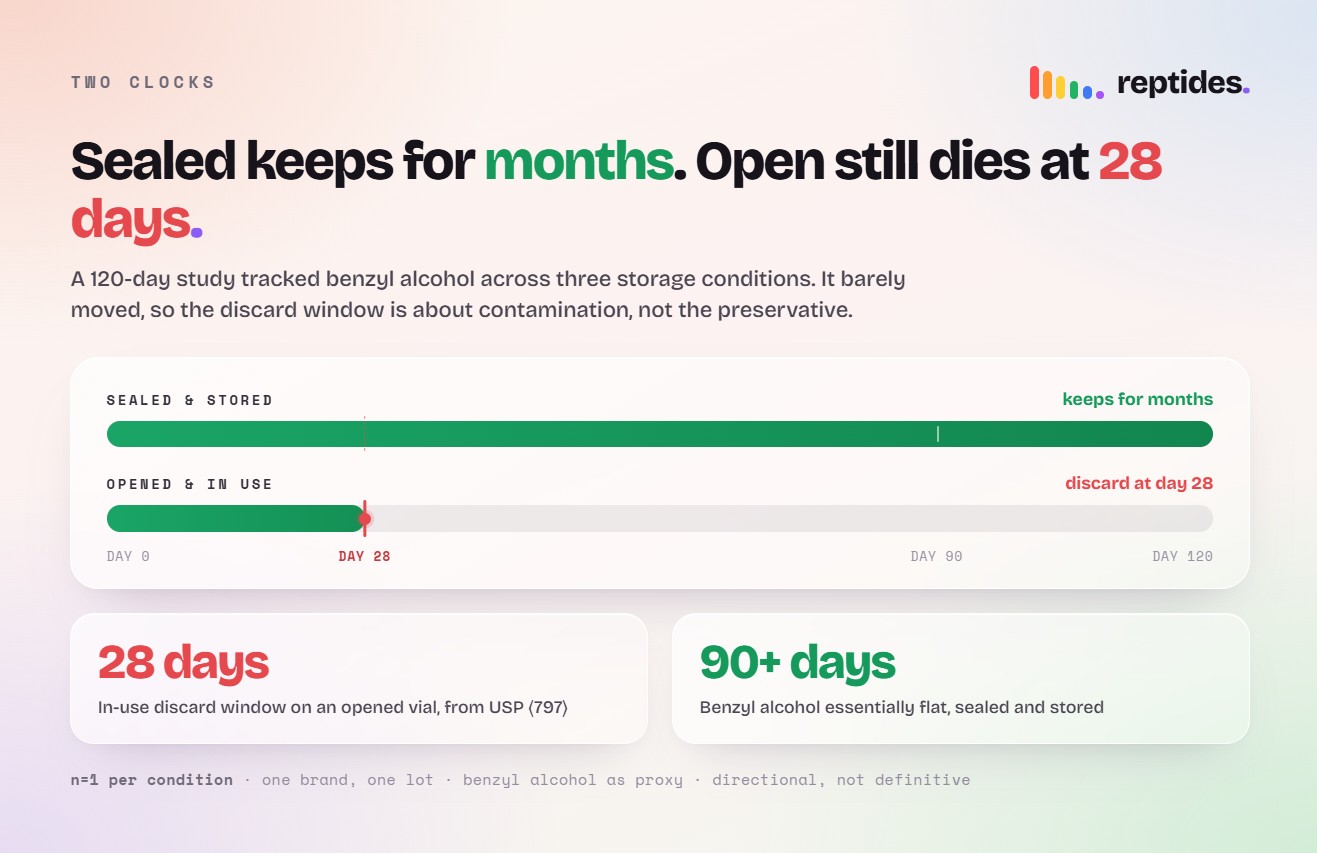
A PTDS stability test measured benzyl alcohol in Hospira over 120 days under three conditions: room temperature with monthly use, room temperature with weekly use, and refrigerated with weekly use. Levels stayed steady through day 90. Between day 90 and day 120, the study saw a 6-9% drop, but all samples stayed above the practical preservative floor. Refrigeration did not meaningfully change the pattern.
The standard 28-day discard window on an opened multi-dose vial is not because benzyl alcohol suddenly stops working. It comes from sterile-practice rules around contamination risk from repeated needle entries. The chemistry supports that distinction. It does not erase the opened-vial clock, because the study did not test actual contamination risk.
So keep the two clocks separate. Sealed and stored properly, Hospira can hold for months. Once opened and in use, the 28-day limit still matters regardless of what the chemistry numbers show.
The limitations matter: one brand, one lot, n=1 per condition, benzyl alcohol as a proxy instead of a direct bacterial challenge test, and no true sealed never-opened control vial. Useful direction, not the final word.
What this means in plain language
- Prioritize lawful, lot-traceable product if bac water is being used in a legitimate research or clinical setting. The tighter the shortage gets, the stronger the incentive gets for mystery vials to move.
- Do not switch to sterile water or saline to stretch supply. Different product, different use case, different protection.
- Do not trust an off-brand vial just because it looks normal. Clear liquid does not mean it is good.
- Do not merge the sealed clock with the opened clock. Sealed product can hold for months. Opened multi-dose vials still follow sterile-practice in-use dating.
- Do not turn this into protocol advice. Handling, sterile technique, dosing, and clinical use belong under qualified professional oversight.
The peptide is the part everyone obsesses over. The water is the part that quietly decides whether the whole exercise survives contact with reality.
Not medical advice. Not sourcing advice. The point is simpler: do not let a bac-water shortage turn into a substitution problem.
[1] FDA drug shortages database and ASHP / University of Utah shortage bulletin for bacteriostatic water for injection: currently in shortage; Pfizer sole listed supplier; manufacturing delays; 30 mL vials in limited supply. · FDA shortage database · ASHP bulletin 1166
[2] ASHP / University of Utah bulletin 1166 on Hospira NDC 0409-3977-03: limited supply, manufacturing delays, no resupply date listed; on and off shortage history since 2021. · ASHP bulletin 1166
[3] Amazon delisting of bac-water listings across 2025-2026, reported by peptide community sellers and commentators. No official Amazon category-wide statement confirming a ban; much of the reporting comes from vendors selling bac water. · Derek Pruski, no more bac water on Amazon
[4] DailyMed Hospira bacteriostatic-water label: Rx only. FDA March 3 2025 warning letter to Amazon.com targeted three specific unapproved injectable lipolytic products. The warning letter does not name bac water. · DailyMed Hospira label · FDA warning letter to Amazon.com
[5] Research Radar / Derek Pruski, March 2026, sharing Peptide Crafters data tested by Vanguard Laboratory: 11 Amazon bac-water samples tested for benzyl alcohol and pH; only 2 passed. Chemistry only, no sterility or endotoxin testing. · bac water Amazon testing
[6] DailyMed labels: bacteriostatic water for injection contains 0.9% benzyl alcohol preservative and is multiple-dose; sterile water for injection contains no bacteriostat, antimicrobial agent, or added buffer and is single-dose. · bacteriostatic water label · sterile water label
[7] Krysia / PTDS market survey, June 7 2026: only Hospira and Ocean Pharmaceutical passed benzyl alcohol percentage, pH, sterility, and endotoxin. Pure Labs: 0.00% benzyl alcohol. Harmonify and Aqua Science: sterility failures and high endotoxins. BAC0129: pH 8.84. Lambda: endotoxin 0.765 EU/mL. Single-author market survey, not regulatory. · bac water wars
[8] Krysia / PTDS 120-day Hospira stability assessment, June 7 2026: Hospira benzyl alcohol by LC under three storage/use conditions; steady through day 90; 6-9% drop day 90-120; all above the preservative floor. 28-day USP <797> in-use window is driven by contamination risk from repeated entry, not preservative breakdown. Limitations: n=1 per condition, one brand/lot, benzyl alcohol as proxy, no sealed never-opened control. · only 28 days?