On July 23, a federal advisory committee sits down to decide whether seven peptides get a legal path into compounding pharmacies. The FDA's own staff already wrote down their answer. For all seven. In public. Weeks early. It's no.
That's the story everyone's running with. It's also the wrong one to bet on.
A quick word on why a sleepy compounding-list vote gets a whole brief from us: we're bullish on peptides. Genuinely. Not the influencer kind of bullish, the read-the-briefing-documents kind. This is the class that already gave the world the GLP-1 drugs, and most of the rest of it still trades in a legal gray zone nobody's happy with. July 23 decides whether a slice of that finally moves into the daylight. So yeah, we're paying attention.
Here's the setup. The documents that say no are real, and we read all eight of them. But documents don't vote. Fourteen people in a room in Silver Spring do, and this spring somebody rebuilt that room into the most peptide-friendly panel the FDA has seated in years. There's also a precedent from 2022, same committee, that lines up with July almost beat for beat. So the whole thing comes down to one gap: the paperwork versus the room. We think the room wins, and we're not hedging it.
Everyone's reading the negative staff documents as the outcome. We think they've got it exactly backwards. Our read: the panel recommends adding at least the headline peptides, maybe most of the seven, against a staff package that says reject all fourteen. The catch is real, and it lands at the end. Even a yes barely moves anything for a year or more.
- The vote: July 23-24, the FDA's Pharmacy Compounding Advisory Committee, seven peptides, fourteen chemical forms.
- FDA staff already recommended, in writing and in public, keeping all fourteen off the 503A compounding list.
- The last panel that looked at peptides (October 2024) voted every one of them down. This isn't that panel.
- Seven of the eight members seated this spring run peptide, longevity, or men's-health clinics. The chair seat is empty.
- In 2022 this same committee voted 8 to 5 to add something staff told it to reject, after the public docket got flooded. The July docket is open through July 22.
- Bullish on the vote, sober on the timeline: a yes is only advice, and the last peptide this committee approved still isn't on the list four years later.
What July 23 actually decides
The Pharmacy Compounding Advisory Committee (PCAC, if you want the acronym) meets July 23 and 24 at the FDA's White Oak campus in Maryland. Two days, seven peptides. BPC-157, KPV, TB-500, and MOTS-c on day one. Emideltide, epitalon, and semax on day two. (Emideltide is the FDA's name for the sleep peptide most people call DSIP.)
The question is narrower than the headlines make it sound. It's not whether these are safe, or whether they work. It's whether a pharmacy can compound them from raw powder. Safe or effective is a different fight on a different day. All this vote decides is whether each peptide lands on the 503A Bulks List, named after the section of federal law that lets pharmacies compound in the first place. It's the roster of ingredients a pharmacist can legally use when there's no FDA-approved version to start from. On the list, you can make it. Off it, making it is a violation.
Sounds like plumbing. It's also the whole ballgame. On the list, a peptide gets made in a licensed pharmacy that answers to inspectors. Off it, the same molecule gets made somewhere nobody's watching. A field this big is better off with the plumbing than without it, and the real stake is hiding right under a boring procedural vote.
Two weeks out, the FDA posted eight briefing documents, one per peptide plus an introduction. The introduction went down the list and recommended keeping all fourteen off. Fourteen, because the FDA splits each peptide into two forms: a free base and an acetate salt (the pure molecule and the shelf-stable version paired with acetate). Same peptide, two entries, fourteen line items. Fourteen “do not add”s on the record before anyone in the room has said a word.
It reads like a verdict. It's closer to an opening argument.
And here's the part the headlines skip. The vote is advisory. It doesn't add anything to anything; it's a recommendation, a strongly worded suggestion delivered on the record. Even a unanimous yes just sends it upstairs, and actually getting a substance onto the list takes a formal rulemaking (the slow legal grind of writing a federal rule and finalizing it) that runs well over a year. So the staff documents aren't the ruling. They're the FDA's staff telling the FDA's own outside experts how they'd like them to vote.
The paperwork has a real point
The lazy version of the bull case waves the staff documents off as politics. They're not. On the actual evidence, the FDA has a genuine argument, and it earns a fair hearing before we take it apart.
For all seven peptides, there's no finished, published, placebo-controlled human trial showing the thing works for the use the FDA is looking at. That's not the same as no evidence. And that gap, unproven versus disproven, is exactly what the room fights about on July 23.
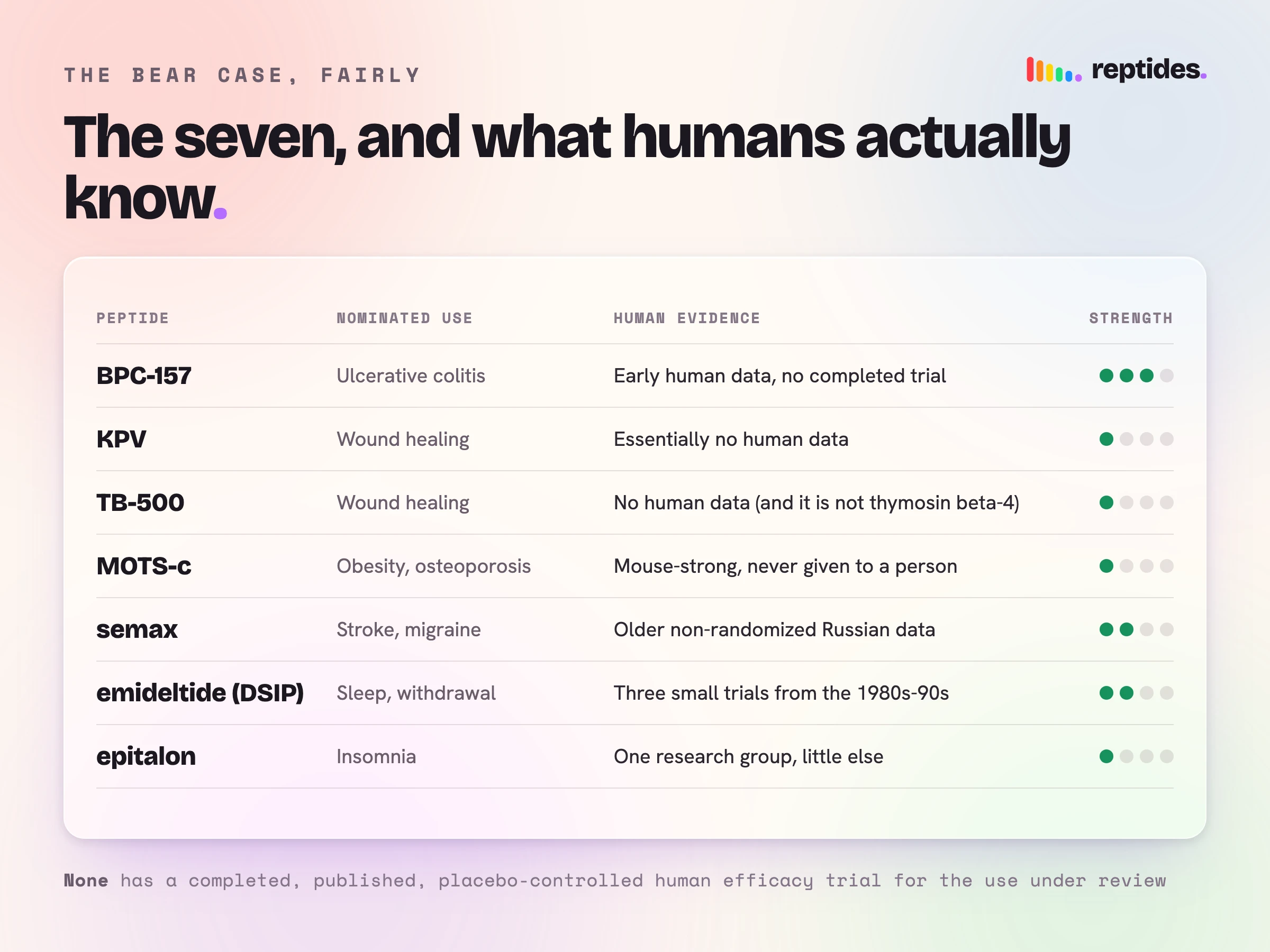
Row by row, it runs from thin to basically empty.
- BPC-157 (up for ulcerative colitis): an old industry program, Pliva's PL-14736, threw off some conference-abstract data and a healthy-volunteer safety study, and two human trials are registered now. No controlled efficacy trial has ever been published.
- KPV and TB-500 (both for wound healing): basically no human data at all. And TB-500 isn't even the molecule its own marketing leans on. The good wound-healing trials belong to full-length thymosin beta-4, which is a bigger, different protein.
- MOTS-c (obesity and osteoporosis): no trial has ever given MOTS-c to a person. The Phase 2a a registry search returns, an insulin-sensitivity study in prediabetes, is a fabricated record. Zero human osteoporosis data.
- Semax (stroke and migraine): a real but non-randomized Russian literature the FDA reads, fairly, as too thin to build on.
- Emideltide (DSIP) and epitalon (sleep): a few small European trials from the 1980s and 90s, one of which basically shrugged and said the effect probably isn't worth much. Epitalon's evidence comes almost entirely from one research group. Take that for what it's worth.
Then there's a manufacturing problem that's harder to shrug off. A bunch of these aren't well characterized, meaning nobody's pinned down exactly what's in the vial, how pure it is, or which form. A lot of them get injected. And injected peptides can get the immune system to turn on them (that's immunogenicity), a risk nobody here has actually measured. For a room full of pharmacists, that's a legitimate reason to hesitate.
There's history, too. In October 2024, the previous PCAC voted down every peptide it saw. Ipamorelin 0 to 12. Kisspeptin-10 0 to 11. Ibutamoren 1 to 13. If you're pattern-matching, that's the pattern. The catch, and it's a big one, is that those were different molecules in front of a different panel.
Thin science, messy chemistry, a prior no. All true. None of it is what decides July 23.
The room got rebuilt to say yes
Between April and May, HHS remade this committee. Eight new members. Seven of the eight run private peptide, longevity, hormone, or men's-health practices. The eighth runs pharmacy software. If you set out to build a panel that likes peptides, this is more or less what you'd draw up.
This isn't a hunch; it's the roster. The scientific director of a men's-health peptide company. The global chief medical officer of a 400-clinic men's-health chain that markets peptide therapy. Founders and physicians of regenerative and longevity clinics across five states, several with peptide-therapy certifications. And a sitting Tennessee state senator who's also a compounding pharmacist, whose mother, a member of Congress, personally leaned on HHS to loosen the peptide rules.
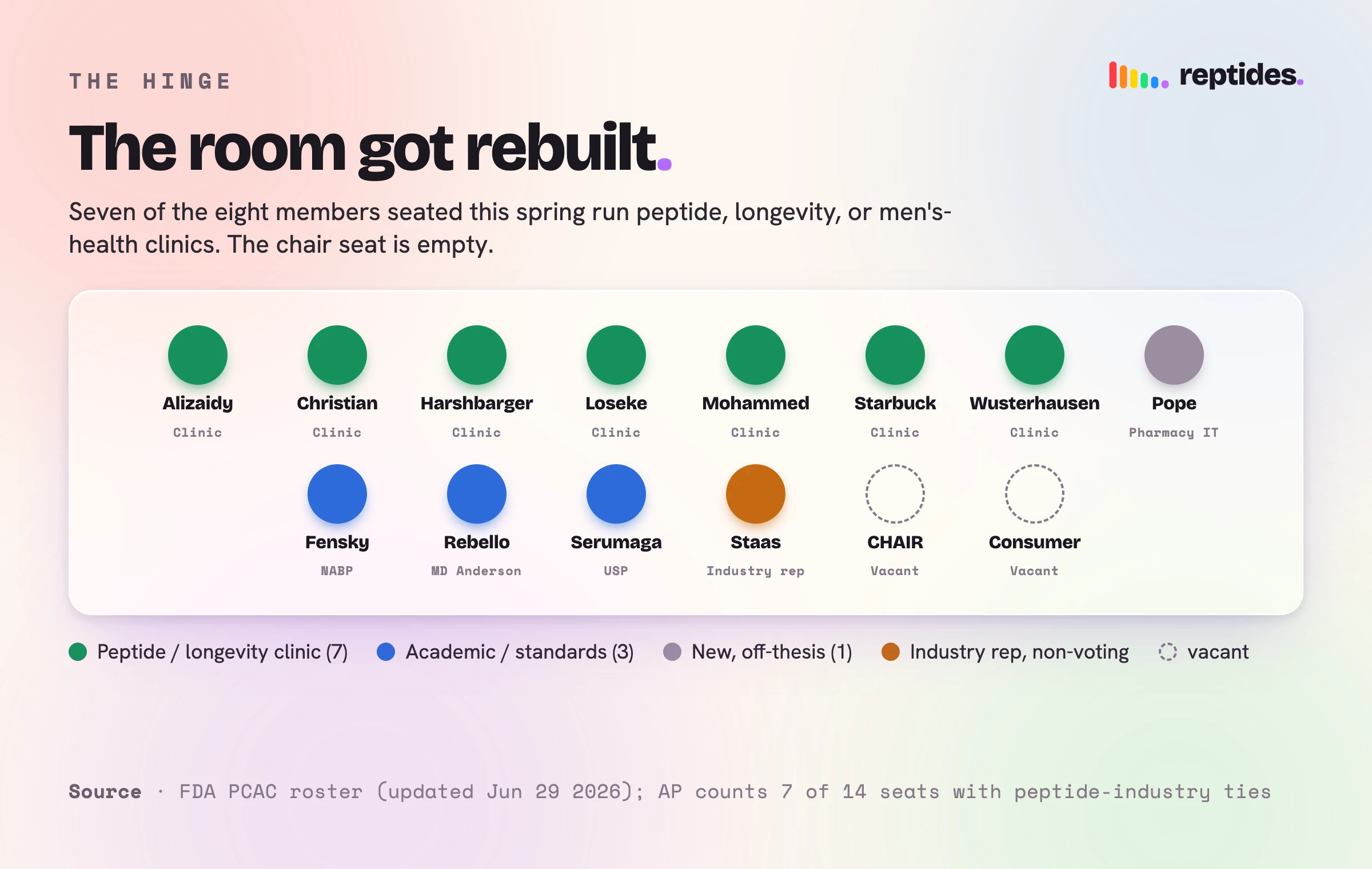
Reuters counts seven of fourteen seats with peptide-industry ties. STAT counts eight of twelve voting members running private wellness clinics. The AP just came out and said it: the old compounding panels were mostly professors from Duke, Harvard, and Johns Hopkins. This one isn't. And the chair seat, the tie-breaker, the one that sets the tone, is empty.
The other side of the ledger, because it belongs here. HHS says everyone cleared the normal ethics vetting, and that anyone who couldn't got cut (that's spokesperson Emily Hilliard, to Reuters). The watchdogs aren't buying it. CSPI's Peter Lurie and UC Davis's Paul Knoepfler have both called the panel stacked. Put it together and you've got the real picture: a committee built to be friendly to peptides, and a live fight over whether that's reform or capture (industry quietly running the agency that's supposed to check it).
You don't have to settle the ethics question. You just have to notice who picked the jury. The people who'll vote were chosen, on purpose, by the peptides' loudest fan in government.
This committee has literally done this before
Here's the thing the consensus isn't pricing. In June 2022, this exact committee sat where it's about to sit again: a substance nominated for the compounding list, and an FDA staff briefing that said no.
The substance was glutathione. The public docket (the FDA's open file for written comments) had filled up with more than eight thousand messages from patients and clinicians who wanted access. The committee heard staff say no, and voted 8 to 5, with one abstention, to add it anyway.
A negative staff package plus an open, floodable docket isn't a forecast of failure. In 2022 it was the exact setup for an override.
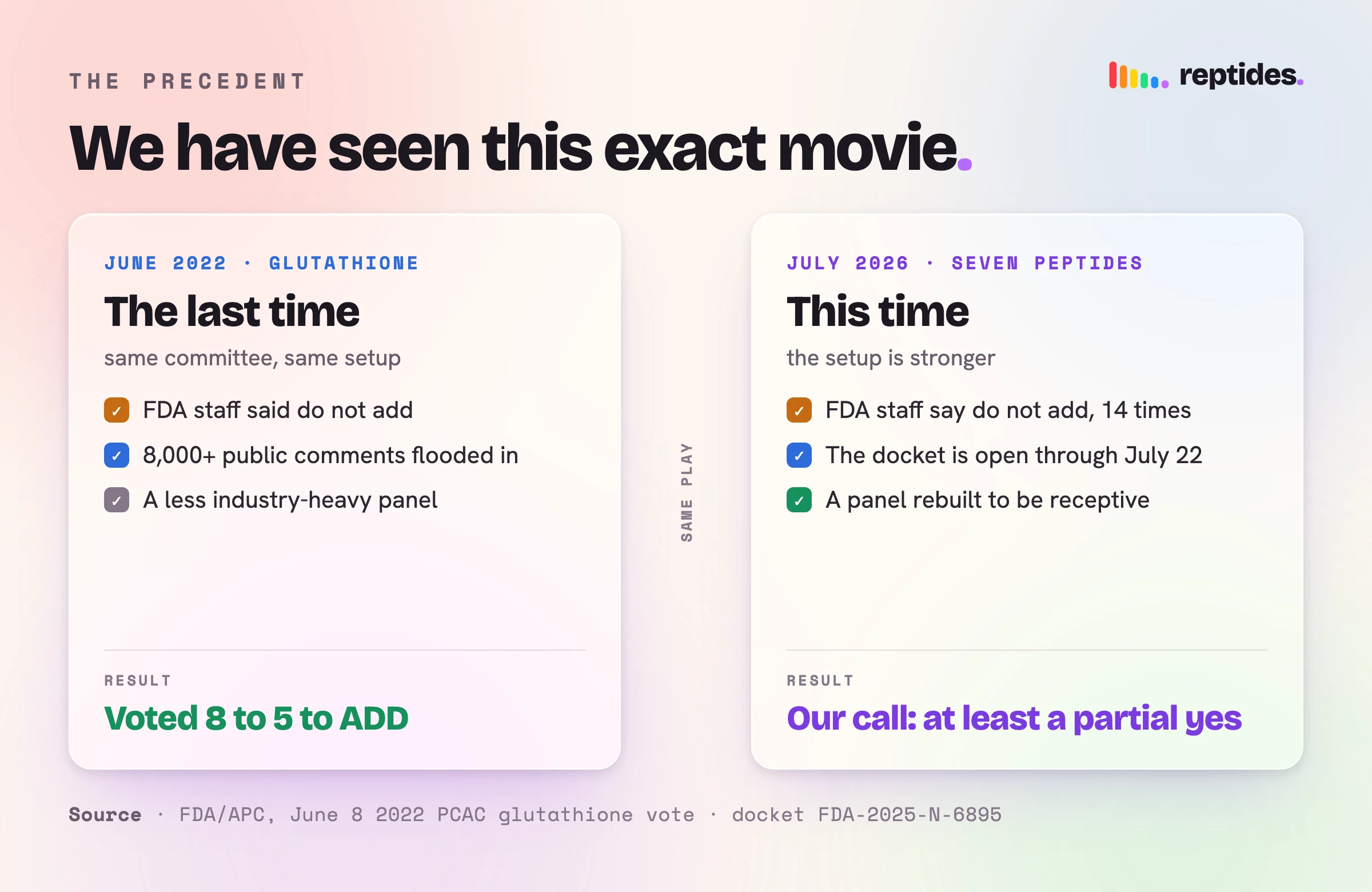
Now lay July over June 2022. Negative staff package? Check, and fourteen of them this time. Open docket anyone can flood? Check: FDA-2025-N-6895, open through July 22. A committee that leans toward access over staff caution? Check, way more than the 2022 panel did. The one thing 2022 nails down is that a staff no isn't the last word in this room. It's been overruled here before, under lighter conditions than these.
And a committee going off staff isn't some freak event. The FDA split from its own advisory committees about 12 percent of the time between 2010 and 2021, and in three of seven votes in 2025. Committees wander off the script all the time. This one got built to wander in one specific direction.
The destination got announced from the top
You can't read July right without reading the man who picked the panel. The Secretary of Health and Human Services, Robert F. Kennedy Jr., has called himself “a big fan of peptides,” called the 2023 decision that shoved these compounds into limbo “illegal,” and said in April the plan is to “restore regulated access” and “shift demand away from the black market.” That's not a neutral referee walking through a process. That's a stated destination.
The FDA's own conduct is the quieter tell. Staff say reject. Leadership did two things pointing the other way. In April it pulled twelve peptides out of the “Category 2, significant safety risk” bucket the 2023 action had dumped them in. Then it chose to hold this vote even after the original nominations had been formally withdrawn. It didn't have to hold the meeting. Letting the nominations die was the easy move. Running the vote anyway looks a lot like building a yes onto the record.
Underneath the politics there's a real argument, and the access side makes it well. Category 2 never meant “the FDA found this dangerous.” It meant “the data didn't satisfy the agency.” Missing homework, not proof of harm. And the demand is already here, at scale. Deny it a legal, inspected, pharmacist-run path and it doesn't disappear; it just moves to research-only vendors with zero oversight. Framed that way, a yes is the safety-conscious vote, and a friendly panel is primed to hear exactly that.
And we'll say the quiet part out loud. We're not anti-market here, not even close. This space is full of legit operators doing careful, real work, and we're rooting for them to win. What we can't stand is the other half: the fly-by-night crowd dropshipping mystery vials out of China and ripping people off. So on daylight versus the gray market, reptides isn't neutral. The demand doesn't care how the vote goes. The only real question is whether it gets served by a pharmacy an inspector can walk into, or a website that takes Zelle and ships from who-knows-where. We know which side we want to win, and it's the honest one.
The bear reads the science and sees a no. The bull reads the room, the docket, the precedent, and the Secretary, and sees a setup.
Where we land, in two numbers
Read only the staff documents and the 2024 votes, and you'd bet against these peptides. Honestly, so would we. Call it 70 percent reject, 20 split, 10 approve, the number everyone leans on. It weights the evidence and the paperwork perfectly. It also ignores everything in sections three through five.
Our house view flips it, and we're not being cute about it. On the vote itself, we think the panel more likely than not recommends adding at least the headline peptides, the ones with the most commercial pull and the least ugly safety story: BPC-157 first, probably TB-500 and MOTS-c behind it. A near-sweep wouldn't shock us. A clean rejection of all seven would. Call it better than even that the committee hands the FDA at least a partial yes.
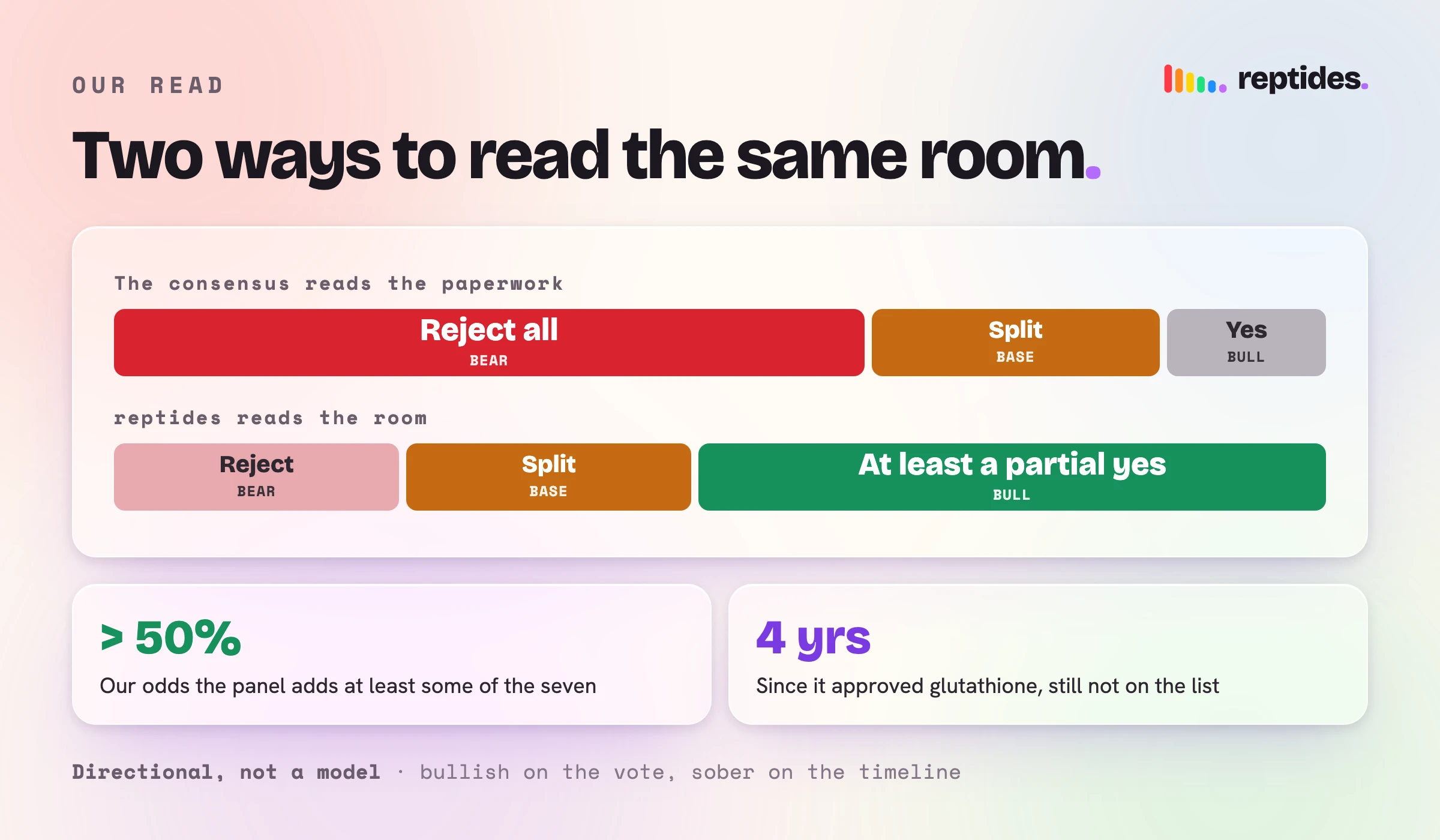
Now the cold water. A yes is advice, not a product. It kicks off a rulemaking. The proof is sitting right inside the precedent we just leaned on: glutathione won its 8-to-5 vote in 2022 and still isn't on the list, four years later. A July yes on BPC-157 could mean no legally compounded BPC-157 until 2028 or later. The vote moves the story. It doesn't move the shelf.
A better vote than the paperwork predicts. A slower payoff than the hype wants. The mistake is pricing only one of them.
What would prove us wrong
We hold this with our eyes open. Here's what could break it:
- A real scientist bloc. The panel still seats a USP standards expert (USP writes the official quality rules for medicines), an MD Anderson anesthesiologist, and pharmacists who care what's actually in the vial. The same 2022 committee that passed glutathione voted plenty of thin-data substances down the same day. Real experts can say no to bad data even in a friendly room.
- The optics backfire. The louder the stacked-panel story gets, and Knoepfler, Lurie, and Public Citizen are making it loud, the more a yes looks like capture. The FDA might quietly want the committee to vote no, then simply not crack down (that's enforcement discretion, the agency choosing to look the other way), and pocket the credit without the headline.
- The cheapest path is no vote plus no crackdown. Leadership already gave its base a win by stripping the Category 2 label. It doesn't strictly need a visible yes to keep the peace.
- Makary's other hand. The FDA commissioner is running a hard crackdown on compounded GLP-1s and illegal peptide imports. Different fight, different politics, but not the posture of an agency in a permissive mood.
And a concrete tripwire: the meeting-specific voting roster and the financial-disclosure files land around July 21. If they show heavy recusals (members forced to sit out over conflicts) that gut the peptide-friendly bloc, we soften the call fast. If the docket stays quiet instead of flooding, the glutathione parallel weakens. We're watching both.
What happens after the gavel
Two days of votes give you a recommendation, not a rule. The signal is in the details:
- The roster and conflict files (around July 21): who actually votes, and who has to sit out. The biggest swing factor left.
- The vote spread, peptide by peptide: a split decision, yes on BPC-157, no on the sleep peptides, tells you the committee is weighing evidence instead of rubber-stamping. That's both the likeliest and the most interesting outcome.
- The FDA's next move: a yes starts a clock a court already has the agency on the hook for, roughly March 2027. Watch whether they actually move, or let it drift the way glutathione drifted.
- The sequel: a separate PCAC meeting before the end of February 2027 takes up five more peptides, LL-37, GHK-Cu, dihexa, melanotan II, and PEG-MGF. GHK-Cu is the one to watch, because the FDA already split it by route, injectable off the table and topical back in play. How July goes sets the weather for that room.
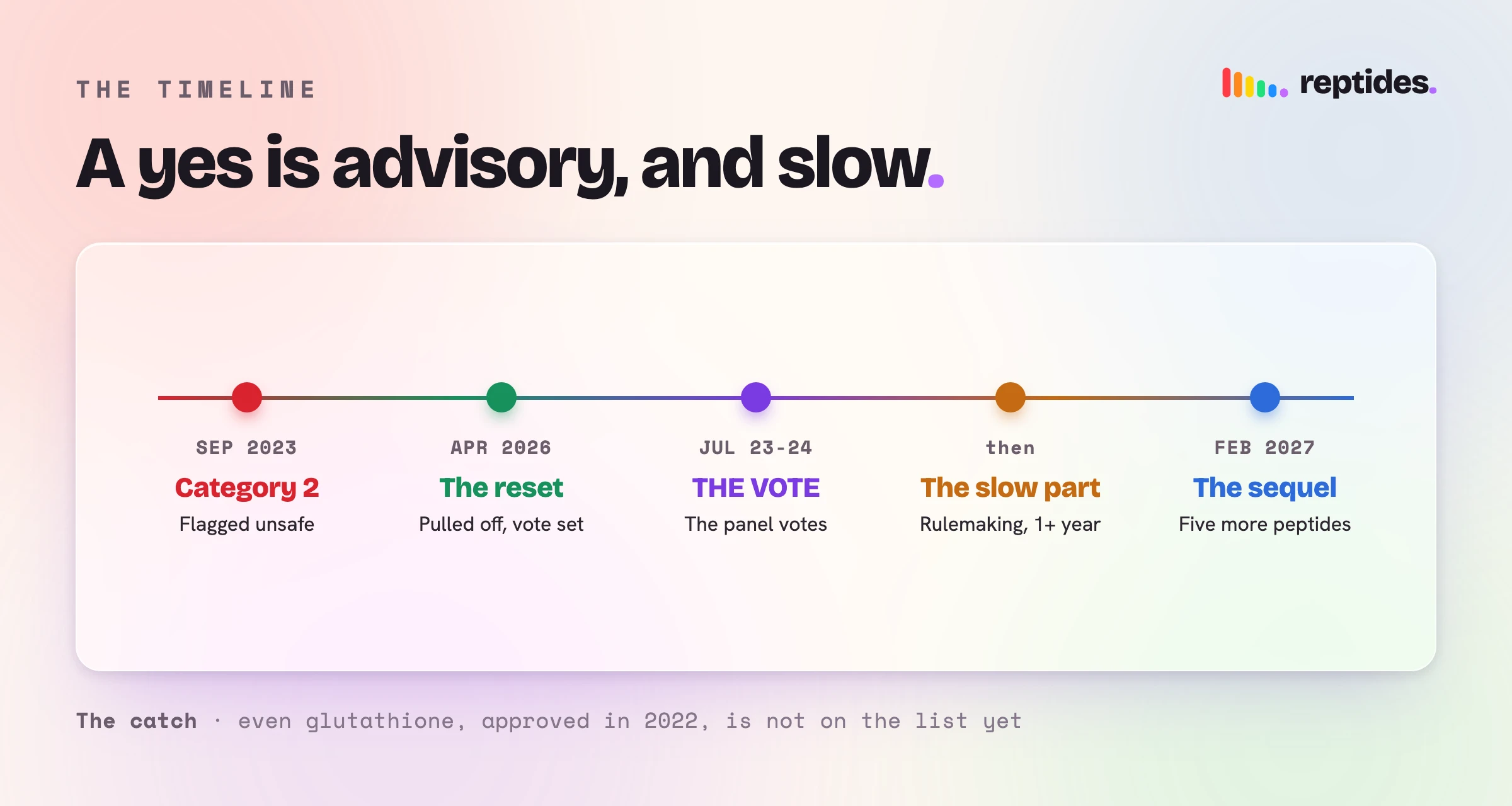
One last thing, because it's the reason any of this is on our radar. The vote decides a list. It doesn't decide the direction. The peptide field spent a decade as an internet gray-market curiosity, and now it's pulling federal advisory committees, a court deadline, and a cabinet secretary who name-drops it on podcasts. That arrow points one way. July 23 is a fight over how fast, not whether.
And one call we'll put our name on: the day you can walk out of a doctor's office with a legal, pharmacy-compounded BPC-157, the kind an inspector signs off on, is closer than the staff documents want you to believe. If July breaks our way and the rulemaking follows, our honest guess is a year or two out, not a decade. A real prescription from a real pharmacy, not a mystery vial off a website. That's the whole reason getting this vote right matters.
The consensus built its forecast out of the documents, because the documents are what you can read today. We built ours out of the room, because the room is what votes. On July 24, we find out which one was the better tell.
Our money's on the room. Our patience is set to years.
[2] FDA, July 23-24 2026 PCAC meeting event page + briefing materials
[5] Reuters, Sneha S K, July 1 2026 (HHS spokesperson Emily Hilliard on ethics vetting; 7 of 14 members with peptide-industry ties)
[6] Associated Press, Matthew Perrone, June 29 2026 (panel composition; contrast with Duke/Harvard/Johns Hopkins panels)
[7] STAT News, Lizzy Lawrence & Sarah Todd, June 29 2026 (Paul Knoepfler; 8 of 12 voting members run private wellness clinics)
[8] FDA / Alliance for Pharmacy Compounding, June 8 2022 PCAC glutathione vote (8-5-1 to add, over FDA staff objection; 8,000+ comments)
[9] RFK Jr. / HHS, April 15 2026 statement on peptides (“restore regulated access,” Category 2 removal of 12 peptides); via Frier Levitt, Orrick, NPR
[11] Hims & Hers Health, Inc., February 21 2025 (acquisition of a California peptide-manufacturing facility)
The committee reads what comes into the public docket, and that is exactly how June 2022 happened. Here is a draft. Fill in the brackets so it is yours (personal comments count for more than copy-paste), then submit it to the FDA in two taps.