i pulled a real certificate of analysis off a random chinese wholesaler's product page. no login, no insider access, just a PDF sitting under the buy button the way thousands of them do. then i read every line. this is which tests prove what you are actually holding, which ones only look reassuring, and why the market tends to skip the ones that matter most.
- a COA is a claim, not proof, until an independent lab stands behind it.
- the tests are not equal. identity first, then content, then purity.
- identity by mass spec is the only test that proves the molecule.
- purity by HPLC tells you how clean the main peak is, but it does not name it.
- net peptide content tells you how much of the powder is actually peptide once water and counterion salt are subtracted.
- endotoxin outranks sterility on contamination risk because it survives filtering and heat.
- heavy metals matter over the long run. a fentanyl screen is mostly reassurance.
the real fix is a third-party COA matched to the vial's lot with a mass spec result on it.
what a COA is
a certificate of analysis is the lab report behind the vial. it lists what the seller claims is inside, the tests they ran, and what came back. it is worth exactly as much as the answers to two questions: who ran the tests, and what did they actually test.
one community testing lab has put the number around 43% of screened peptides coming in under their label claim in recent rounds. that is why the document does real work when it is real. most people who buy research peptides look at the big purity number at the top and stop there. the trouble is the sheet can list a dozen tests and they do not carry equal weight. some prove what you are holding. some only look good on a product page.
how peptides are actually made, and where they go wrong
almost every research peptide is built one amino acid at a time on a solid support, then cleaved off and dried into powder. every step can leave damaged or incomplete versions behind. short chains appear when a coupling step fails. damaged chains happen when oxygen or water nicks a residue.
some broken versions weigh exactly the same as the real peptide, which is why mass spec alone is not enough. chains can clump. leftover wash chemicals stay bonded as salt and add real weight that is not peptide, and that amount varies batch to batch. so a peptide is never one clean molecule. it is the one you wanted surrounded by near-misses, and every line on a certificate only measures one slice of that crowd.
what a test is actually protecting
a test can protect two different things. one protects the person it ends up in. the other protects a finished product that has to survive shipping and months on a shelf. pharma products get both sets because they are built as complete sealed devices. a research powder you mix yourself is a different object. when the shelf-life and packaging tests disappear down-market, the safety risks do not disappear with them. they just move onto you.
the tests that prove what you are actually getting
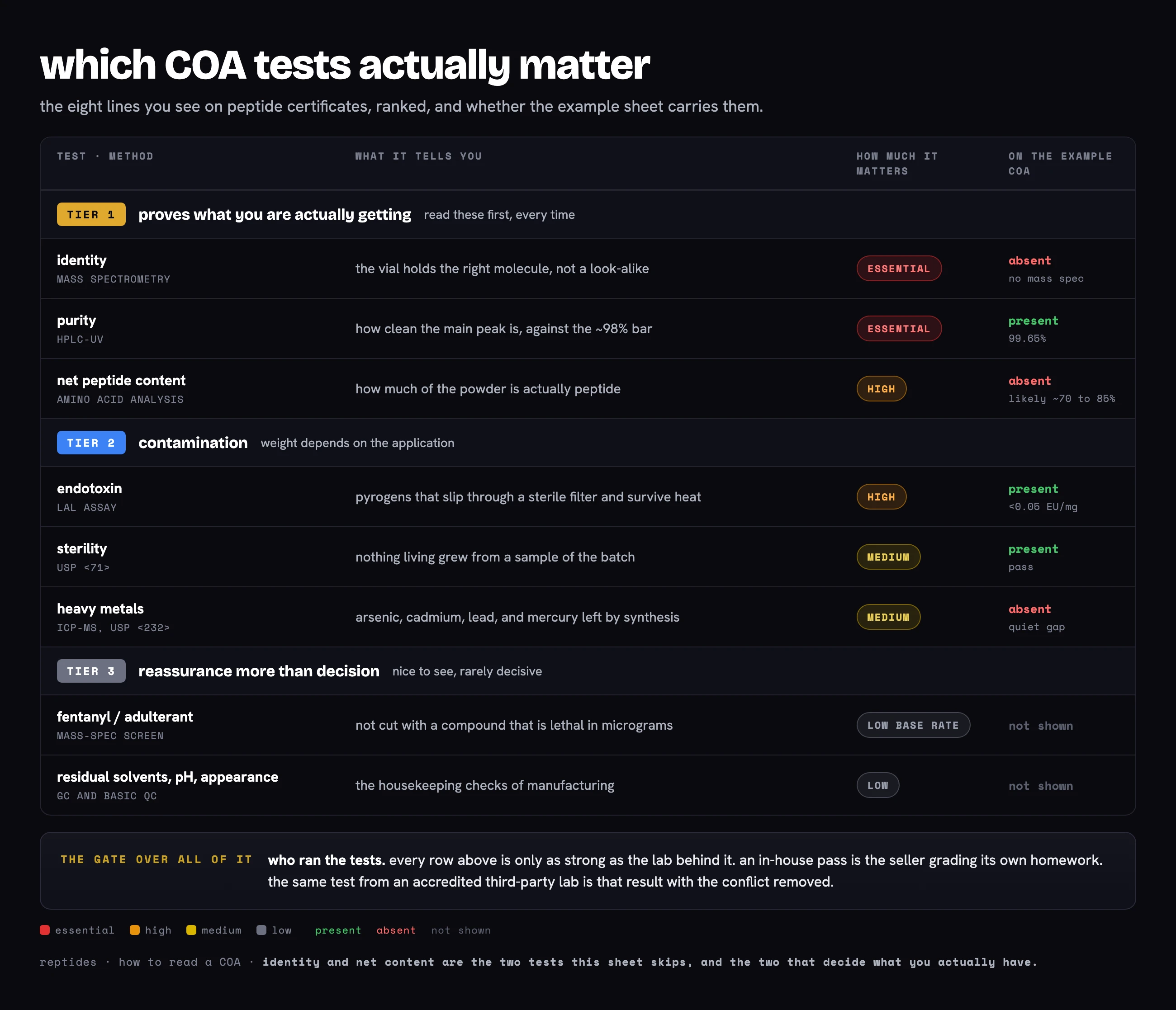
these three decide whether the vial holds the right molecule, how much of it is real, and how clean it is. read them first, every time.
identity by mass spectrometry is the test that proves the molecule. it weighs the compound and matches the result to the expected mass, around 1418.70 Da monoisotopic for BPC-157, give or take a dalton, plus the charged ions. a peptide that is one amino acid off can still run 99% pure on HPLC and be the wrong molecule entirely. only the mass catches that.
and some degradation products weigh exactly the same as the real peptide, certain D-amino-acid versions for example, so mass spec alone misses them too. you need both the separation step and the weight. a COA with no mass-spec line has never actually said what is in the vial.
purity by HPLC is how clean the right molecule is. it is an area-percent, the main peak divided by everything the detector saw, with about 98% as the usual research-grade bar. it is a real and useful number with one blind spot: identity. it ranks the biggest peak without ever naming it. that is why purity and mass spec travel together.
net peptide content is how much of the powder is actually peptide once you subtract bound water and the counterion salt. amino acid analysis or elemental nitrogen testing measures it. a 99% pure peptide by HPLC routinely lands near 70 to 85% peptide by mass. two TFA counterions alone can add roughly 16% to BPC-157's weight, and residual water adds another 5 to 10%. this is the line that tells you how much peptide you actually have, and it is the most-skipped of the three.
a vial can read 99% pure and still be mostly water and salt by weight. when one research group test-bought online semaglutide vials labeled 99% pure, measured purity came back between 7.7 and 14.4% (JMIR, 2024), and a companion study found the semaglutide that was present ran 29 to 39% above the dose on the label (JAMA Network Open, 2024). a percentage on its own can leave a vial well under or well over its labeled amount while the certificate still looks clean.
HPLC area-percent measures peak ratios, not mass. Two TFA counterions add about 16% to BPC-157's weight and residual water another 5 to 10%, so net peptide content by amino acid analysis commonly lands around 70 to 85% (acetate salts higher). The 10.12 mg in this vial is likely 7 to 8.5 mg of actual peptide, a figure this sheet never measures.
the contamination tests, and when they matter
three more tests cover contamination rather than the molecule. how much they matter depends on what the material is for.
endotoxin by the LAL assay is the contamination number most people overlook. endotoxins are bacterial fragments, among the most potent contaminants a lab screens for, and they are not alive. they slip through a 0.22-micron sterile filter and survive autoclaving, so a vial can pass sterility and still carry them. look for a real figure like under 0.05 EU/mg, not just the word "pass."
one independent lab found quantifiable endotoxin above trace levels in roughly 8% of the gray-market peptides it checked, and the online-semaglutide study above found detectable endotoxin in every vial it bought even though all of them passed sterility.
sterility by USP <71> confirms nothing living grew from a sample of the batch. it is a real test and good to see. the caveat is that it certifies the sealed powder the lab tested, and anything that happens once the vial is opened sits outside its scope. nothing in normal synthesis and freeze-drying guarantees a sterile result, which is why this one carries real weight even though it is slow and destructive to run.
heavy metals by ICP-MS scan for arsenic, cadmium, lead, and mercury against USP <232> limits. they catch what synthesis reagents and cheap manufacturing leave behind, and they matter most where small amounts add up over time. gray-market sheets often skip this one quietly. legitimate synthesis does not normally use the heavy reagents that create them, but forensic work on falsified peptides has turned up arsenic and lead, some samples up to ten times the parenteral limit (Janvier et al., 2018).
the tests that reassure more than they decide
a fentanyl or adulterant screen is a mass-spec sweep for compounds that kill in microgram doses. it is the scariest-sounding line on a COA and the one with the lowest base rate here, because a lyophilized peptide from a synthesis lab is a different supply chain from street powder cut with opioids. a lab that runs it is signaling care, and it is cheap insurance, so welcome it. just know it guards a corner where the real risk rarely sits.
residual solvents, appearance, and pH round out the basics. nice to see, rarely the thing that decides a vial.
the gate over all of it is still who ran the tests. every result above is only as strong as the lab behind it. an in-house pass is the seller grading its own homework, and the same test from an accredited third-party lab removes that conflict. ISO 17025 is the accreditation that actually verifies a lab can run these specific tests. ISO 9001 is just organized paperwork, and GMP describes how something was made, not how it was tested.
now read the sheet against the ranking
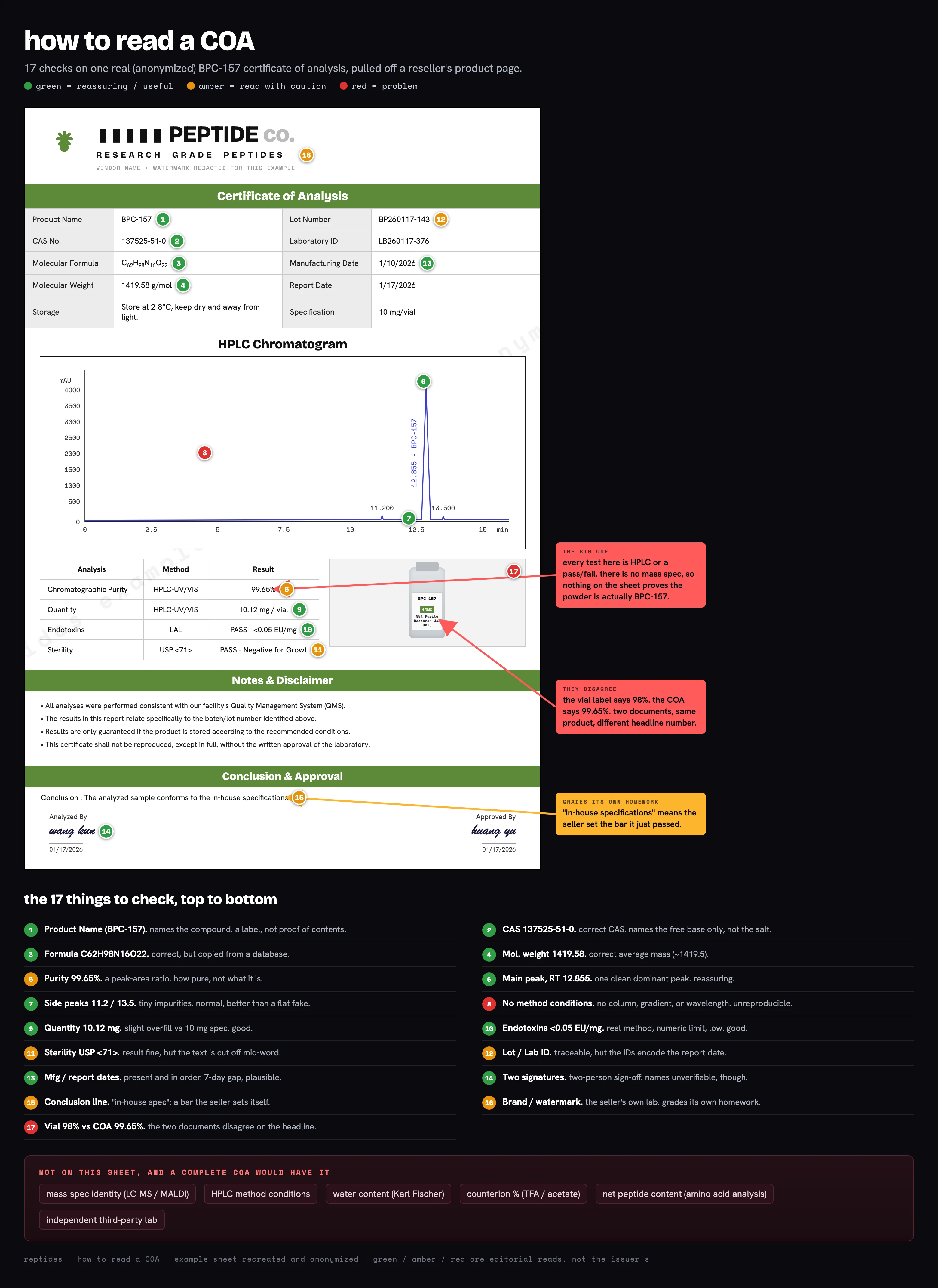
the header looked right, and that is the floor, not the ceiling. BPC-157 with correct CAS, formula, and average mass. all of that can be copied from a database by anyone with a template.
the tier-one tests are where this sheet thinned out. purity read a strong 99.65% by HPLC, and the chromatogram showed one clean peak at 12.855 minutes with only tiny impurities. that part was genuinely good. but there was no mass spec anywhere, so identity was never proven, and there was no net peptide content, so the real peptide amount was unknown. by the ranking, the sheet skipped the two tests that decide what you actually have.
the tier-two safety rows were the strong part. endotoxin passed under 0.05 EU/mg with a real number. sterility passed by USP <71>. heavy metals, though, were absent, the quiet gap that matters over the long run.
then the documentation told on itself. the chromatogram printed no method conditions, so the 99.65% cannot be rechecked. the conclusion certified against "in-house specifications," a bar the seller sets. the watermark was the seller's own lab. and the vial label read 98% while the COA read 99.65%, two documents for one product disagreeing on the number that sells it.
how to actually verify a vial
good news: a COA earns its keep once you make it work. here is the checklist worth running, in priority order.
start with the lab. an accredited outside lab issuing or co-signing beats an in-house sheet every time. names like Ethos Analytics (ISO 17025 accredited and FDA-registered, though peptide identity and purity are outside its accredited scope) or labs that multiple unrelated sellers use are the shape to look for.
match the lot. the lot on the COA has to match the lot stamped on the vial it claims to cover. a COA for another batch is a COA for another product.
then read the tests by name. identity can be supported by a named method, and becomes independently checkable when the sheet also prints a molecular weight, observed m/z, or mass spectrum. read HPLC purity and peptide assay as two different measurements: purity describes the chromatography signal, while assay accounts for how much peptide material is present after water, salts, and counterions. then find measured net content against the vial label. no one percentage can replace the other evidence.
for any contamination-sensitive work, add the tier-two checks: an endotoxin number, a sterility pass, and heavy metals against USP limits. a fentanyl screen is a fine bonus, not a substitute.
and when the answer matters enough, an independent lab can test a sample directly. that is the step that turns a claim on a PDF into a measured number.
one more habit: read the masses and the net content line, not just the marketing name. we have seen blends where the label said one thing and the net content line on the COA quietly said a different molecule at five times the mass. the number on the sheet is what caught it.
and a certificate is a photo from one day. peptides keep degrading after it, faster once mixed, faster warm or in light. a clean result from months ago says little about a vial sitting on a shelf today. better labs run several vials per batch, so you see uniformity instead of one lucky vial passing.
a vial is only as trustworthy as the one line that weighs the molecule: a mass-spec result, run on your lot, by a lab that does not also sell you the vial. the purity number everyone screenshots is usually the cheapest, least dangerous thing the lab measured. the tests that decide whether the vial is contamination-clean, correctly identified, and accurately labeled for content are the ones the market most often drops, because their cost falls on you.