hey researchers,
Welcome back to the October edition of the Reptides Dispatch. There is a lot to get through in this one.
September put a new BPC-157 trial on the registry and a peptide research bill in Congress. It also brought federal searches at an Apex-linked business, another FDA warning letter to a major compounder, and five X account suspensions we confirmed ourselves.
Then Lilly closed the month with detailed retatrutide results and a tirzepatide combination that reached 23.3% average weight loss in its headline analysis. [1] [3] [4] [15] [19]
The research is giving us more to work with. The arguments over who gets to sell, prescribe, advertise, and study these compounds are getting more specific too.
So this issue covers the human studies, the enforcement developments, what actually changed in Lilly's court cases, and the numbers that need a little more explanation than they got on X.
- 01 · research · BPC-157 gets a prospective trial and a much larger patient-record analysis
- 02 · veterans · what the PEPTIDES for Veterans Act would actually do
- 03 · enforcement · Apex, five X suspensions, and the fentanyl comparison
- 04 · courts · Astra, Aesthetic Envy, and a new question in Lilly's FDA appeal
- 05 · compounding · FDA examines the individualized-prescription argument
- 06 · development · retatrutide, EloraTZP, and Novo's weekly oral bet
- 07 · pediatrics · prescribing is rising while the trials catch up
- 08 · dispatch shots · addiction, muscle preservation, Happy Meals, and a hidden-drug recall
BPC-157 has a new human trial to watch.
A University of Arkansas-sponsored Phase 1 study appeared on ClinicalTrials.gov on September 3. The registry lists an estimated 30 participants undergoing rotator cuff repair, with daily subcutaneous BPC-157 for 90 days compared with a control group. Both groups receive postoperative rehabilitation. [1]
The planned start is January 2027. It is not yet recruiting.
Shoulder strength is the primary registered outcome. The study description also discusses tendon healing, function, and other recovery measures. That gives researchers a specific question to investigate: does adding BPC-157 improve recovery after this particular surgery?
A small Phase 1 study cannot establish every claim made about BPC-157, and registration does not guarantee a trial will start on schedule. The record also has inconsistencies in its enrollment and control descriptions that need clarification.
Still, a prospective study gives us something useful to follow: a defined patient group, a comparison, and outcomes selected before the results arrive. [1]
the 79% needs a denominator.
A separate September preprint searched a clinical network containing 15.2 million patients and identified 1,039 documented BPC-157 users.
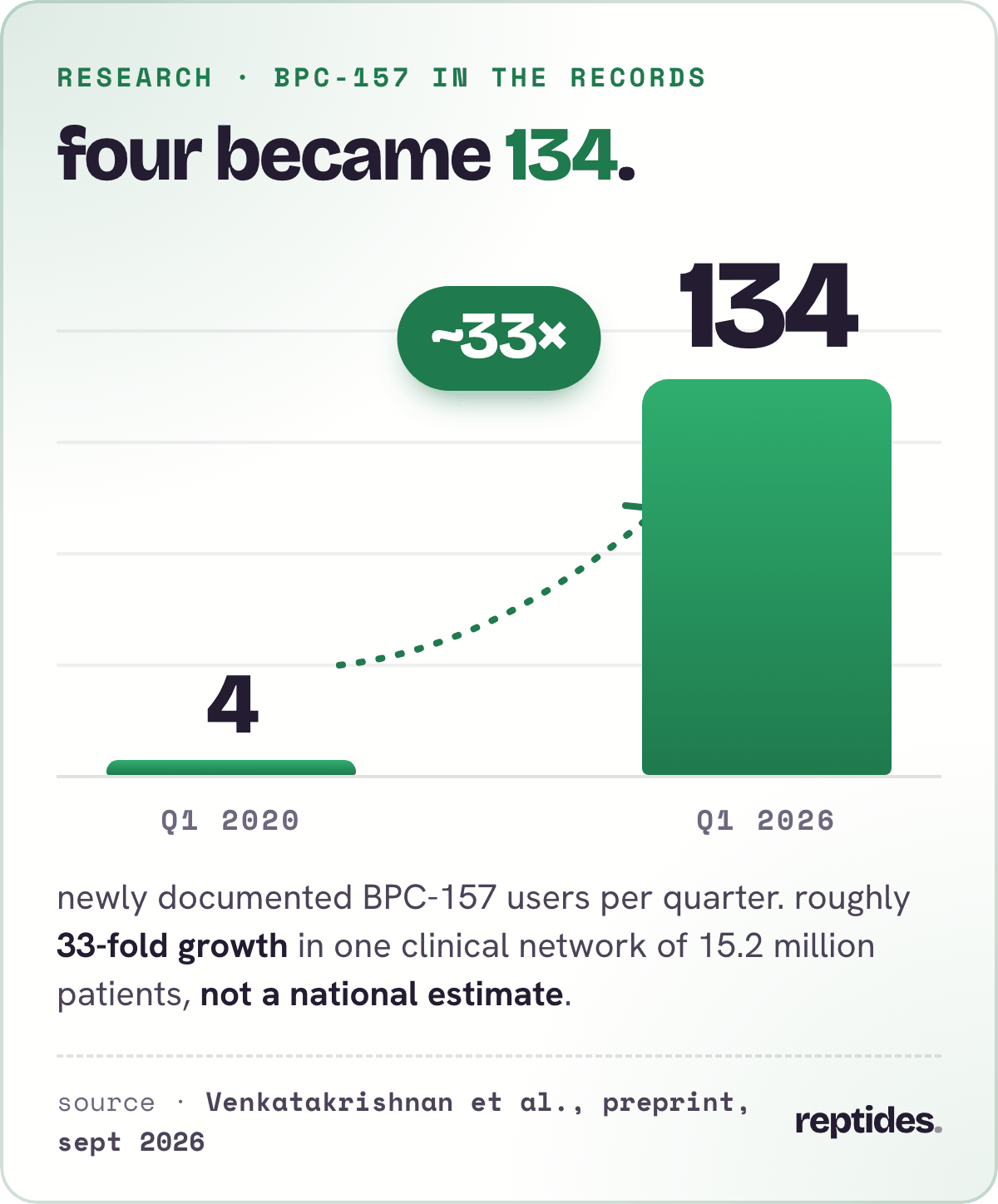
Newly documented users rose from four in the first quarter of 2020 to 134 in the first quarter of 2026. That is roughly 33-fold growth in this network's records, rather than a national estimate of everyone using BPC-157. [2]
Pain was the most common recorded reason for use. Another therapeutic agent appeared alongside BPC-157 in 50.5% of users, including testosterone in 17% and TB-500 in 12.9%.
Among 354 people with a documented directional symptom response:
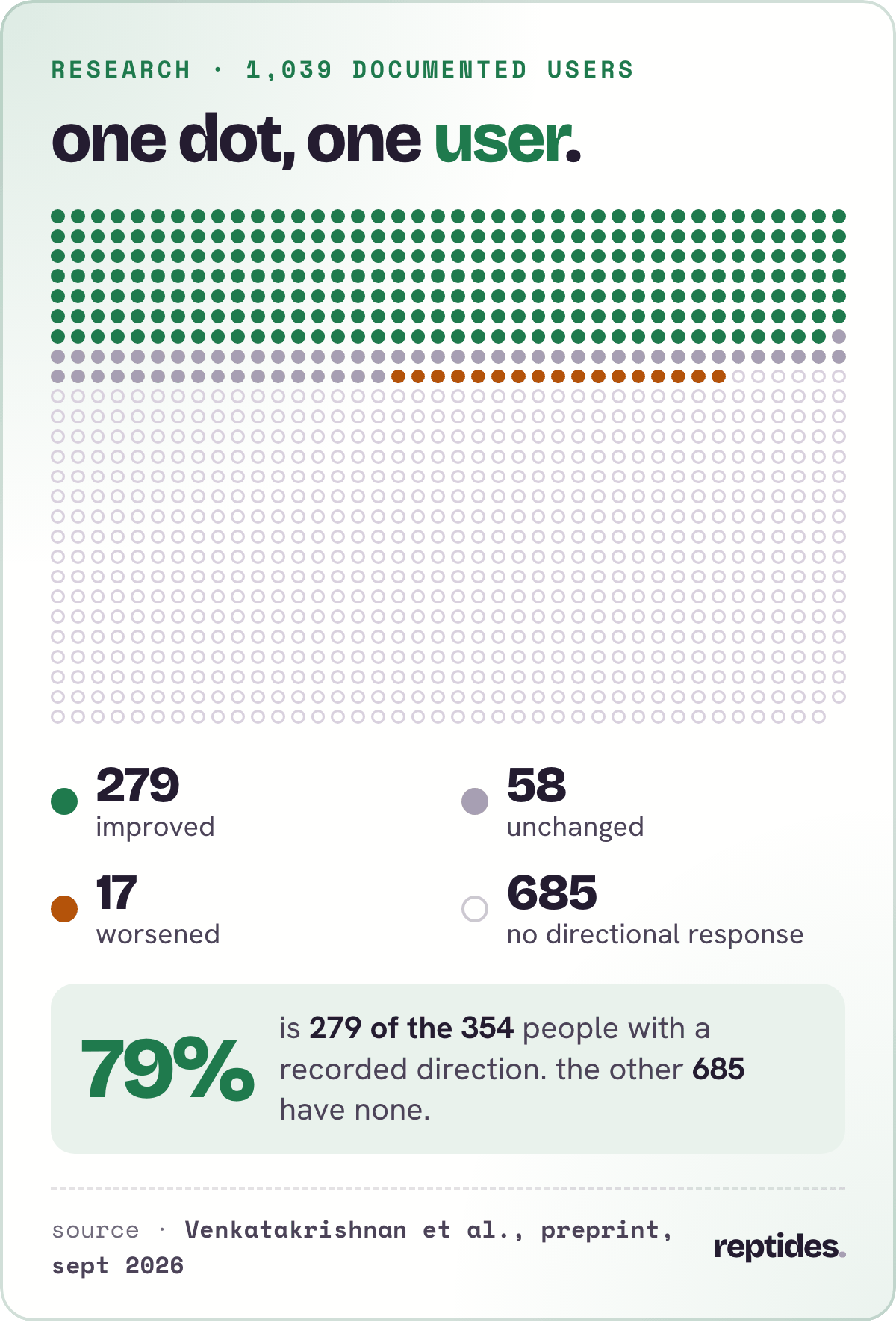
That produces the 79% improvement figure. The other 685 users had no directional response available.
The preprint used LLM-assisted extraction from clinical notes, with physician checks. It was not randomized, products and treatment were unstandardized, and other therapies were common. The records depend on what patients report and clinicians record.
It shows growing documented use and a signal worth investigating. It cannot tell us how much improvement BPC-157 itself caused. [2]
a peptide bill is now in Congress.
On September 1, Rep. Nancy Mace introduced the PEPTIDES for Veterans Act. It now has a bill number, H.R. 10212, and published text. It was referred to the House Committee on Veterans' Affairs. [3]
The proposal would put the VA through three stages.
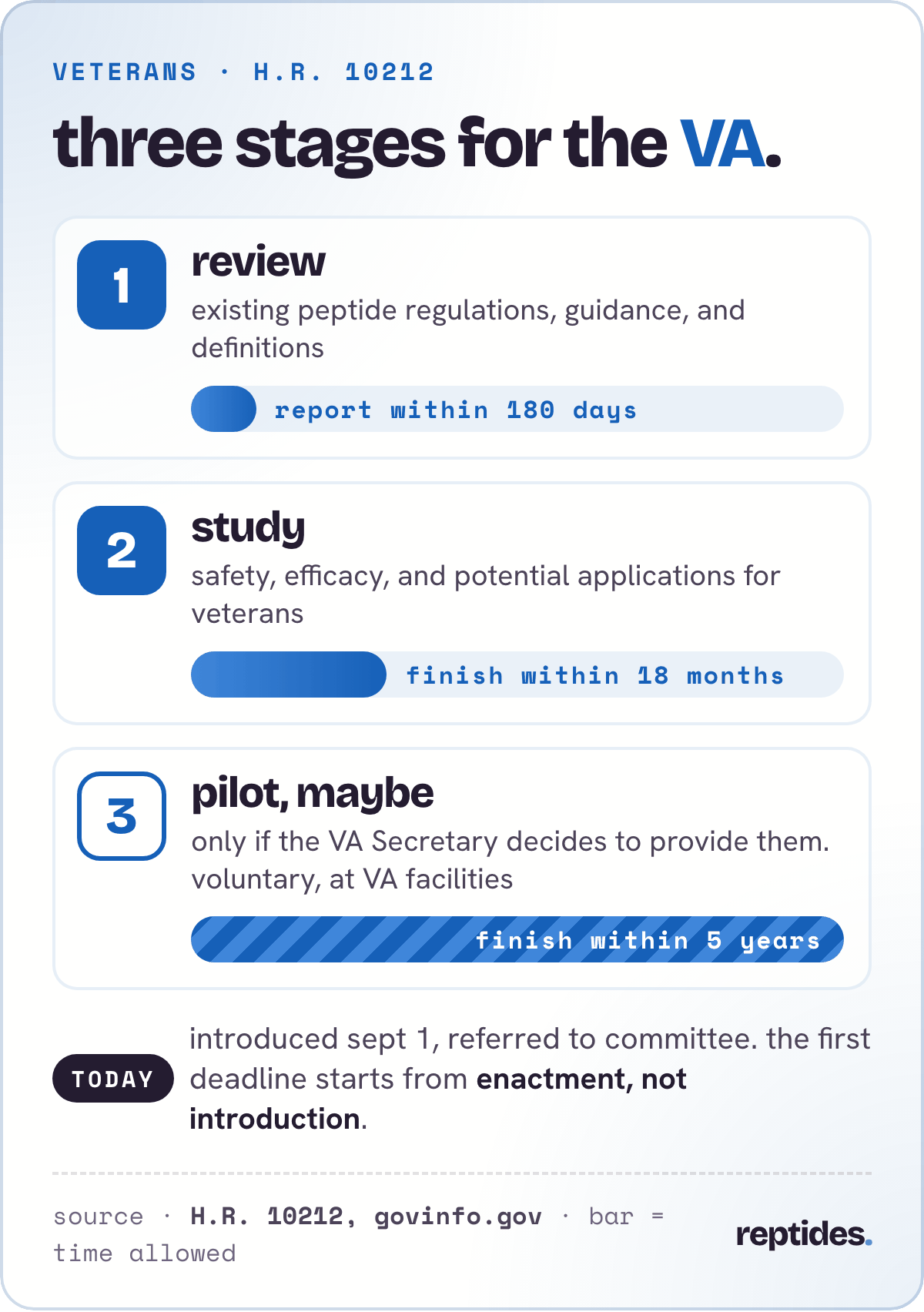
That sequence matters. The bill does not immediately give veterans access to BPC-157 or approve a list of research peptides. It proposes a process for deciding what should be studied and potentially offered.
It also remains a bill. The first deadline starts from enactment, not introduction. The study and pilot would follow on their own timelines.
Apex: five agencies, multiple searches, and an explanation still pending.
Federal agents searched Apex Waste Management in North Sioux City, South Dakota, on September 23. A home in nearby Dakota Dunes was also searched.
KTIV identified five agencies involved in the operation:
Postal inspectors on scene came from Minneapolis, while FBI agents came from the Omaha and Minneapolis offices. [4]
KTIV's review of business filings connected Apex Waste Management, Apex Research, and Apex Peptides through their owners and registered addresses. That is the documented connection between the searches and the peptide business. [4]
Postal inspector and spokesperson Travis Fondow subsequently confirmed to KSCJ that federal agents had visited multiple locations in the Sioux City area. He declined further details because the investigation was active. KSCJ also reported that two people were seen being led away in handcuffs, but their identities and any charges had not been disclosed. [5]
An anonymous tip provided to Reptides alleges that the investigation may involve mail fraud, money laundering, tax evasion, and distribution of prescription drugs or steroids. It also alleges that related businesses were used to move proceeds and that products were supplied to local clinics.
These are unverified allegations from the tip, portions of which are secondhand. They are not charges announced by authorities, and we have not independently corroborated them.
The tip also claims FDA involvement. We have not found public confirmation of FDA's participation in these searches.
As of October 6, the public reporting we reviewed still did not establish what prompted the operation or whether peptide sales were its central focus. That remains the question an official statement or public court filing needs to answer.
five X accounts suspended. the notices identify sourcing posts.
Reptides confirmed that five notable peptide accounts were suspended on X during September, including research-use-only businesses and affiliate accounts. We are keeping the accounts unnamed.
The two enforcement notices shared with Reptides cite X's "Illegal and Regulated Behaviors" rule and identify the posts that triggered action.
One notice identifies a direct reply pointing another user to a retatrutide seller and offering a checkout discount code. The other identifies a post promoting a peptide blend and directing readers to an RUO. These were direct supplier referrals and product promotions.
X's published policy prohibits facilitating drug sales as well as selling directly, and lists post removal, read-only restrictions, and account suspension among its enforcement options. That is X's stated moderation basis, not a court finding about the posts. [33]
All five account owners have appealed. As of October 6, 2026, all five accounts remained inactive on X.
the fentanyl comparison arrives.
Former DHS chief Chad Wolf urged a peptide crackdown in a September 2 Fox News opinion piece. [6]
The underlying supplier question deserves scrutiny. Chainalysis has linked some Chinese peptide suppliers to businesses involved in the synthetic-drug precursor trade. Its report also explicitly distinguishes those businesses from the wider population of overseas chemical manufacturers. [7]
There is a border-enforcement record too. CBP previously described more than 300 master-carton smuggling attempts containing roughly 5,000 individual peptide shipments, including retatrutide. Those seizures accumulated from December 2025 through March 25, 2026, and were announced in March. They were not a fresh September operation. [8]
If the issue is deceptive importing, examine the shipments. If it is contamination, examine the testing. If it is marketing an unapproved drug for human use, examine the conduct.
Those are specific questions with specific evidence. Treating "peptides" as one interchangeable threat makes the conversation less useful for everyone trying to understand what is actually happening.
Lilly's August cases started moving.
Last issue covered the six retatrutide complaints Lilly filed on August 12. September brought an unusual problem in the Astra case: identifying the business behind the storefront.
In its August 31 amended complaint, Lilly added an Astra Peptides operator whose true legal identity was unknown. The filing says Lilly had been unable to identify that defendant despite reasonable efforts. [9]
Our September 2 docket report described Lilly dismissing the separately named Astra LLC after an unrelated transportation company said it had been served in error. The distinction was the scope of that dismissal: removing that entity did not mean Lilly abandoned the claim against the unidentified peptide operator. [10]
There was a different outcome in California.
On September 11, Lilly voluntarily dismissed its entire case against Aesthetic Envy with prejudice. The notice does not explain why or disclose settlement terms. It also does not contain a merits ruling establishing that either side's underlying position was correct. [11]
retatrutide's classification fight now has a procedural problem.
Lilly's separate dispute with FDA reached oral argument at the Seventh Circuit on September 24. The fight concerns whether retatrutide belongs in the biologics framework. [12] [13]
There are two questions in the underlying decision: whether it qualifies as a protein, and whether it could qualify as a product analogous to a protein. The district court accepted FDA's interpretation of the protein definition but required the agency to revisit its explanation of the second question. [13]
The practical stakes remain significant. FDA says biological products do not qualify for the ordinary 503A and 503B compounding exemptions. Keeping a product in the drug framework leaves those statutes potentially relevant, subject to all their other requirements. It does not automatically make current retatrutide compounding lawful. [14] [16]
Ahead of the hearing, DOJ's September 21 letter cited a recent decision to argue that FDA's scientific interpretation deserved substantial weight. Lilly replied on September 23 that the same decision supported independent judicial interpretation and that FDA's reading was neither persuasive nor settled. Both sides claimed the precedent helped them. [31] [32]
But the latest development is about whether this appeal can proceed at this stage.
After the September 24 argument, the judges ordered both sides to submit additional briefs on appellate jurisdiction, specifically appeals by private parties from decisions sending matters back to agencies. Those briefs are due October 8. [12]
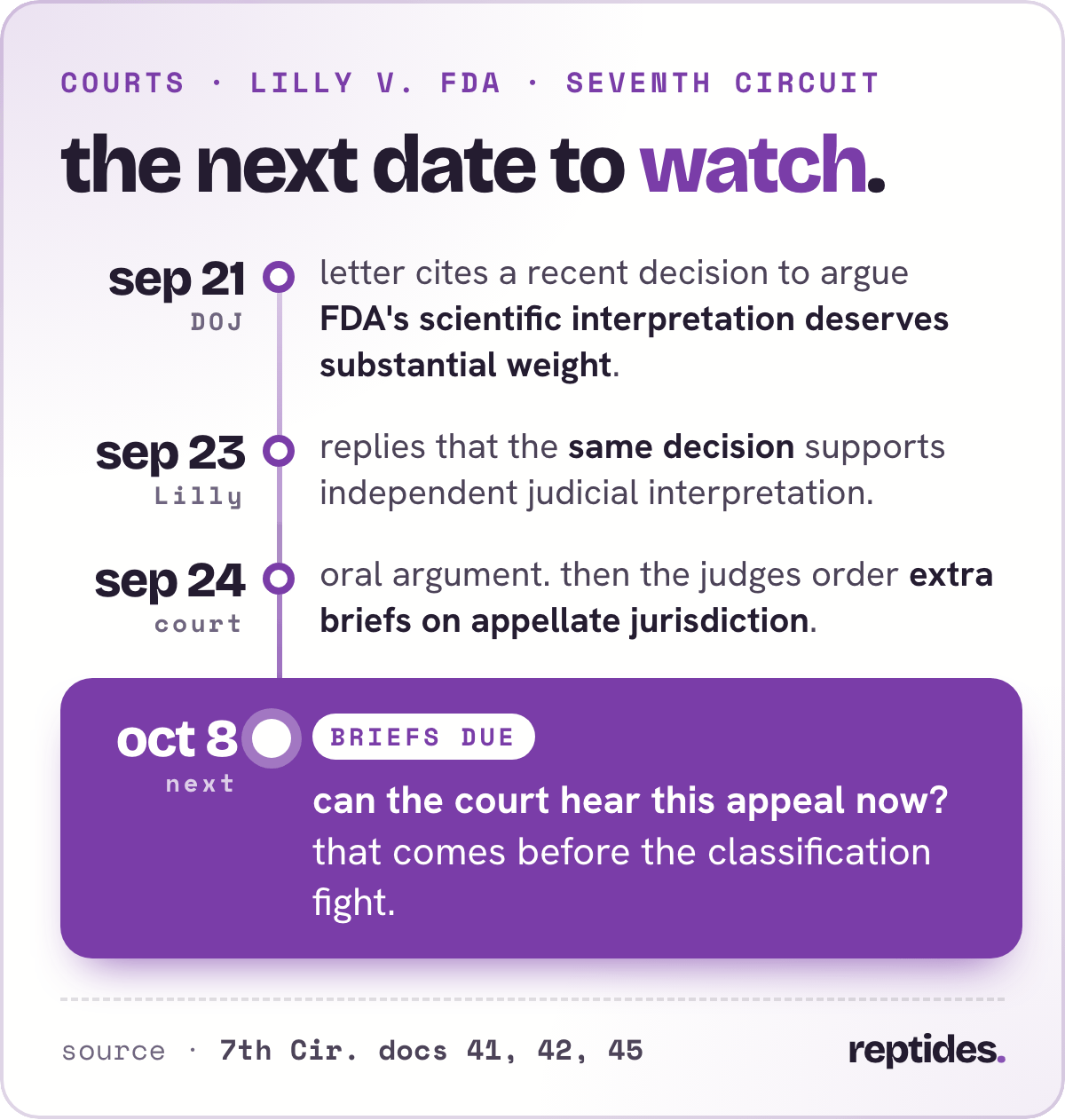
Before the court resolves the classification arguments, it needs to address its authority to hear this appeal now.
That is the next date to watch.
FDA wants to see the individual patient behind the justification.
FDA's September 18 warning letter to Empower Pharmacy concerns more than adding a vitamin to a GLP-1.
The agency inspected Empower's Houston facility in November 2025. Its letter identifies compounded semaglutide/cyanocobalamin, or B12, and tirzepatide/niacinamide, and says the pharmacy was regularly producing what appeared to be essentially copies of commercially available drugs. [15]
Under 503A, a prescriber can determine that a change makes a "significant difference" for an identified individual patient. That patient-specific determination matters to whether a compounded product is treated as essentially a copy. [14] [15]
FDA questioned missing determinations, explanations repeated verbatim across prescriptions, and third-party platforms offering preset justifications. The agency also questioned whether apparent differences between products were pretextual.
For the post-shortage market, that is a substantial issue. A customization argument has to survive scrutiny of the prescription and the clinical reasoning behind it. A different ingredient list does not finish that job. [15]
the safety totals need their date.
FDA's GLP-1 webpage lists 990 adverse-event reports associated with compounded semaglutide and more than 730 associated with compounded tirzepatide.
Those totals are as of May 31, 2026. They are not September-only counts. Reports also do not establish that a product caused an event, and raw totals cannot establish comparative safety without knowing exposure and reporting differences. [16]
The same page describes complaints about warm shipments, inadequate refrigeration, and labels naming pharmacies that either do not exist or did not make the product.
It also recommends discarding compounded GLP-1 multidose vials within 28 days after first use, including when a compounder's instructions allow longer use, and reiterates that retatrutide and cagrilintide cannot be used in compounding under federal law. [16]
retatrutide's detailed Phase 3 results are here.
TRIUMPH-2 followed 1,152 adults with obesity or overweight and type 2 diabetes for 80 weeks. Detailed results were released around EASD and published in The Lancet. [17]
At 12 mg, the headline average weight loss was 20.8% using the efficacy estimand: an analysis estimating what would happen if participants remained on treatment under the trial's specified conditions. The treatment-regimen analysis, which accounts for outcomes regardless of treatment discontinuation, reported 18.8% weight loss versus 5.1% with placebo. Same trial, different questions about what happens during treatment. [18]
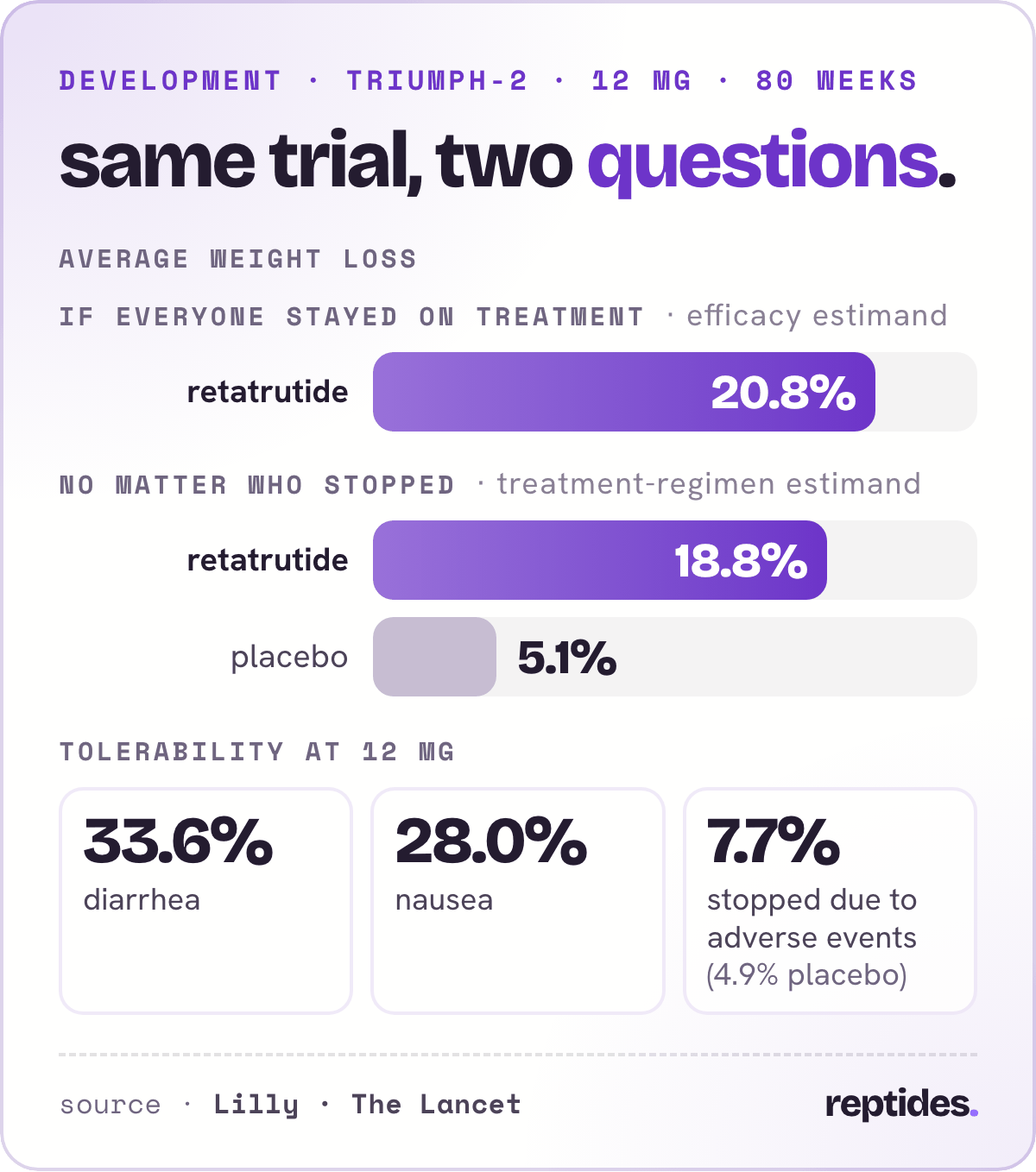
Lilly's efficacy-estimand results at 12 mg:
These are weight and risk-marker results; they do not establish a reduction in heart attacks or strokes.
Tolerability belongs beside those numbers. At 12 mg, diarrhea occurred in 33.6%, nausea in 28.0%, and dysesthesia, or altered skin sensation, in 7.3%. Adverse events led 7.7% to discontinue, compared with 4.9% on placebo. [17]
Lilly added amylin to tirzepatide.
EloraTZP combines tirzepatide's GIP/GLP-1 activity with eloralintide, a selective amylin receptor agonist.
Lilly's September 30 Phase 2b announcement covered 367 adults with obesity or overweight and type 2 diabetes, followed for 48 weeks. The efficacy-estimand results included:
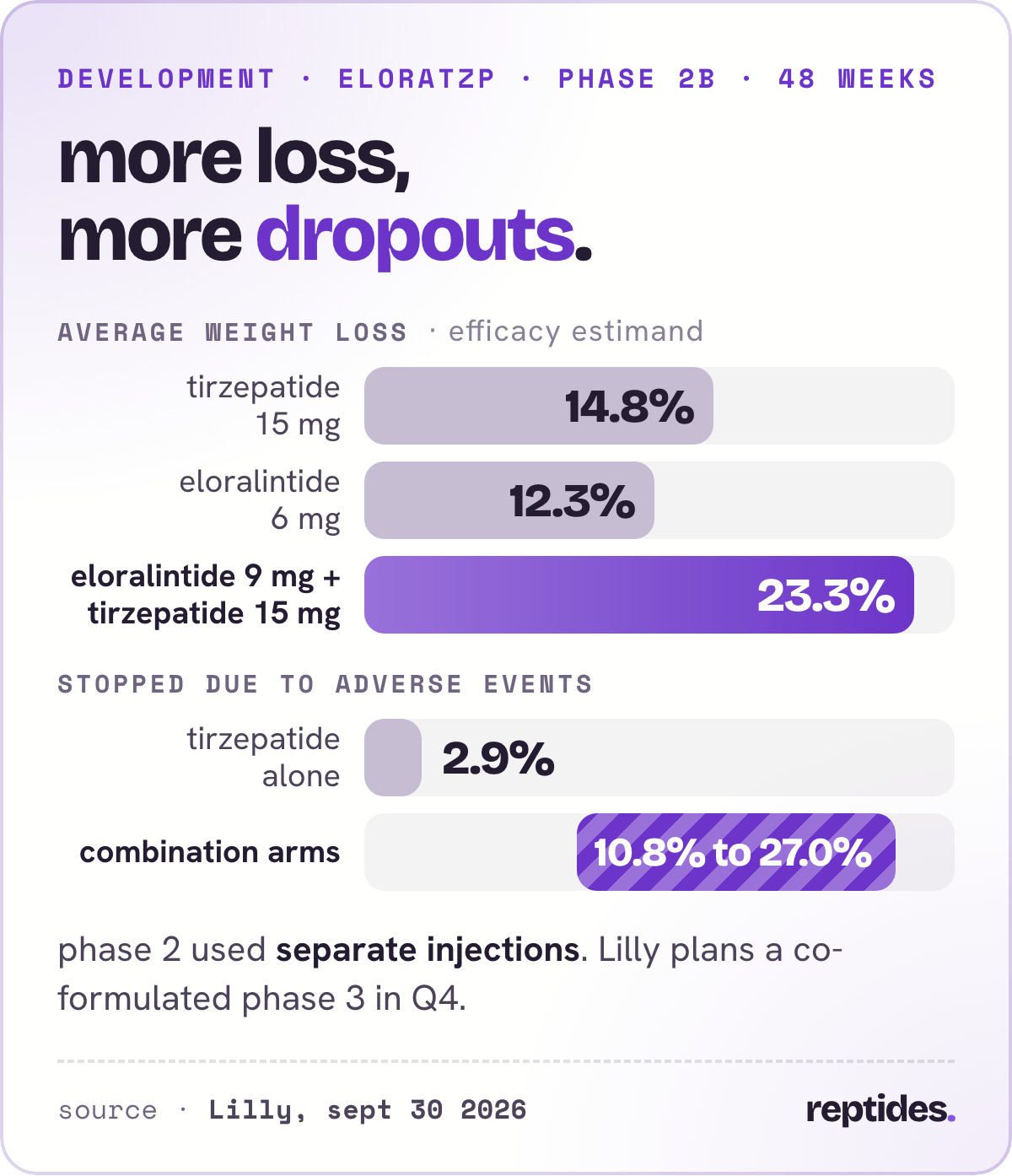
The highest combination also reduced A1C by 2.9 percentage points.
The tolerability problem was substantial. Adverse-event discontinuations ranged from 10.8% to 27.0% across combination arms, compared with 2.9% for tirzepatide alone. Gastrointestinal events were concentrated during dose escalation.
Lilly plans to adjust that escalation schedule and move a co-formulated product into Phase 3 in Q4. The Phase 2 study used separate injections. [19]
That gives the next study two jobs: establish the benefit in a larger population and show whether more people can remain on treatment. Comparing its headline number with retatrutide's separate trial cannot tell us which treatment is better.
Novo's next oral bet could be weekly.
On September 29, Novo and Hengrui announced a licensing agreement for HRS-1596, a GLP-1/GIP dual agonist being developed for potential once-weekly oral dosing.
The deal is worth up to $2.6 billion, including $300 million upfront, with the remaining payments contingent on milestones and potential royalties on top. At announcement, the candidate was Phase 1-ready. [20]
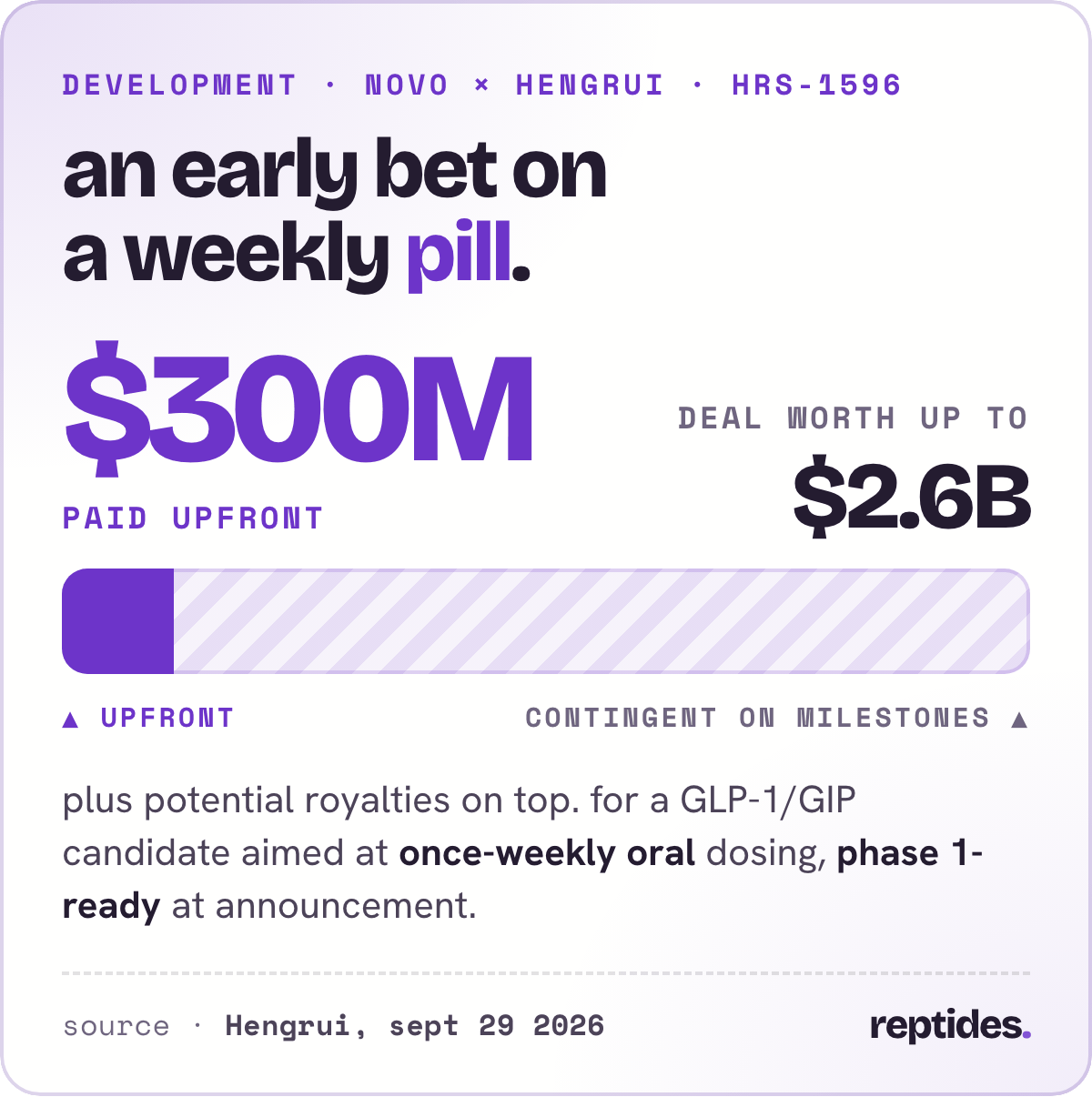
A peptide taken orally once a week could substantially change the convenience of treatment. Human studies still have to demonstrate that the intended exposure, efficacy, and tolerability can be achieved.
There is now a concrete trial to follow. A Phase 1 record posted September 25 lists an estimated 122 participants, evaluating safety, tolerability, and how the drug behaves in the body. Its latest posted status is not yet recruiting; it does not establish that dosing has begun. [21]
Our follow-up through October 6 found no published human efficacy result. The weekly pill remains a development goal.
the prescribing is already happening.
A Pediatrics study examined GLP-1 prescribing in children ages 8 to 11 with obesity and without diabetes. It reported a 310-fold increase in its annual prescribing measure between 2019 and June 2026.
Across the full study cohort of more than 3.5 million children, 20,282 received a prescription, approximately 0.6%. Almost 94% of recipients had severe obesity, and 65% had an obesity-related health condition. [22]
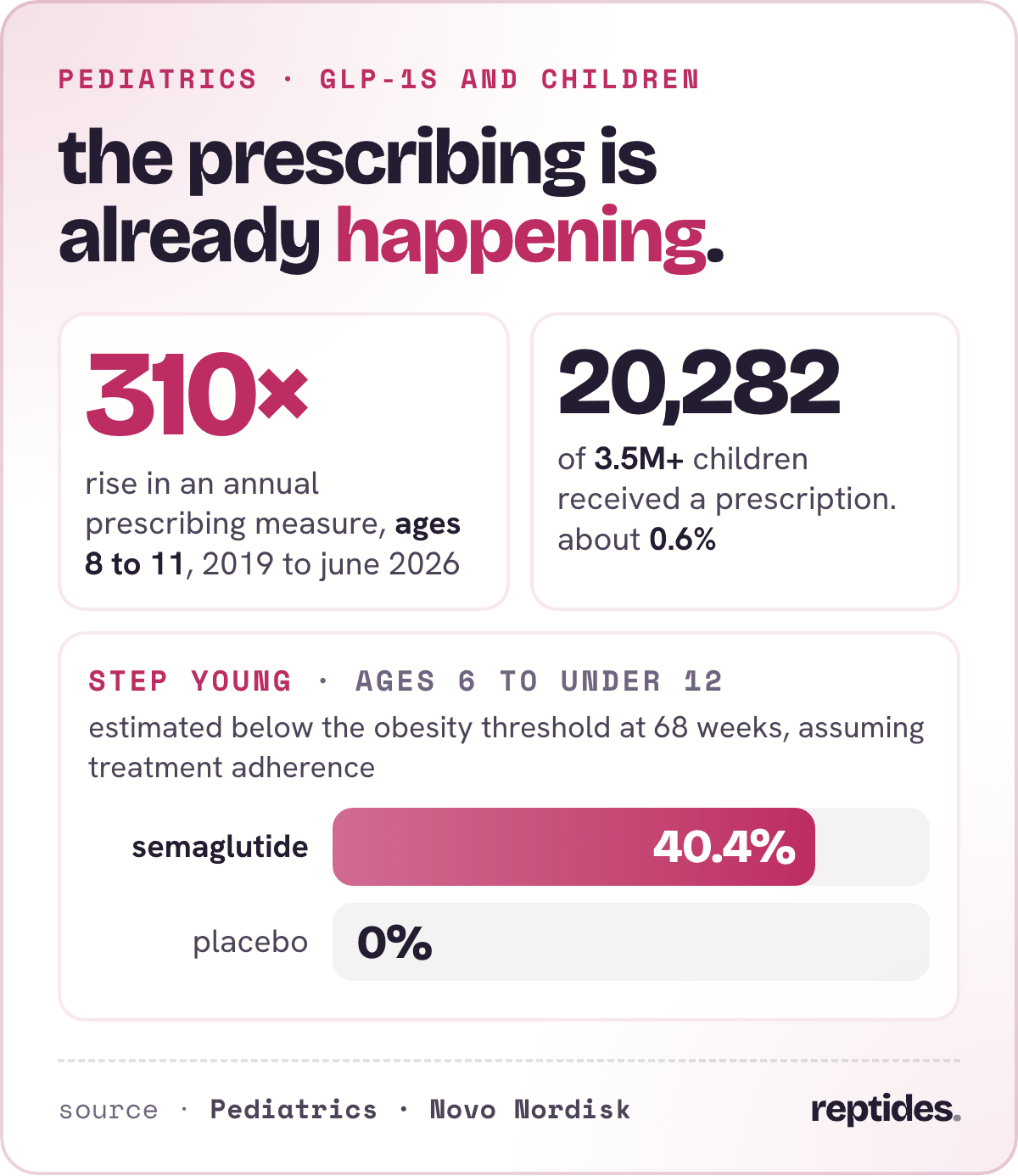
Most recipients had substantial disease burden. A prescription record also does not establish that a medication was dispensed or taken.
Three days after that paper's online release, Novo announced topline results from STEP Young.
The Phase 3 trial enrolled 165 children ages 6 to under 12. Both groups received dietary and physical-activity intervention. At 68 weeks, 40.4% in the semaglutide group were estimated to fall below the obesity threshold, compared with 0% on placebo, using an analysis assuming treatment adherence. More than 85% began with severe obesity. [23]
The trial met its primary BMI endpoint. Novo reported no new safety signals and plans to present detailed findings at ObesityWeek in November.
For obesity, Wegovy injection's FDA-approved pediatric indication still starts at age 12. The under-12 results do not themselves change that approval. [30]
The results deserve attention. The full safety tables, treatment discontinuations, growth measures, and longer follow-up deserve attention too. A favorable topline release cannot answer every question about years of treatment during childhood.
Lilly presented early brenipatide data at Psych Congress in September. Also called LY3537031, it targets GIP and GLP-1, with development programs directed at substance-use and psychiatric conditions. [24]
Phase 3 alcohol-use-disorder trials are already underway. RENEW-ALC-1 lists an enrollment goal of 1,100 and an October 2025 start, so September's presentation was an update on the program, not its launch. [25]
Now the trials have to show whether brenipatide actually changes drinking behavior. The early safety and drug-exposure data cannot answer that.
BG-104 combines GLP-1, GIP, and growth-hormone receptor agonism with activin type II receptor targeting.
In aged mice with diet-induced obesity, researchers reported weight loss comparable to tirzepatide, with roughly 99.5% of the lost weight attributable to fat mass and minimal lean-mass decline.
That is the composition of the weight lost, not 99.5% of starting body fat. The finding comes from a June conference abstract that attracted attention in September, with no human result yet. [26]
September reporting highlighted McDonald's CEO Chris Kempczinski's observation that more adults were ordering Happy Meals as appetites changed. The HBR interview was in August; discussion of smaller portions, lighter options, and lower-sugar drinks also draws on earlier company comments. [27]
The commercial question is straightforward: what happens to a food business when customers still want the meal, but want less of it?
FDA testing found undeclared fluoxetine in Lipofit Extreme Fat Burner 2.0's AM tablets and DNP in its PM tablets.
FDA warned about it on June 4. The company announced a voluntary recall on August 27, which FDA published August 31. DNP can cause fatal toxicity, including extreme overheating and cardiac arrest.
The recall concerns lot 25M12F, expiring September 2027. A supplement label did not disclose what was actually in these tablets. [28] [29]
see you next month,
James Lake · Chief Bro Officer & Co-Founder, Reptides · @reptidesco · @James9thlife
Download reptides on the App Store
[2] Venkatakrishnan et al. Rising Use of Unapproved BPC-157, September 7 preprint
[3] H.R. 10212, introduced September 1, 2026: full text
[4] KTIV reporting: September 23 federal searches, syndicated by Dakota News Now
[5] KSCJ: Postal Inspection Service confirms active Apex investigation, September 24
[6] Chad Wolf, Fox News opinion, September 2, 2026
[7] Chainalysis: Inside the Gray Market Peptide Crypto Boom, June 4, 2026
[8] CBP: Cincinnati seizure announcement, March 31, 2026
[9] Lilly v. Astra: first amended complaint, August 31, document 6
[10] Reptides September 2 docket report: Astra defendant dismissal
[11] Lilly v. Aesthetic Envy: voluntary dismissal with prejudice, September 11, document 6
[12] Lilly v. Kennedy: September 24 Seventh Circuit supplemental-briefing order, document 45
[13] Lilly/FDA district-court amended order, October 3, 2025
[14] FDA: Compounding questions and answers
[15] FDA warning letter to Empower Pharmacy, September 18, 2026
[16] FDA: Concerns with unapproved GLP-1 drugs used for weight loss
[17] Lilly: Detailed TRIUMPH-2 results, September 29, 2026
[18] TRIUMPH-2, The Lancet: treatment-regimen estimand, DOI 10.1016/S0140-6736(26)01861-1
[19] Lilly: EloraTZP Phase 2b results, September 30, 2026
[20] Novo/Hengrui: HRS-1596 license announcement, September 29, 2026
[21] ClinicalTrials.gov: HRS-1596 Phase 1 study, NCT07841860
[22] Pediatrics prescribing study and NYU Langone author-institution release
[23] Novo: STEP Young topline announcement, September 7, 2026
[24] Lilly: Psych Congress 2026 presentation materials
[25] Lilly: RENEW-ALC-1 Phase 3 study
[26] Jeon et al., Diabetes 2026 abstract 3075-LB
[27] Moneywise: McDonald's Happy Meals and GLP-1 reporting, September 20
[28] FDA: Lipofit hidden ingredients warning, June 4, 2026
[29] Lipofit voluntary recall announced August 27, FDA publication August 31
[30] Current Wegovy prescribing information: pediatric obesity indication age 12 and older
[31] Lilly/FDA appeal: DOJ supplemental-authority letter, September 21, document 41
[32] Lilly/FDA appeal: Lilly's response, September 23, document 42
[33] X: Illegal and Regulated Behaviors policy, accessed October 6, 2026
reptides editorial · research reference, not medical advice. Investigational results do not establish the identity or quality of products sold outside the studies.