I have been tracking prices (both RUO and compounded) for peptides since my first GLP3 order back in Nov 2025. It has been fascinating to watch this market evolve and I decided it was time to analyze the data I have gathered and offer my predictions on where I believe the market is heading (both on the compound/clinic side and RUO).
Reta's inception on the market really started gaining traction in late 2023. I found myself in a bad place late 2025, overweight, out of shape, and desperately needing to overhaul my life with a baby on the way. At this time Reta still existed in a bit of a niche, I had heard about Ozempic, and tirzepatide but more and more TikToks came on my feed, like Dawson Weiss (Dtren) and other fitness/looksmaxxer influencers talking about how effective it was as a fat loss tool in a physique enhancing context. This seemed to deviate largely from the general stigma of the Ozempic faced celebrities that had used GLP1s and turned into hollowed out versions of themselves in doing so. So I decided it was time to give it a shot (literally) and I placed my first order based on information I had gathered off Reddit and Finnrick tests.
Since that point Reta went from a handful of RUO vendors charging whatever they wanted to a commodity in under a year.
I believe the compounding side is next. More peptides are getting the green light for 503a pharmacies, and a lot of new buyers are about to enter the market.
This article is an analysis of what has happened within this last year, and where I see things headed next.
A couple quick definitions I will be using here to broadly categorize segments of the market:
I know there is quite a bit of nuance beyond these categories but this is just a general framework for brevity.
My n=1
I started my research journey with GLP3 so we will start here.
Here is how RUO GLP3 has trended per mg, based off my purchase history (list price, before codes) [1]:
- Nov 2025: $18.44
- Dec 2025: $11.58
- Feb 2026: $4.50
- Jul 2026: $3.50
- Oct 2026: $3.38
For reference I paid $236 for that first 16mg vial, and that was after a Black Friday code [1]. RIP to my wallet.
NOTE: my purchase history shows the path of someone going from a complete noob in this market to a more informed researcher. I anticipate the same will happen with compounded buyers as well.
Right now a public price tracker with 227 GLP3 vial listings has the typical 10mg vial at $55.80 ($5.58/mg) [2]. My last order was $3.38/mg, about 40% under that. Trackers like that show today's price though. Historical RUO peptide pricing does not exist right now, or at least not that I am aware of at this moment.
Grey market GLP3 from China suppliers are pretty uniform, about $1 to $1.30/mg on a 10mg kit (one outlier at $2.03) and $0.55/mg on 60mg [3].
This highlights something very important, there has been, and will continue to be, an information asymmetry right now in peptides. We see this clear as day with RUO GLP3.
When I started only a handful of vendors had it, independent tests were coming back all over the place, independent lab testing was still forming as a best practice, and the few vendors people trusted could charge whatever they wanted. Then more RUOs came in, testing demands went up, customers became more informed buyers, and margins got thin.
Most of the drop happened in the first 3 months... per vial prices have only gone from $4.50 to $3.38 since Feb [1].
Where the money goes on a vial
This is probably the most interesting part of the whole thing. I have access to two bulk price sheets, one from a China supplier that keeps stock in a US warehouse and one from a US RUO wholesaler [4].
GLP3 10mg, price per mg by who's selling it [1][3][4]:
- China direct: $1.05
- China supplier with US warehouse stock: $1.79
- US RUO wholesaler: $2.00
- RUO retail (my last order): $3.38
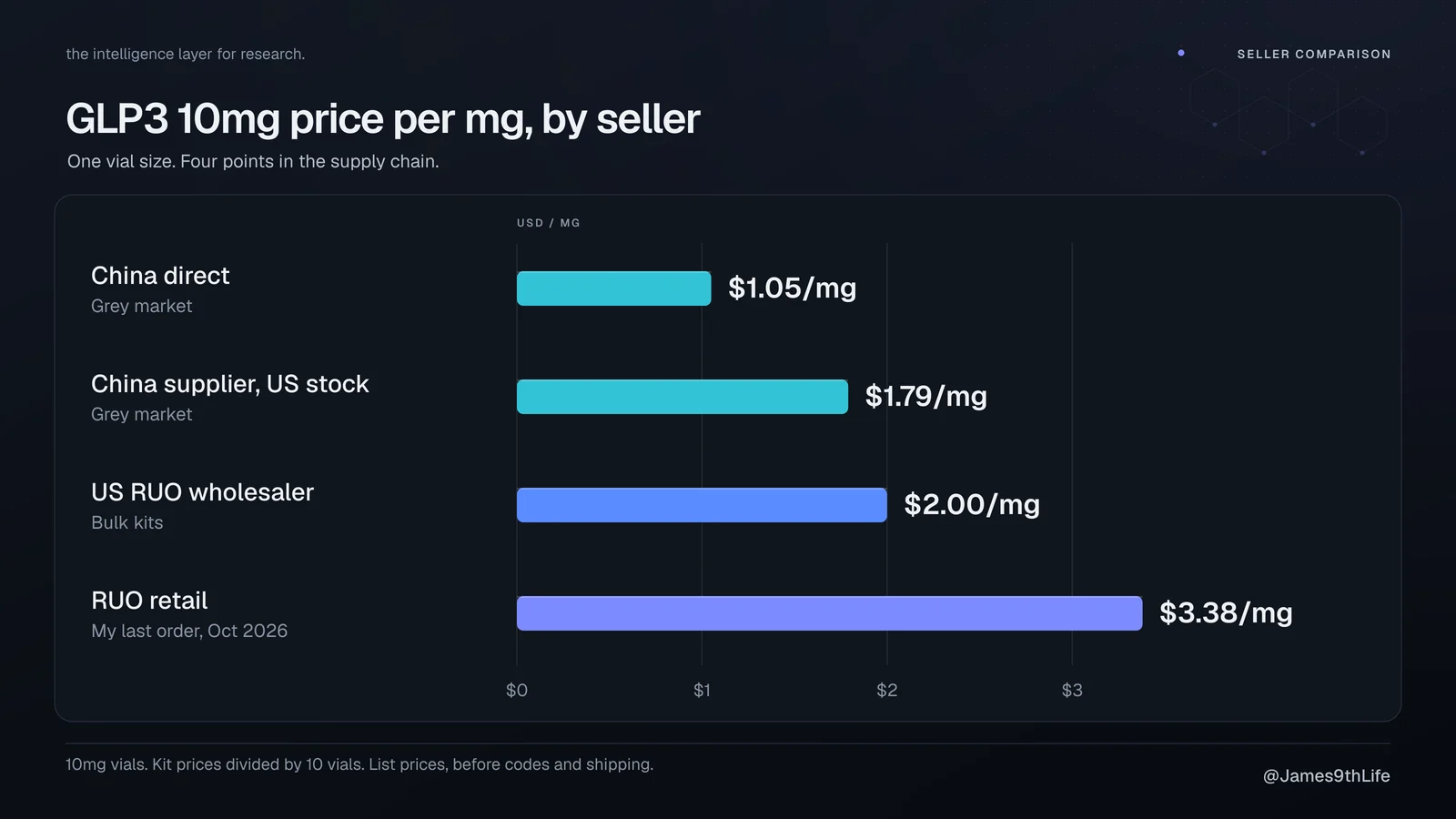
Grey is cheapest because you're the one eating the customs and quality risk. Every step up the chain gets paid to take some of that risk off you.
54 items show up on both sheets at the same size, so I lined them up [4]:
Some RUO 10 packs now go for less per mg than that wholesaler's kits [4][5], so the middle of the chain is getting squeezed from both sides.
Both sheets work out to roughly a flat cost per vial plus a cost per mg [4]. The US wholesaler is exactly $10 a vial + $1 per mg on GLP3 and $7.50 a vial + $0.50 per mg on tirz and sema. The vial, filling and labeling cost about the same whether there's 10mg or 60mg in it, which is why the big vials are so much cheaper per mg.
GLP3 still runs 1.7 to 2x tirz per mg at the same vial size on both sheets [4]. If GLP3 goes the way tirz did, there's still room to come down at the source, granted that source is able to continue producing product.
RUO GLP3 is basically a commodity now
Last couple months [5]:
- 10mg vials now anywhere from $27 to $99
- 60mg vials $95 to $105
- 10 packs listing as low as $1.11/mg
- Free GLP3 vials as a loss leader
- One vendor cut every size in a single email (10mg went $130 to $99)
Vendors are exiting too. The biggest US RUO shut down in March [6] and another closed in October with a 60% off final sale [5]. Thin margins + Lilly suing 6 sellers in Aug and reporting 14,000+ sites, ads, posts and listings [7][8] + FDA warning letters [9].
From here I don't see another big drop in RUO GLP3. My last 10mg vial was about 3x grey, and the cheapest 10 packs list at about 1.7 to 2x grey at the same size [1][3][5]. More enforcement and more exits push it the other way if anything.
The compounding side will be no different
And it's already happening. Everyone's talking like "oh now these peptides are getting prescribed"... dude they've been getting prescribed for months now. I was buying compounded CJC/Ipa from a pharmacy back in Apr 2025 [1], and a clinic in my inbox launched GLP3 in Feb 2025 [10]. A CBS investigation in June counted 50+ clinics and 120+ websites selling it [11]. The green light just means more pharmacies willing to take the risk.
Compounded CJC/Ipa (6/6) was $300 a vial when I bought it in Apr 2025. Same vial is $199.66 today [1]. Compounded tirz too, one 3 month supply went from $1,600 to $1,080 in Sep [10]. Both down about a third. RUO GLP3 dropped about 80% in 11 months [1].
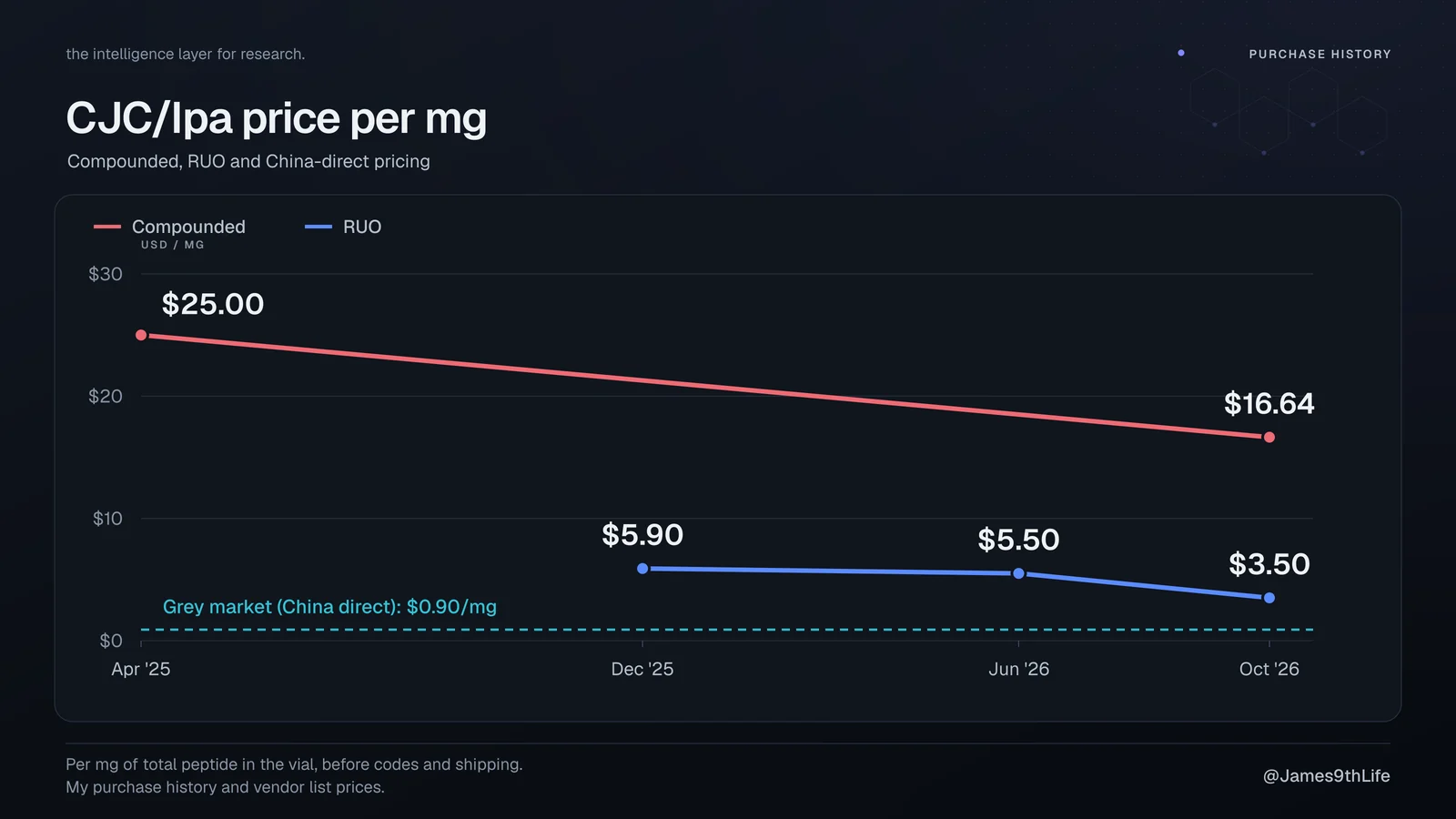
CJC/Ipa per mg, from the top of the chain down [1][3][4][5]:
- Compounded: $16.64
- RUO retail: $2.60 to $3.50
- US RUO wholesaler: $2.25
- China supplier with US warehouse stock: $1.39
- China direct: $0.90
The one layer I'm missing is stateside fill and finish. China API, filled and finished in the US, then sold wholesale to both RUO brands and the compounding side. It's getting more popular and I haven't seen a real wholesale sheet for it yet, and to be honest, not super relevant to this discussion as both the compounder and RUO get to decide what they price to the end buyer. The one public "made in the USA" wholesale list I found has CJC/Ipa at $5.25/mg at 50+ vials [12], above RUO retail and over 2x the US wholesaler's kits.
The clinic I mentioned had GLP3 packages starting at $425 on sale this April and they don't list the mg [10]. If that's a 10mg vial it's $42.50/mg, if it's 20mg it's $21.25/mg. 6 to 13x what I'm paying RUO.
FDA has said since 2025 that retatrutide can't be compounded under federal law [13][14]. In July that same clinic lost a pharmacy partner for it, and by Sep it couldn't service 8 states [10]. Compounded prices are high right now because not every clinic will take the risk.
LegitScript
No matter how much I post about LegitScript, it basically gets zero attention but it is a critical piece everyone is overlooking right now.
We've been seeing peptide content get heavily censored lately, Meta and YouTube in particular. Lilly is openly pushing social platforms to block grey market GLP3 before it reaches consumers, and payment companies to cut it off [8]. So going to market as a grey market or RUO vendor through social is only getting harder.
The compounding side doesn't have that problem. LegitScript certification is what Google, Meta, Bing and TikTok look for before they'll run Rx and telehealth ads [15][16], and for a licensed pharmacy or telehealth company it's relatively easy and straightforward to get. LegitScript says Visa and Mastercard require telehealth companies taking cards online to be certified and monitored too [15]. Right now it is the only legit way peptides get advertised on those platforms, and that's by design.
LegitScript gets paid on every certification [15], so that gate isn't going anywhere. People are upset about the censorship of RUO on platforms, blame it on Eli Lilly, but I speculate that LegitScript is applying just as much pressure and in bed with these social platforms to gatekeep the information being distributed.
The logical conclusion is, that as information distribution becomes more difficult, LegitScript, and their associated clinics, will have a monopoly over the peptide information. Which will come in the form of advertisements.
You can bet clinics are going to dump a ton of marketing dollars into Meta once the regulatory side feels more like a green light. These clinics are getting cash thrown at them by VC [17] and the peptide market is on the cusp of an explosion. These ads land in front of people with zero idea what any of this should cost. Same information asymmetry RUO GLP3 had in Nov 2025, just on a much bigger audience.
So compounded ends up with a distribution moat RUO can't touch. RUO grows through affiliates, group chats and word of mouth while compounded gets to buy reach.
Think tourists vs locals. Tourists pay whatever the first spot charges, locals know where to shop. Right now compounded peptide buyers are almost all tourists.
So informed compounded buyers won't be a thing right away while this new market share gets captured. They'll get there the same way I did on RUO, and prices will follow.
Which peptides go compounded next
This is where the new supply comes from:
- Now: BPC-157, TB-500, KPV, MOTS-c, Epitalon and Semax. HHS just posted an interim policy that lets 503a pharmacies compound them without federal enforcement, as long as they meet 10 conditions [18][19]
- Next: GHK-Cu, Melanotan II, LL-37, Dihexa and PEG-MGF go in front of the PCAC (expected before the end of Feb 2027) [20]
- GLP3: can't be compounded now [13], and once Lilly gets approval, compounded copies stay restricted unless there's a shortage [21]
The PCAC voted yes on 6 of the 7 peptides it reviewed in July [22], so it's looking like most of these make it. HHS even said part of the point is giving people "a more controlled alternative" to foreign RUO peptides [18].
We just need time and more greenlights.
Supply and demand, expect a demand surge when these become readily available, but to match that the market will catch up with more supply ie lower compounded prices.
Compounded still won't get down to RUO pricing though. The policy requires API from an FDA registered manufacturer, a full COA on every lot and adverse event reporting [18], and all of that costs money, advertisements cost money, so the floor sits higher. But many of these clinics have money to spend. It'll spike demand for GMP grade API too.
Modeling brand GLP3 pricing (theoretical, NOT a guarantee)
GLP3 is the clearest case study in all of this. And since it can't be compounded, the legit version is going to be Lilly's.
When Lilly launches GLP3 it has pricing power, but it still has to be competitive with GLP2/Tirz, Novo, and Lilly's own GLP-1 pill Foundayo, which launched in April at $149 for the lowest dose and about $349 for most patients [23]. Lilly also agreed to MFN pricing on all new drugs it brings to market [24].
Timing wise, Lilly plans to submit GLP3 to FDA in Q1 2027 [25] and Kalshi has approval before July 2028 at about 85% (as of Oct 28) [26], so month 0 is probably late 2027 or the first half of 2028 (Clarivate has it launching in 2028) [27].
Nobody knows what Lilly will charge because Lilly hasn't said. The blogs guessing $1,000 to $1,500 a month are guessing list price [28]. Zepbound lists at up to $1,086 and Wegovy at $1,349, and almost nobody paying cash pays that [23]. So the only honest way to put a number on it is to copy what Lilly actually did with Zepbound.
Step 1: Pick the launch price. Right now brand cash mostly runs $149 to $449 a month across Zepbound, Wegovy, the Wegovy pill and Foundayo [23]. Three anchors Lilly already uses:
- High: $599, what Lilly charges for a 7.5mg Zepbound vial outside its refill program [29]
- Base: $449, Zepbound's top self pay tier today (7.5 to 15mg) [23][29]
- Low: $350, the TrumpRx starting price for Zepbound and Wegovy [30]
Step 2: Measure how fast Lilly actually cut prices. Zepbound vials, self pay [29][31][32]:
- 2.5mg: $399 (Aug 2024) to $349 (Feb 2025) to $299 (Dec 2025), down 25% in 15 months
- 5mg: $549 to $499 to $399, down 27% in 15 months
- Average: about 11% off by month 6 and 26% off by month 15, a bit under 2% a month
- TrumpRx: $350 dropping to $250 within 2 years, down 29% [30]
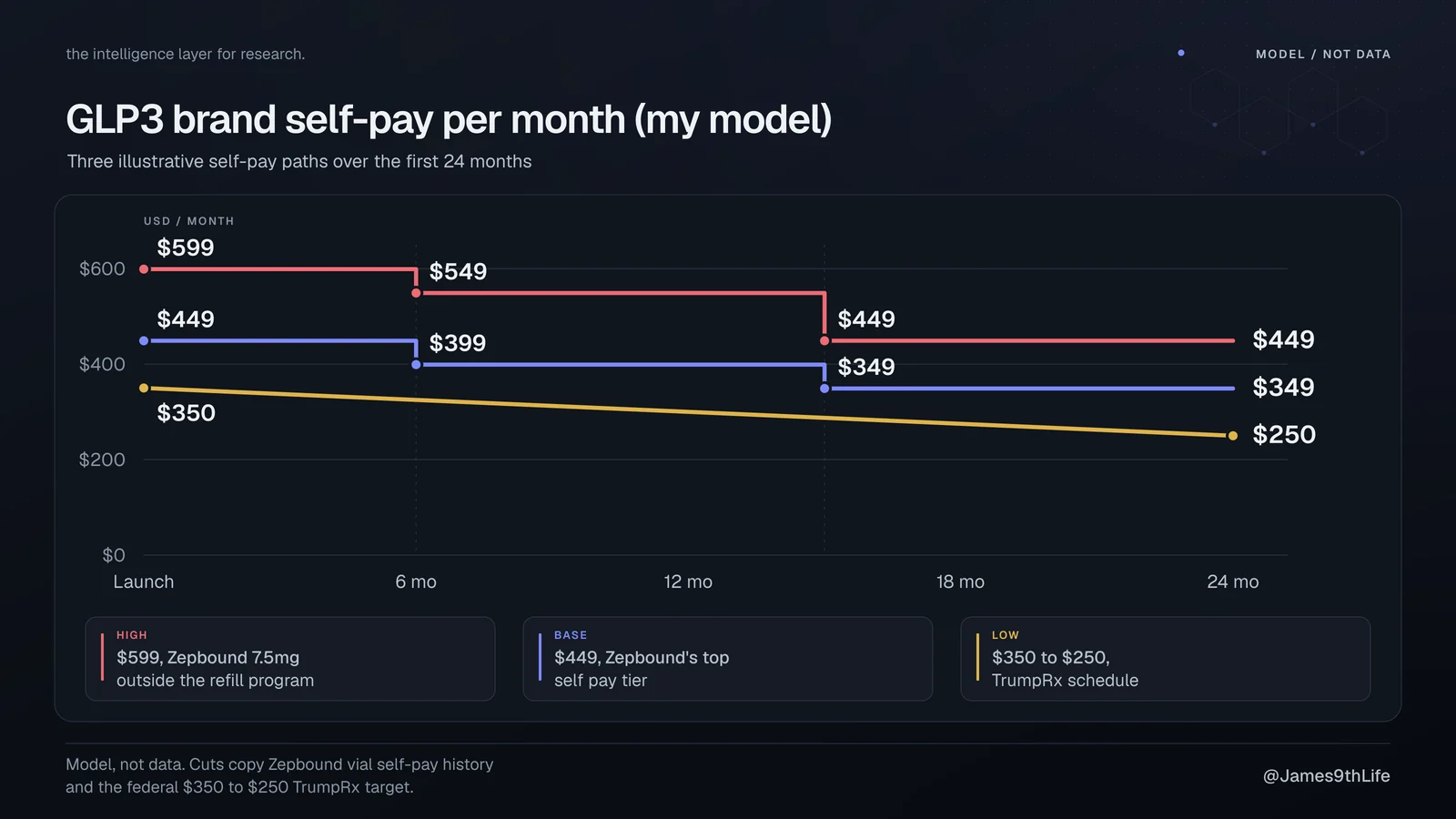
Step 3: Run High and Base through those Zepbound cuts and round to Lilly's usual $49/$99 price points. They hold flat after month 15 since that's as far as the Zepbound history goes. Low just follows the TrumpRx schedule:
- High: $599 at launch, $549 at month 6, $449 by month 15
- Base: $449 at launch, $399 at month 6, $349 by month 15
- Low: $350 at launch, $250 by month 24
Step 4: Convert to per mg so it lines up with everything above. TRIUMPH-1's top dose was 12mg weekly [33], so a month (4 weekly doses) of brand GLP3 is 48mg:
- High at launch: $599 ÷ 48 = $12.48/mg
- Base at launch: $449 ÷ 48 = $9.35/mg
- Base at month 15: $349 ÷ 48 = $7.27/mg
- Low at month 24: $250 ÷ 48 = $5.21/mg
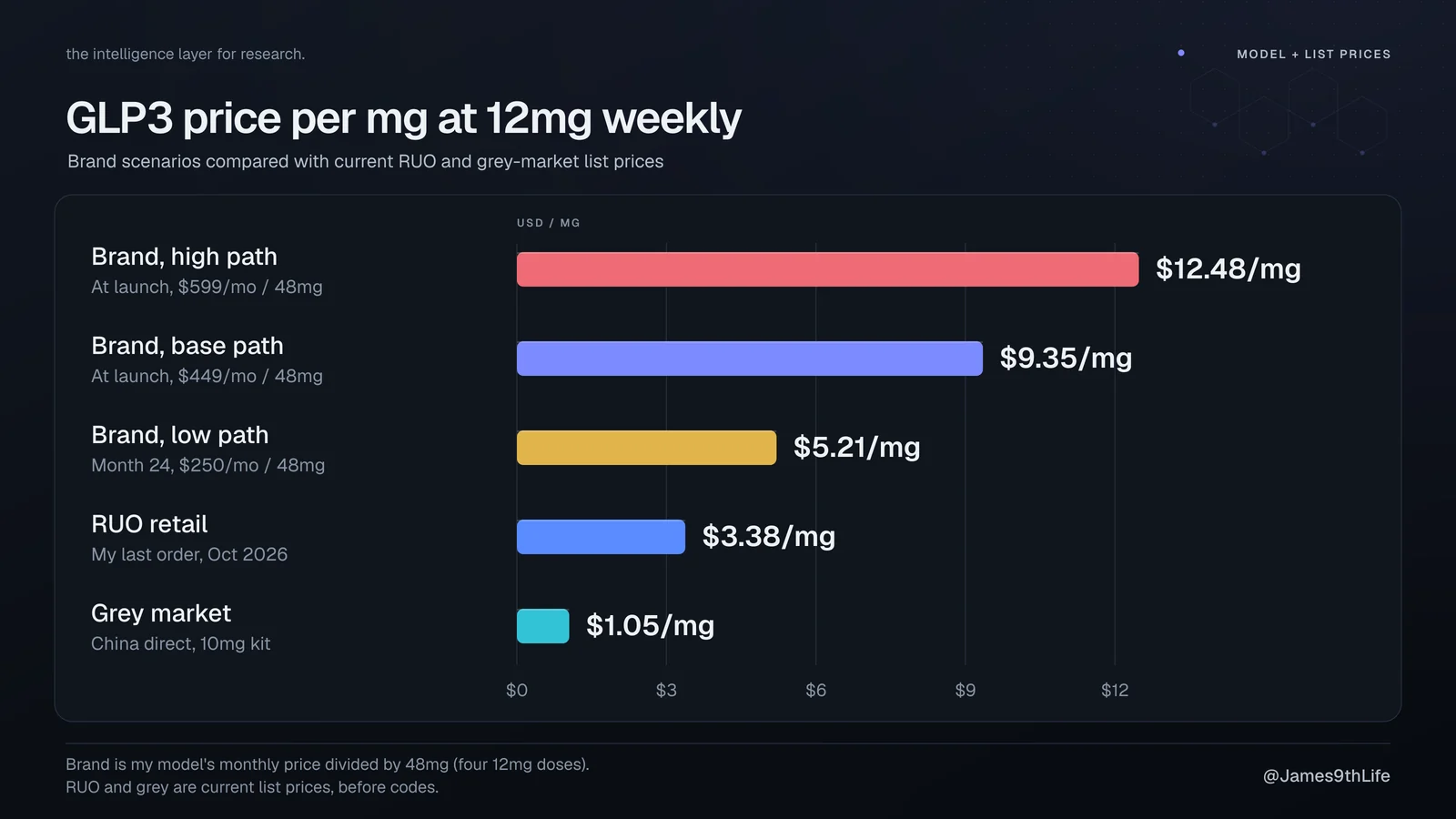
Hold that against what people are actually paying. RUO GLP3 at my last order is $3.38/mg [1] and grey is $1.05/mg [3]. Even the low path lands at about 1.5x RUO. For brand to match my last RUO price at 12mg weekly, Lilly would have to charge about $162 a month. To match grey, about $50.
And 12mg is the best case for brand per mg. Lower doses cost more per mg, same as Zepbound today ($29.90/mg at 2.5mg vs $7.48/mg at 15mg) [29].
Tirz shows where this ends up. Zepbound at 15mg ($7.48/mg) is already cheaper than the priciest RUO tirz I'm seeing right now ($8.90/mg), while the low end of RUO tirz is $1.18/mg [5]. Grey tirz runs about $0.35 to $0.60/mg [3].
Where RUO goes from here
Peptides on the RUO side are commoditized at this point. Razor thin margins, and every RUO is copy and paste when it comes to peptides. 54 of the 82 items on the China supplier's sheet show up on the US wholesaler's sheet at the exact same size [4].
And once someone figures out how to buy China direct and is willing to take that risk, the only reason to come back to RUO is something their supplier can't formulate or isn't formulating.
So RUOs are going to have to start innovating, and there are really two ways to win:
- Be the first vendor to carry a new compound, test it and get it to market
- Be the vendor actually making new, novel products and bringing them to market (blends, delivery mechanisms, small molecules and other research chemicals outside of peptides)
The compounded rules leave room for that. For the six peptides under the HHS policy it's one peptide per vial and a syringe only, no pens [18], so blends and pens on those stay RUO territory.
Being first still gets paid. UBT-251, a newer triple agonist, went up on a waitlist at $99.99 for 10mg ($10/mg) [5]. About 3x what GLP3 goes for now, and close to where GLP3 was in Dec 2025 ($11.58/mg).
Imitating only works for so long though. One of the China sheets already has KLOW, GLOW, a reta/tirz blend and SLU-PP-332 capsules on it [4], so whatever's new gets copied fast. Once product lists look the same vendor to vendor, you're back to competing on price.
My take
Yes prices for peptides are going to be "higher" than compared to RUO/grey on the compound/clinic side but people will pay for peace of mind and doctor oversight.
Many people, especially older generations, will never inject anything unless it is coming from their GP's doc recommendation, this is how most people operate.
The total addressable market for peptides is much larger than the RUO/grey market could ever capture. Lilly did $14.9B on Mounjaro + Zepbound in ONE quarter (Q2 2026) [25]. Clarivate has GLP3 alone doing $30B in 2031 [27]. And we are just talking about the GLP1 class.
Every new market starts the same way. A few sellers, not much info, high prices, and the early buyers pay for it (along with my Nov 2025 wallet... $236 for one 16mg vial... after the Black Friday code... rip).
Will RUO go away? idk
But what I will say is from a pricing perspective look at these historical trends, consider the regulatory context that is happening right now, and think logically which will be a bigger market.
Full disclosure, I co-founded @reptidesco. Reptides doesn't take peptide vendor money, and every vendor, wholesaler and clinic in here is unnamed on purpose.
Sources
- My order confirmations and receipts, Apr 2025 to Oct 2026, plus current prices from the same sellers (on file)
- Public peptide price tracker, retatrutide vial listings, checked Oct 27 2026
- China supplier price sheets, newsletters and board posts, Jul to Oct 2026 (on file, suppliers unnamed)
- Bulk price sheets from a China supplier with US warehouse stock and a US RUO wholesaler (on file, unnamed)
- RUO vendor promo emails, newsletters and price boards, Jul to Oct 2026 (on file, vendors unnamed)
- Public reporting on the Mar 2026 closure of the largest US RUO vendor (vendor unnamed on purpose)
- Healio, Aug 14 2026: Eli Lilly files lawsuits against six companies for allegedly selling retatrutide healio.com
- Eli Lilly, Aug 12 2026: Lilly calls on online platforms, payment companies and regulators to shut down the illegal retatrutide black market investor.lilly.com
- Sheppard Mullin, Sep 18 2026: FDA balances peptide policy with enforcement against unlawful peptide sellers sheppard.com
- Clinic and telehealth promo emails, Feb 2025 to Oct 2026 (on file, unnamed)
- Drug Topics, Jun 10 2026: CBS News investigation into providers prescribing unapproved retatrutide drugtopics.com
- Public "made in the USA" wholesale price list, Oct 2026 (vendor unnamed)
- FDA: FDA's concerns with unapproved GLP-1 drugs used for weight loss (content current as of Oct 1 2026) fda.gov
- FDA letter to the Federation of State Medical Boards on compounded retatrutide, Apr 2025, posted by Arizona's osteopathic board azdo.gov
- LegitScript: Healthcare Certification fact sheet for telemedicine legitscript.com
- Foley & Lardner, Aug 2021: New Facebook policy requires certification and pre-approval for telemedicine company ads foley.com
- Athletech News, Sep 9 2026: a peptide platform that prescribes through licensed clinicians and compounds through pharmacies in its network raises $20M from VC firms (company unnamed here) athletechnews.com
- HHS: 503A peptide enforcement discretion policy hhs.gov
- Reuters via WIKY, Oct 28 2026: US health department to allow temporary sale of some unapproved peptides wiky.com
- The Peptide Catalog, Jul 13 2026: FDA's second PCAC panel on GHK-Cu, Melanotan II, Dihexa, LL-37 and PEG-MGF thepeptidecatalog.com
- FDA guidance: Compounded drug products that are essentially copies of a commercially available drug product under section 503A fda.gov
- Buchanan Ingersoll & Rooney: FDA voted yes on six peptides, now what bipc.com
- Reuters factbox via AOL, Apr 1 2026: Pricing and availability of Novo and Lilly's weight-loss drugs aol.com
- AJMC, Nov 6 2025: Trump announces deals with Eli Lilly and Novo Nordisk for lower weight-loss drug prices ajmc.com
- Eli Lilly Q2 2026 results, SEC Form 8-K sec.gov
- Kalshi: FDA approval of retatrutide market kalshi.com
- PharmExec, Jan 8 2026: Clarivate's drugs to watch, retatrutide forecast pharmexec.com
- Retatrutide.med: What will retatrutide cost? (independent pricing roundup) retatrutide.med
- Eli Lilly, Dec 1 2025: Zepbound single-dose vial price cut on LillyDirect investor.lilly.com
- NBC Chicago, Nov 2025: TrumpRx pricing for Wegovy and Zepbound nbcchicago.com
- Eli Lilly, Aug 27 2024: Lilly releases Zepbound single-dose vials investor.lilly.com
- Eli Lilly, Feb 25 2025: Lilly launches additional Zepbound vial doses and new savings for self pay patients investor.lilly.com
- AJMC, May 21 2026: Retatrutide achieves up to 30.3% average weight loss in Phase 3 TRIUMPH-1 ajmc.com
(I am not endorsing any use of research peptides, nor giving medical or financial advice. This is simply my n=1 research and price tracking, for educational and research purposes only. RUO peptides are sold for research use only, not for human use, and GLP3 (retatrutide) is not FDA approved. Prices come from my own orders, vendor emails and price sheets, they move fast and vary a lot by vendor. Talk to a licensed medical provider before starting anything.)