A vial, some bac water, and a lot of forum myths. No hype and no fear-mongering, just what a peptide actually is, how it is stored, how it is mixed, the math that only has to be done once, and the myths that make people throw away perfectly good product. Every factual claim here is sourced at the bottom.
start with the basics
A peptide is a signal, not a steroid.
A peptide is a short chain of amino acids. The body already makes thousands of them, and they work as messengers, each one telling a specific cell to do a specific job: release a hormone, repair tissue, calm inflammation, regulate appetite. The peptides people talk about online are engineered versions of those natural signals, usually tweaked to last longer in the body before they break down.
Here is the number one thing people get wrong: peptides are not steroids. Anabolic steroids are synthetic testosterone. They bind androgen receptors and force muscle growth directly. Peptides do not do that. Most of them nudge a system the body already runs, asking it to release more of its own growth hormone, or to send more repair signals to an injury. Different molecules, different mechanisms, different risk profiles. Lumping them together is where most of the confusion in this space starts.
This is also why peptides won't "get you jacked" the way the marketing implies. Steroids build muscle by brute force: flood the androgen receptors and tissue grows whether the rest of the body likes it or not. No peptide works like that. The closest is the family that acts on the growth-hormone (GH) axis. Secretagogues like CJC-1295, ipamorelin, sermorelin, and tesamorelin prompt the pituitary to release more of the body's own growth hormone, which raises IGF-1. That is studied for fat loss, where tesamorelin is FDA-approved for HIV-associated fat, with recovery, sleep, and body-composition effects that practitioners cite on thinner data. It is a nudge to a system the body already runs, nothing like a steroid cycle. Anyone promising steroid-style results from a peptide is selling the wrong expectation.
you already know two peptides: insulin and HGH
The word "peptide" sounds like fringe biohacking until you realize two of the most established drugs in all of medicine are peptides.
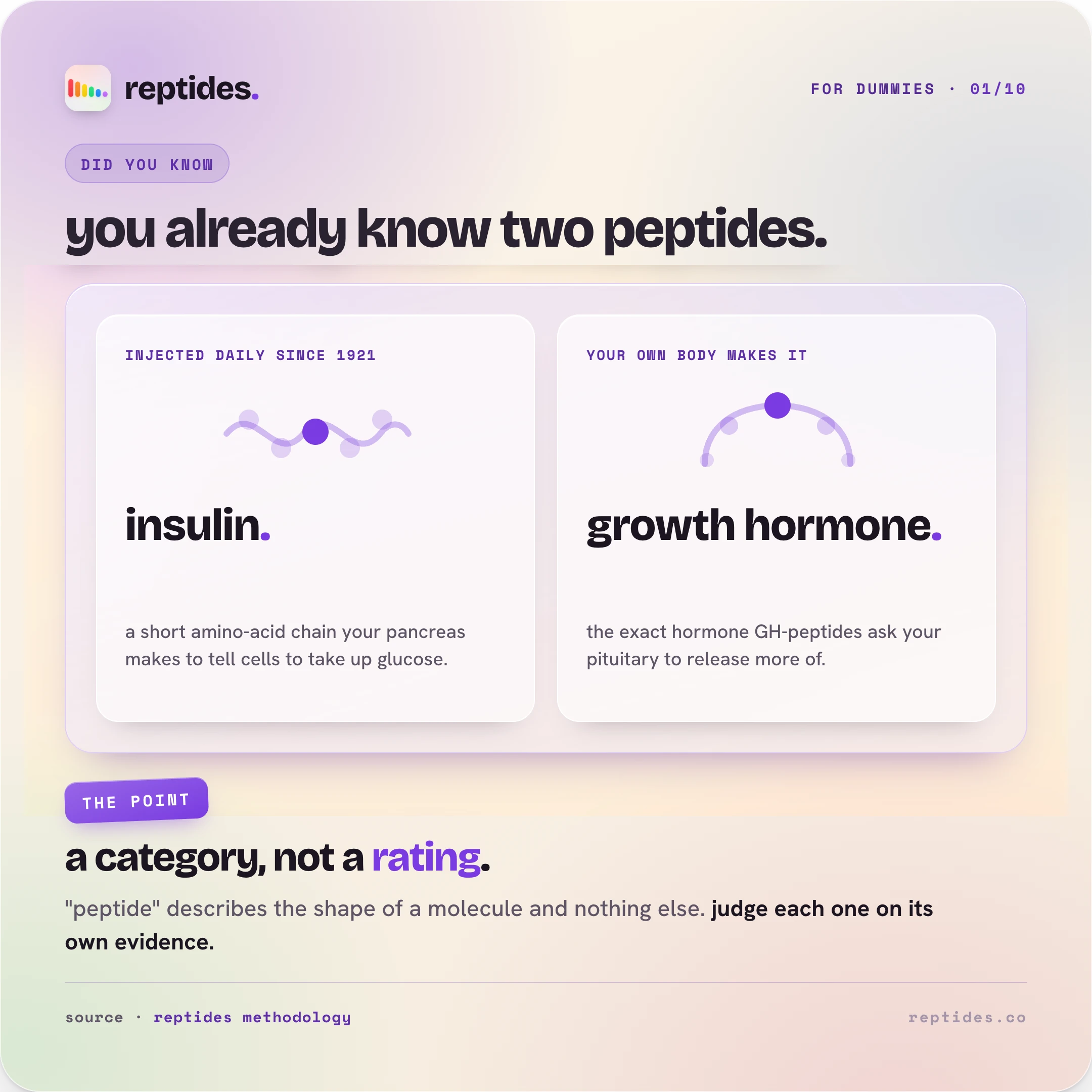
Insulin is a peptide. It is a small chain of amino acids the pancreas releases to tell cells to take up glucose. Frederick Banting and Charles Best first isolated it at the University of Toronto in 1921, and within a couple of years it was in mass production . Millions of people inject it every day. It has been doing the exact thing every peptide does, carrying a specific signal to specific cells, for over a century.
Human growth hormone is a peptide too. A longer one, but the same category. It is the actual hormone that the GH-releasing peptides (CJC-1295, ipamorelin, sermorelin, tesamorelin) ask the pituitary to produce more of. That distinction matters. Injecting HGH directly is a different decision, with a different risk profile, than nudging a gland to release a bit more of its own.
The point is not that peptides are automatically safe. It is that "peptide" is a chemical category, not a safety rating. It tells you the shape of the molecule and nothing else. Insulin is a peptide and a serious drug. An experimental research compound is also a peptide. The word they share says nothing about whether either one belongs in a body. Judge each molecule on its own evidence.
the misconceptions worth killing
Most of the fear in this space comes from forum myths that get repeated until they sound like facts, then scraped back out by chatbots. Here are the ones that waste the most product and cause the most needless panic.
"They're basically steroids." Covered above, but it bears repeating, because it is the root of most bad takes. These are signaling molecules working through receptors the body already uses.
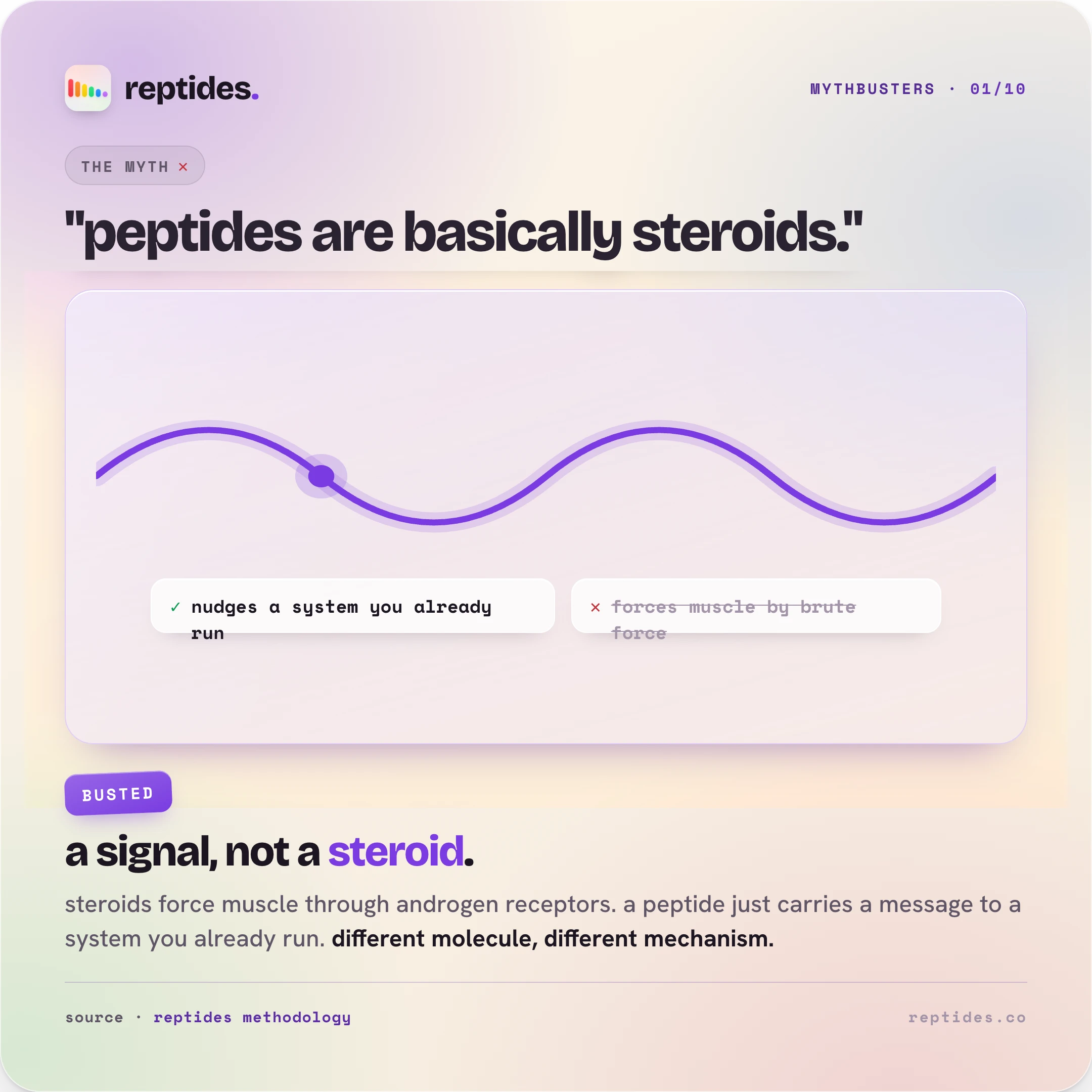
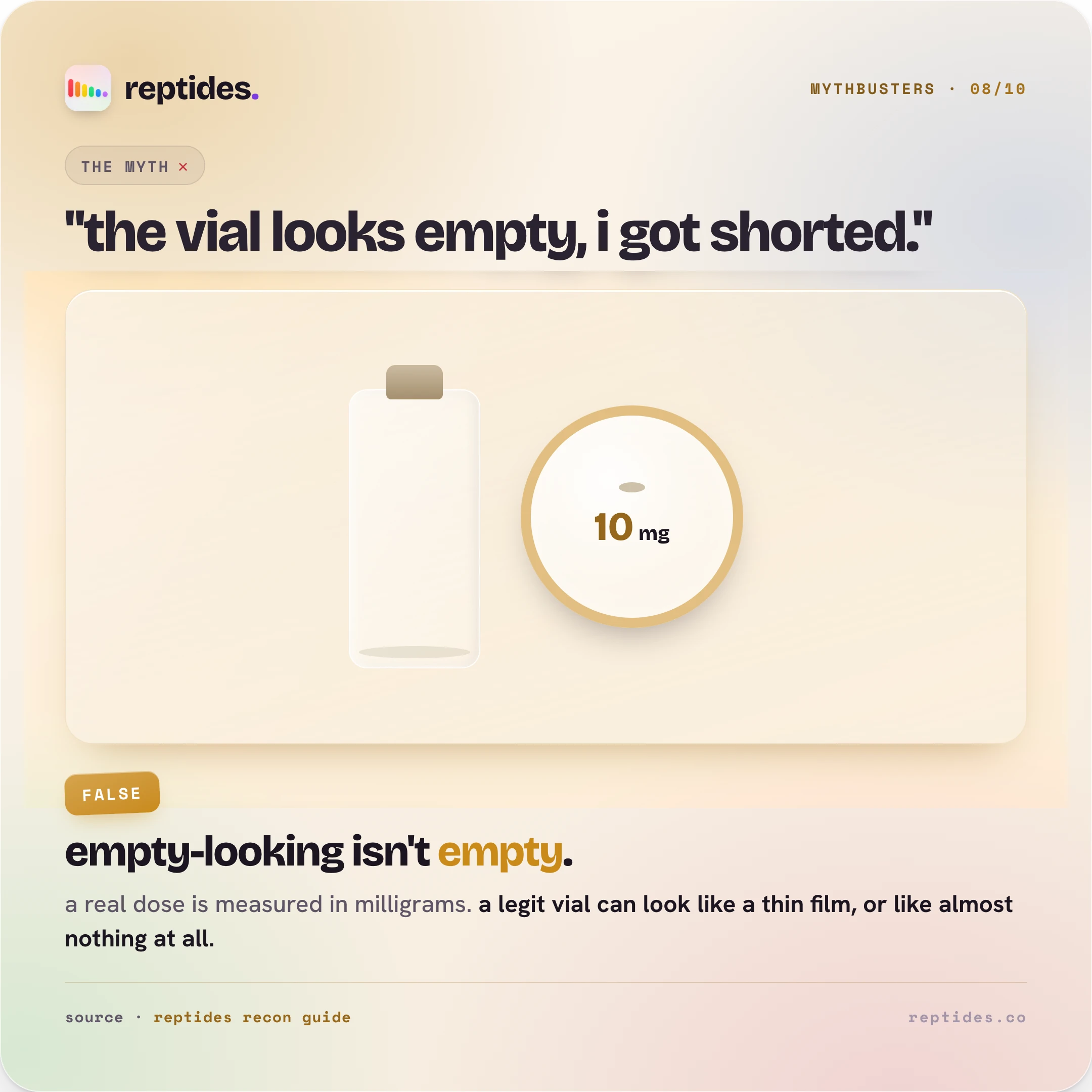
"My powder is clumped, so it's ruined." No. Freeze-dried (lyophilized) peptide can show up as a solid disc, a thin film on the glass, a loose cake, scattered flakes, or a layer so light the vial looks empty. All of that is normal. The drying process isn't standardized across vendors, so the shape the powder lands in tells you nothing about quality. A clump is not degradation.
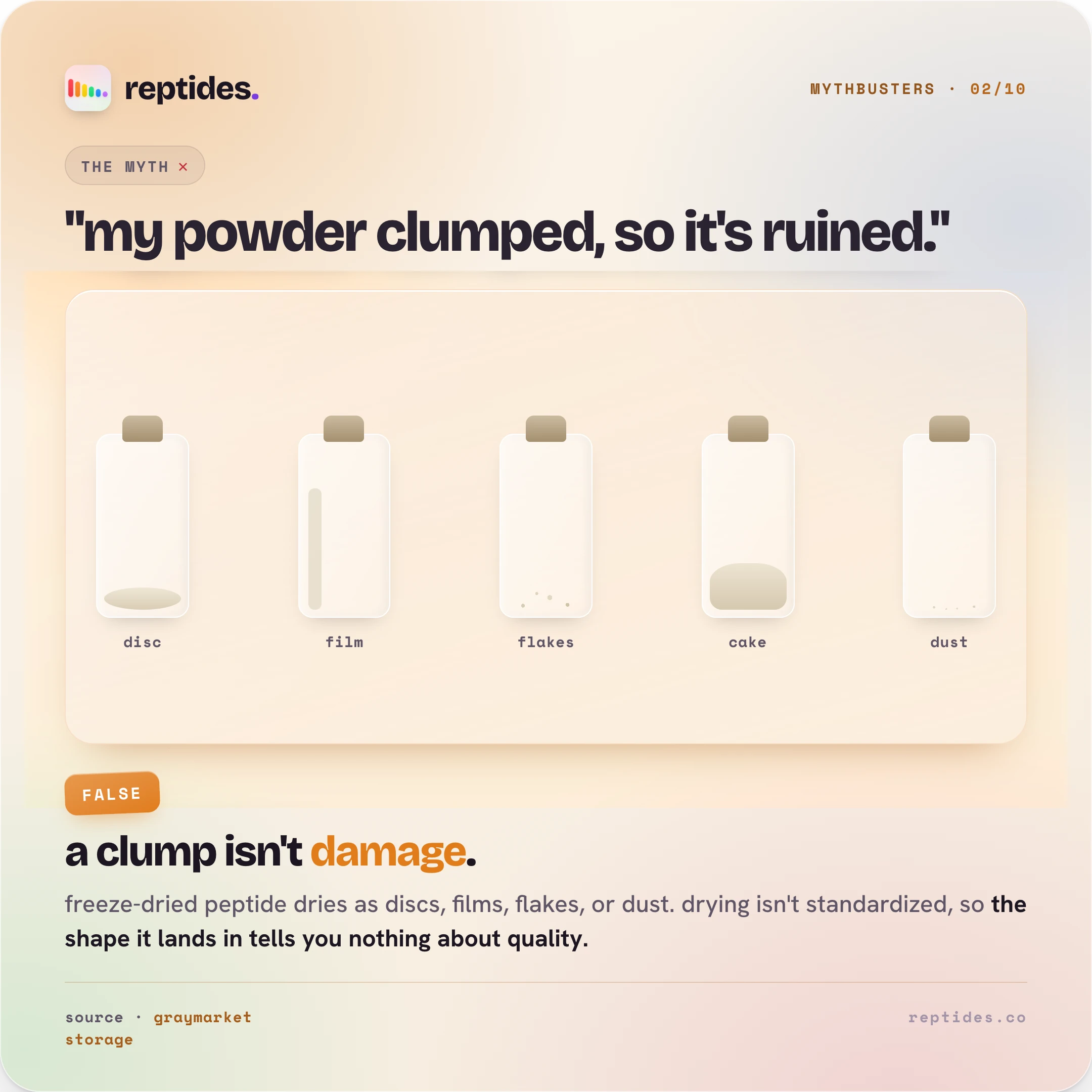
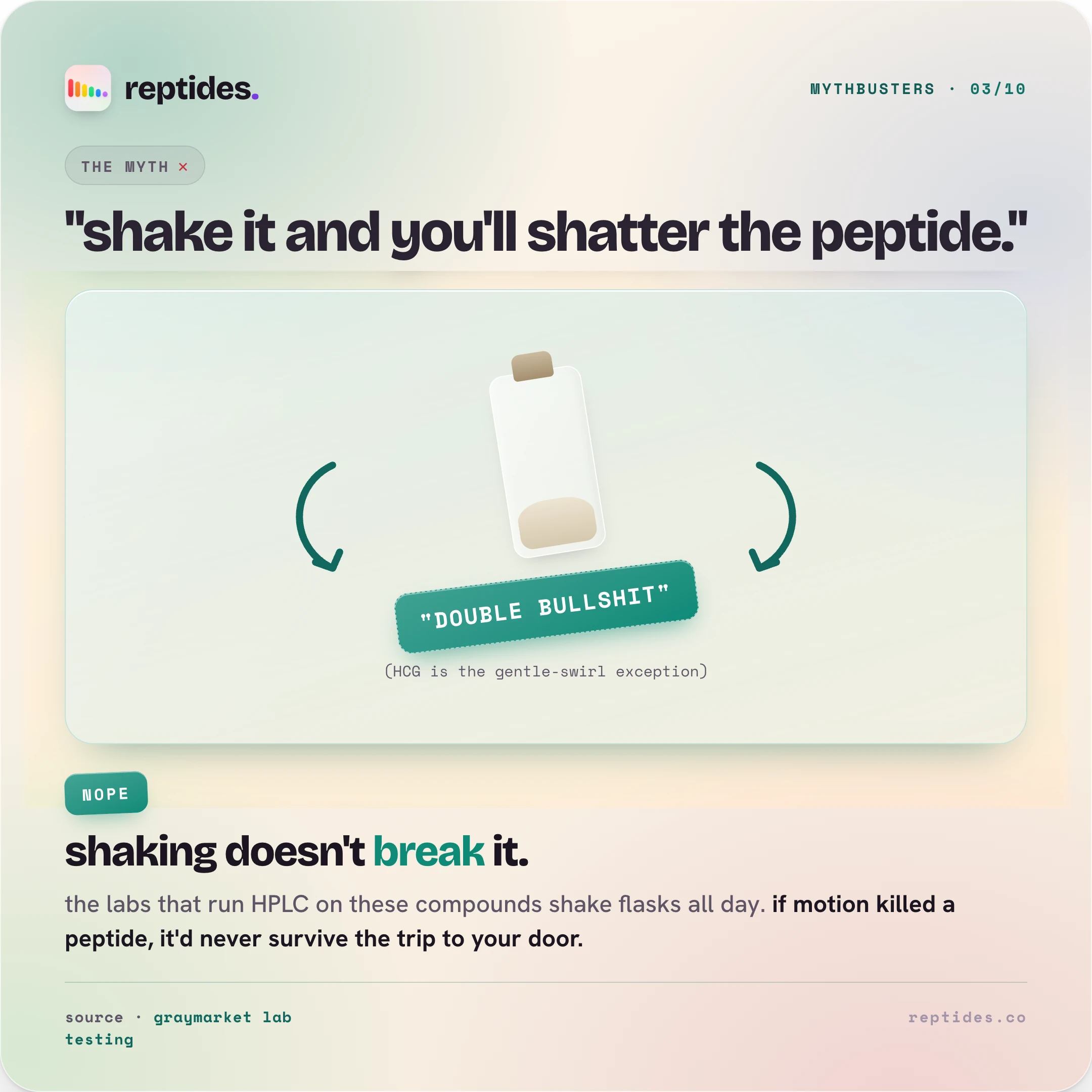
"Never shake the vial or you'll shatter the peptide." This one refuses to die, and it is wrong. The people who run HPLC and mass spec on these compounds shake flasks vigorously as routine lab work. One tester quoted in the Graymarket storage writeup called the anti-shaking myth "double bullshit" . These chains survive shipping, sloshing, and lab handling. Swirling a vial to dissolve powder does not break them. If a molecule fell apart from motion, it would never survive the trip to the door. The one sensible exception: a few larger glycoprotein hormones, HCG being the common one, are genuinely more delicate, so a gentle swirl rather than hard shaking is the smart default there.
"If it hit room temperature in the mailbox, it's dead." A properly dried lyophilized vial is extremely stable. It does not spoil because a delivery truck was warm for a day. A lab tester quoted in that same piece described HGH samples left in an unconditioned garage for more than a decade that had "degraded only slightly" . The cold-chain anxiety online is mostly recycled caution with no lab data behind it. More on this in the storage section.
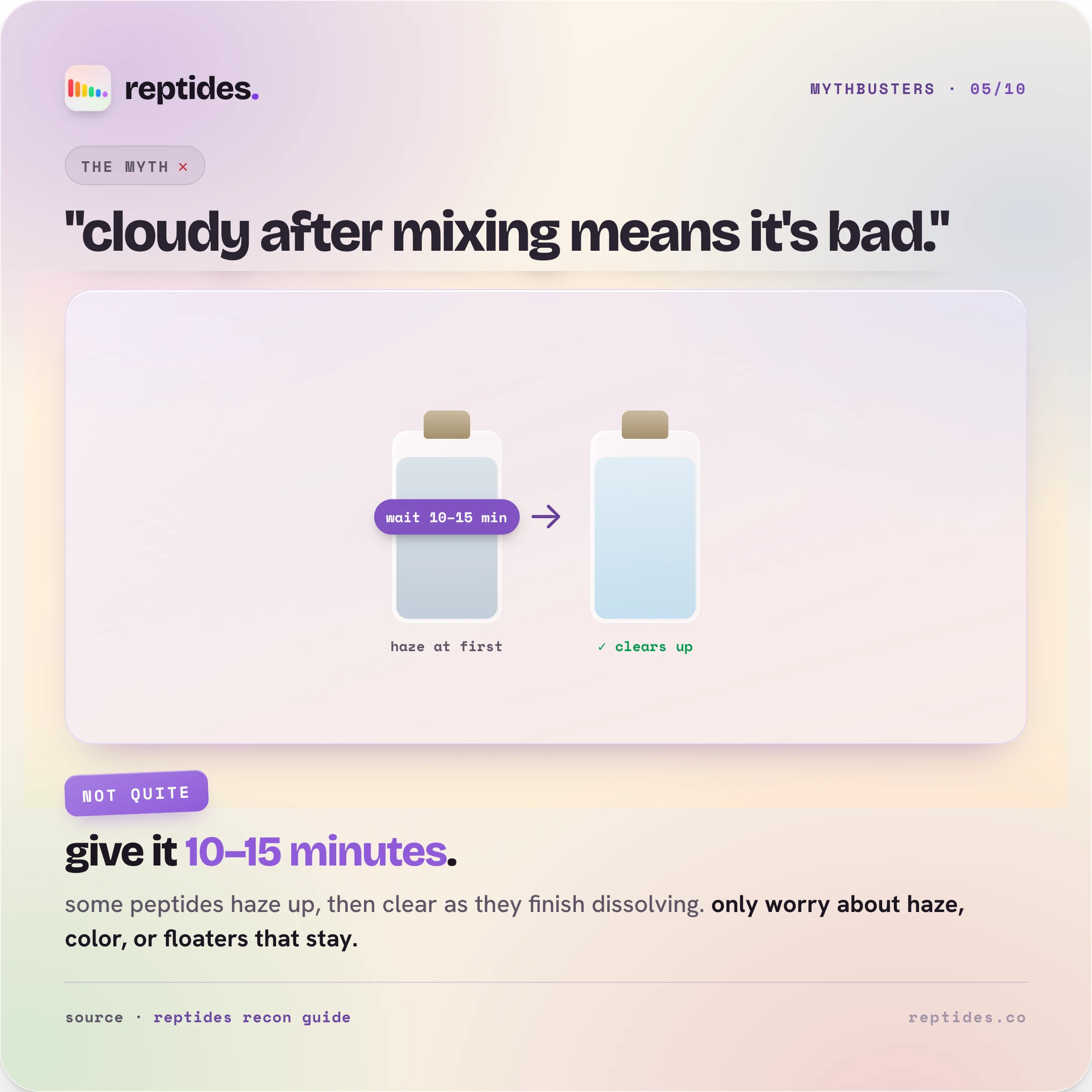
"Cloudy after mixing means it's bad." Not necessarily. Some peptides go slightly hazy or throw a few fine particles right after water goes in, then clear as they finish dissolving. Give it ten to fifteen minutes. What actually warrants a pause is a solution that stays visibly cloudy, discolored, or full of persistent floaters long after mixing. A faint haze that resolves on its own is not that.
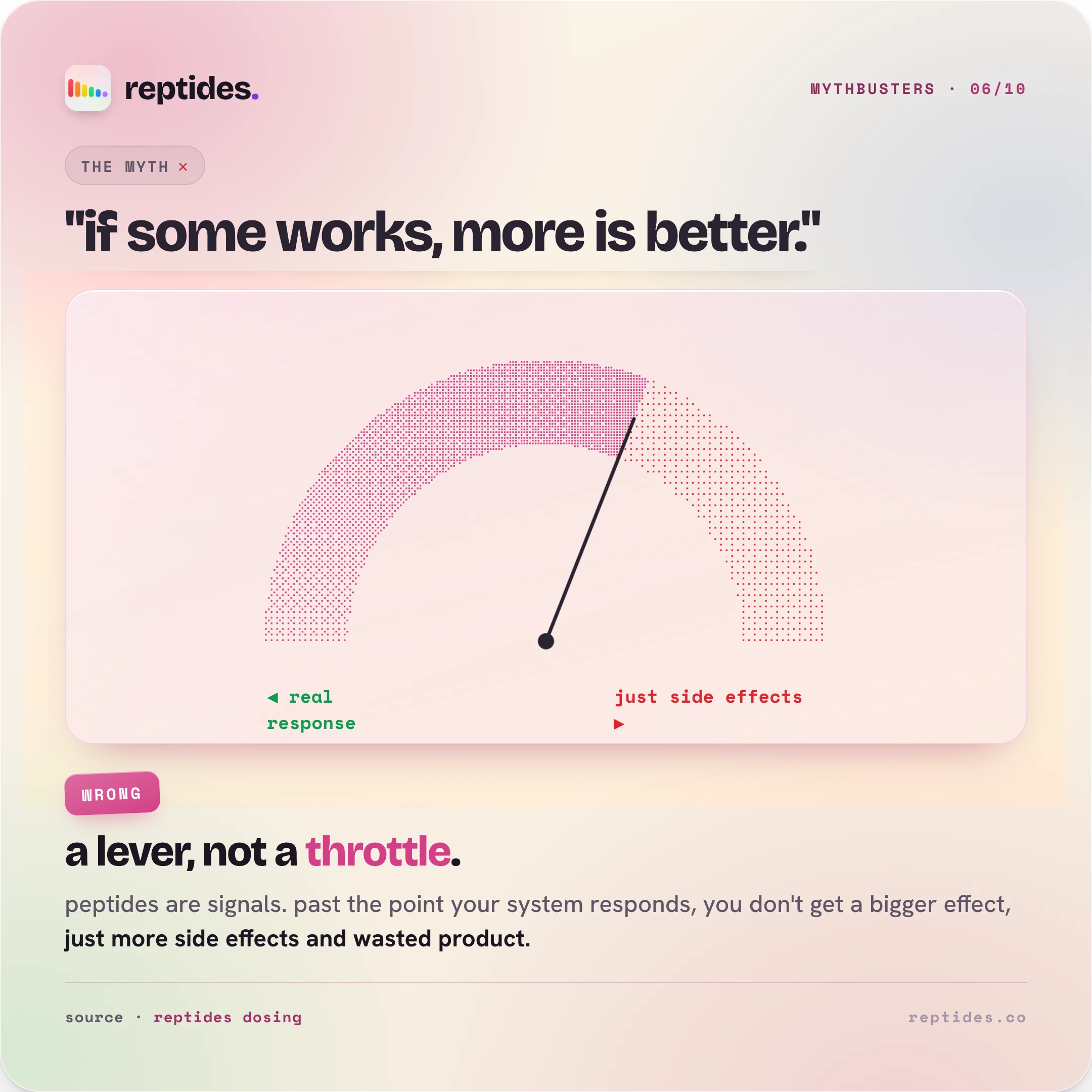
"More is better." Peptides are signaling molecules. The point is to ask a system to respond. Past a certain point, flooding it produces no bigger effect, only higher odds of side effects and wasted product. Dose is a lever, not a throttle.
what to look for in a COA
The COA is the receipt that proves what's actually in the vial.
A Certificate of Analysis is a lab report on one specific batch of peptide. It is the single most important document in this hobby, and most people either ignore it or don't know how to read it. Reptides has a fuller walkthrough written for people without a chemistry background . Two tests carry the weight.

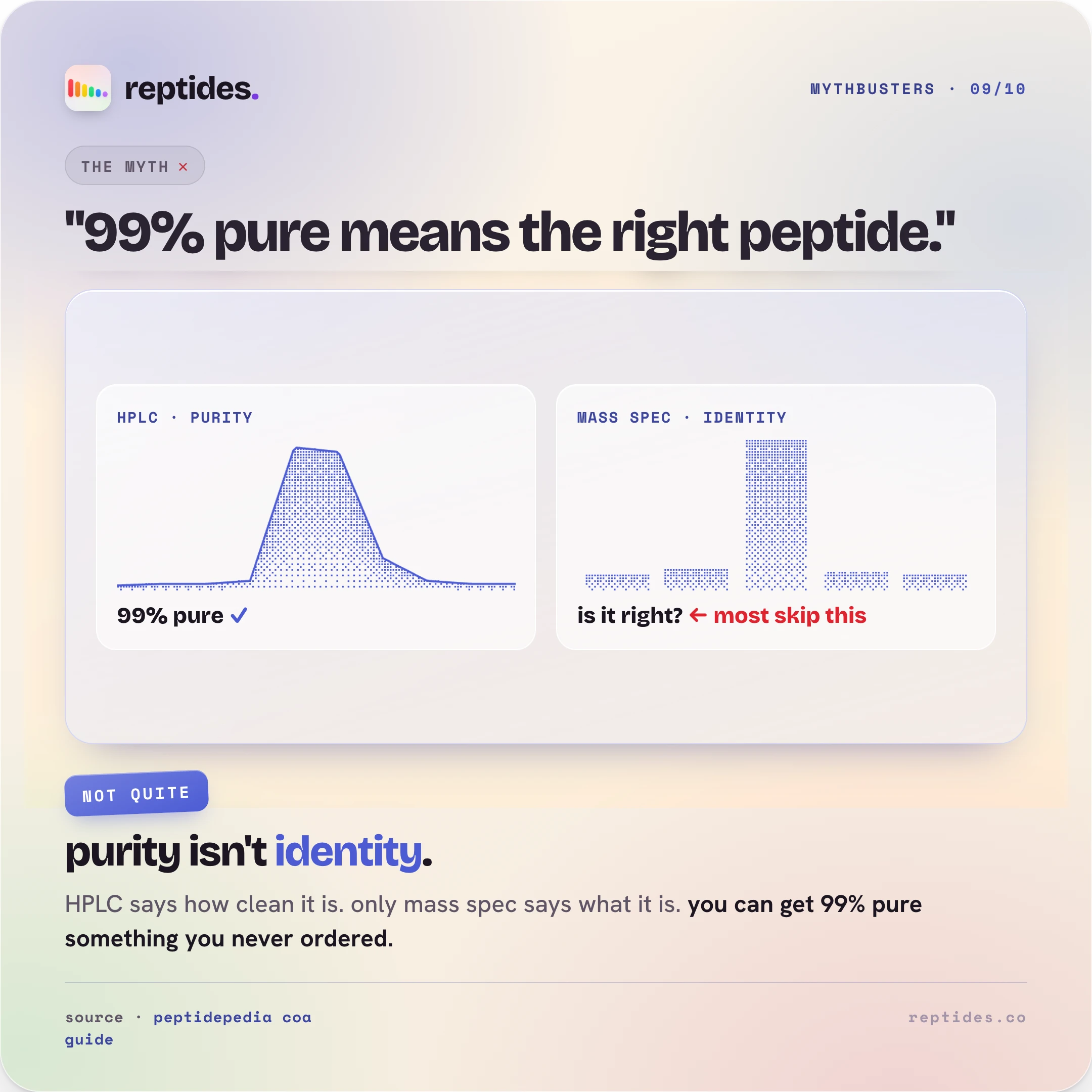
Purity (HPLC). High-performance liquid chromatography separates everything in the sample and reports what percentage is the target peptide versus impurities. It reads in the far UV, around 214 to 220 nanometers, because that is where the peptide bond itself absorbs , which is what makes the detection work on any peptide rather than only the ones with convenient amino acids. USP's own published method for leuprolide monitors at 220 . Now the part nobody says out loud: no standards body sets a purity floor for "research-grade," because research-grade is not a regulatory category. The 98 percent figure quoted all over this hobby is a commercial convention, and the only places that state it are the people selling the powder. Treat a high number as necessary rather than sufficient. Purity tells you how clean the sample is. It says nothing about what the sample actually is.
Identity (mass spec). Mass spectrometry measures the molecular weight and confirms the compound is the peptide it claims to be. The measured mass has to line up with the expected mass for that exact sequence, and a good lab will also fragment it to verify the sequence rather than just the weight. USP's worked example is the shape of it: leuprolide's theoretical mass is 1209.6533 and the measured value came back 1209.6515 . That is what flags a wrong or truncated peptide. This is the check people skip, and it is the one that catches a vial that is 99 percent pure something nobody ordered. Purity without an identity confirmation is close to meaningless.
Beyond those two tests, run down this list:
- Lot / batch number matches the vial. A COA describes one specific batch. If the lot on the paper doesn't match the lot on the vial, that COA doesn't describe that product. This is the most common sleight of hand: a real COA, for a different batch.
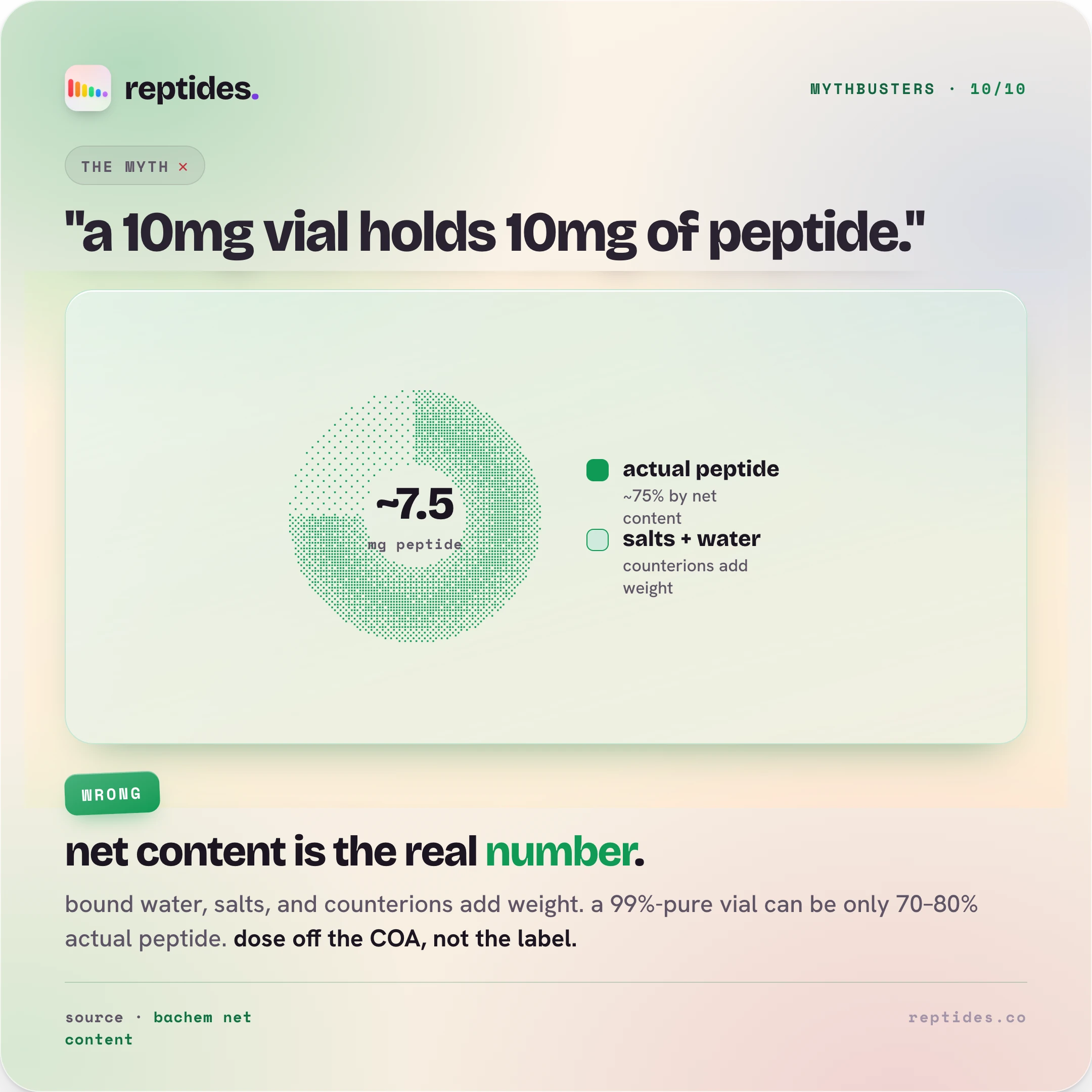
- Net peptide content. A vial labeled "10mg" is not always 10mg of peptide. Peptides ship with bound water, salts, and counterions that add weight. The two numbers measure genuinely different things: HPLC purity is a percentage of what shows up in the detector, while net content is a weight-for-weight fraction of the actual powder, so a sample can be highly pure and still be meaningfully less peptide than the label says . This is not a gray-market quirk. USP shifted many of its own peptide reference standards to lyophilized form specifically so that users would stop having to work out counterions and residual moisture themselves . The concentration math depends on that net number. The label figure overstates what is actually there.
- Third-party lab, not in-house. An independent lab has no reason to flatter the product. In-house numbers can be legitimate, but a recognized third-party report carries more weight.
- A recent date. A test from two years ago on a batch just bought doesn't tell you much.
Red flags: purity with no mass spec, a lot number that doesn't match the vial, a bare screenshot with no lab letterhead or method listed, or a vendor who can't produce a COA at all. Any one of those is a reason to slow down.
Before the COA even matters, it helps to know whether a compound is worth the trouble. [Reptides](/) is an independent research-peptide wiki that grades 60 compounds S through F on the strength of the actual evidence, with a citation behind every claim and an assistant that answers only from that cited corpus. It takes no vendor money and runs no affiliate links, which is most of why the grades are worth reading. It will tell you whether the thing in the vial has real data behind it or just forum hype. Read the evidence first, then read the COA.
how to store peptides
Lyophilized powder is far tougher than the internet claims. Reconstituted liquid is where the clock actually starts.
powder (lyophilized)
Freeze-dried peptide is remarkably stable. The lab testers who handle these compounds daily are blunt about it: an undissolved lyophilized vial lasts a long time even in less-than-ideal conditions. Rough, realistic timelines for mainstream lyophilized peptides :
- Room temperature (~20 to 25°C): months to years
- Refrigerator (2 to 8°C): 5+ years
- Standard freezer (-15 to -25°C): decades
- Ultra-low freezer (-40°C and below): effectively indefinite
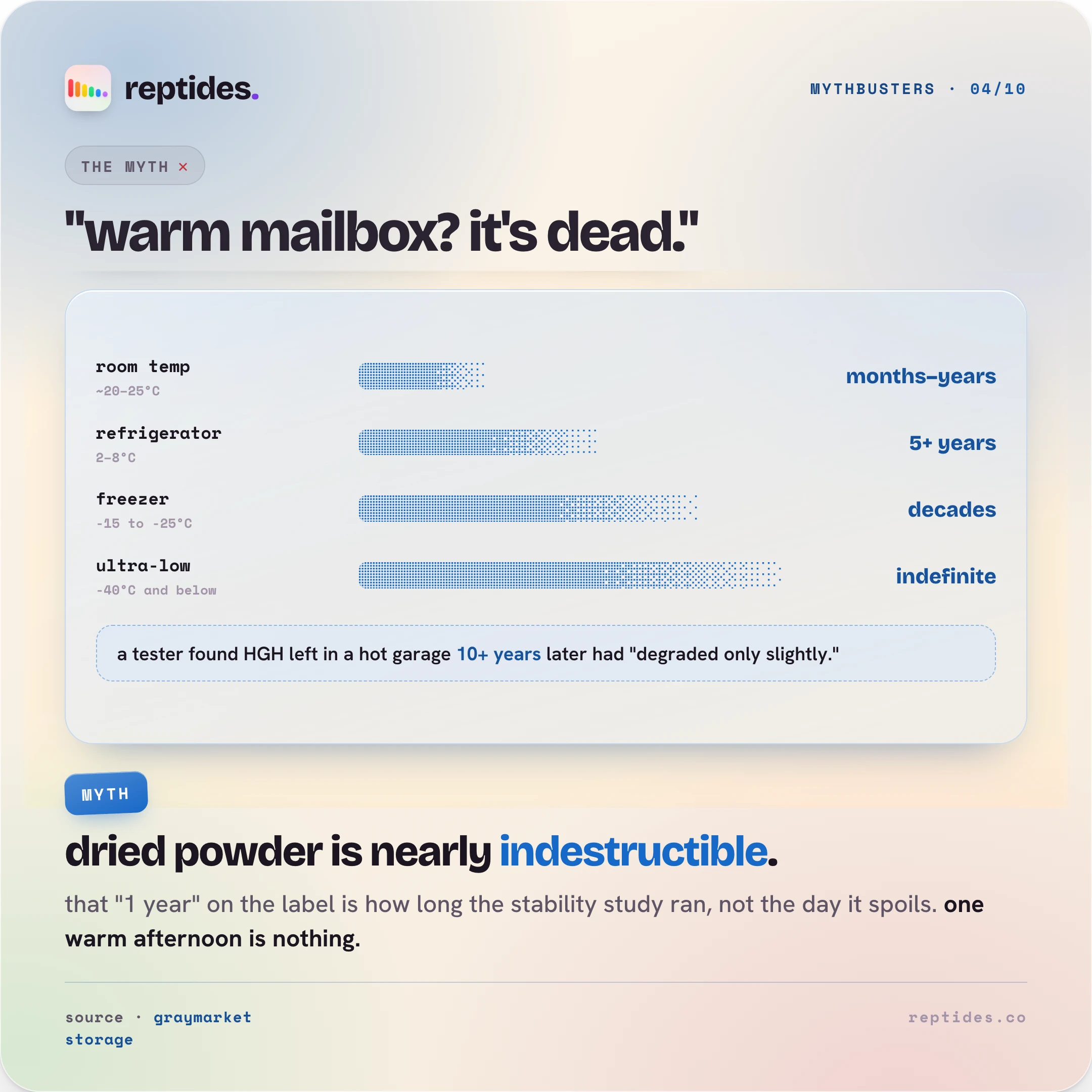
That "1 year" shelf life printed on the label is not the day it spoils. It usually just reflects how long the stability study ran. Nobody pays for a ten-year study to print a ten-year number .
Practical version: the fridge is plenty for almost everyone. Freezer for a long-held stash. A hot mailbox for a few hours does not ruin lyophilized powder.
Two honest caveats. Repeated temperature swings do more damage than any single warm afternoon, so pick a spot and leave it there. And a handful of peptides are genuinely more fragile than the mainstream ones, so treat this as a general rule with exceptions.
reconstituted (mixed with liquid)
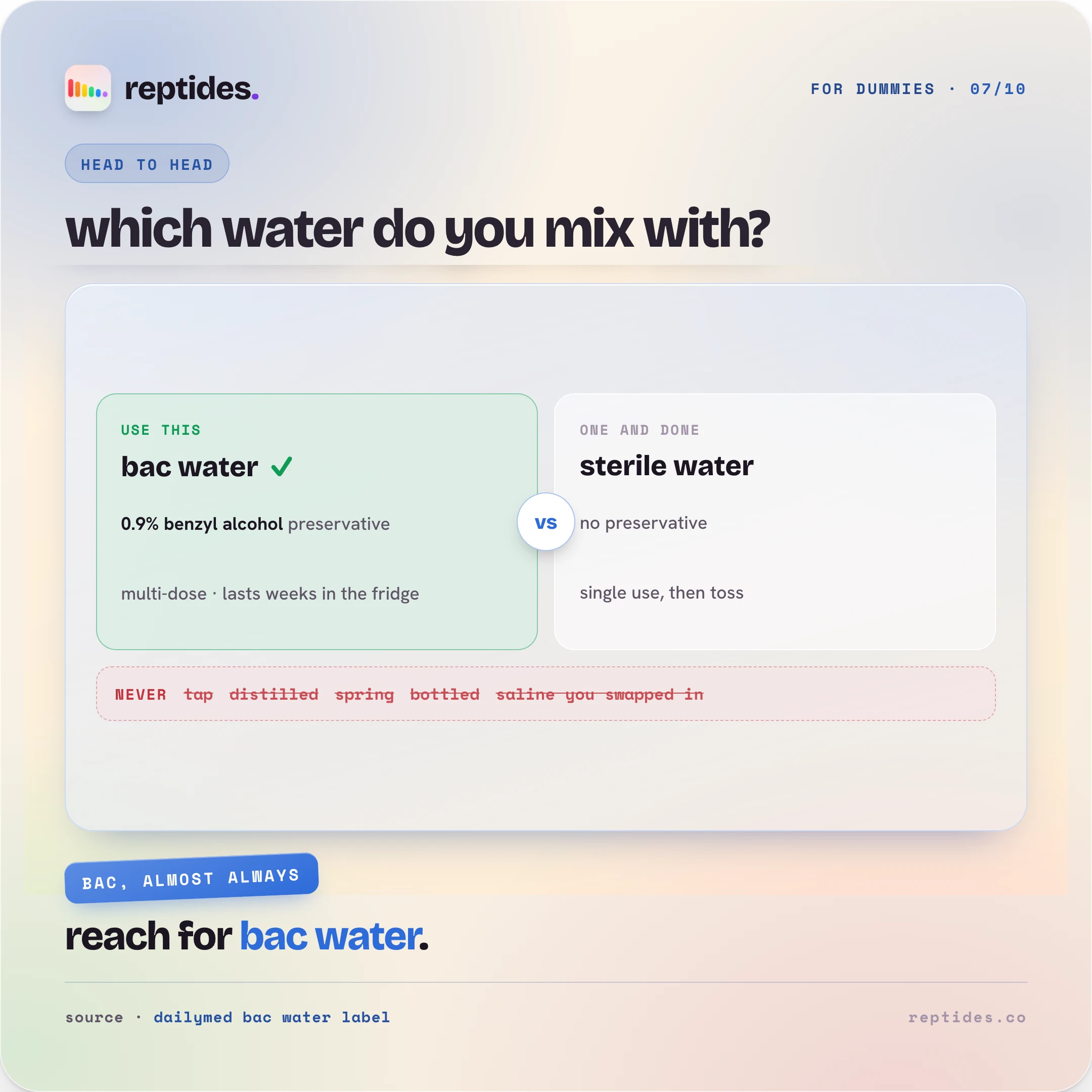
Once water goes in, the clock starts. Reconstituted vials keep in the refrigerator, out of direct light, and are used within a few weeks. The exact window depends on the peptide and the water. Bacteriostatic water contains benzyl alcohol, a preservative that suppresses bacterial growth and stretches usable life well past what plain sterile water gives .
One rule with no asterisk: a reconstituted vial does not go in the freezer. Freezing and thawing a mixed solution can stress the peptide, and there's no upside. Keep it cold in the fridge between uses.
how reconstitution works
Reconstitution is three things: the right amount of water, the math off the COA, and a record of both.
This is the step that intimidates newcomers, and it really shouldn't. Here is the clean version.
the materials
Reconstitution uses a short list of materials:
- A lyophilized peptide vial
- Bacteriostatic water (the version with benzyl alcohol, for longer shelf life)
- An insulin syringe for measured volumes, plus a larger syringe and needle some prefer for mixing
- Alcohol prep pads
a word on water
The right water is bacteriostatic water: water with 0.9 percent benzyl alcohol added, which inhibits bacterial growth and lets a vial be drawn from for weeks instead of once . The Graymarket reconstitution guide specifically recommends a pharmacy-grade brand like Hospira/Pfizer . One heads-up for 2026: bacteriostatic water has been running short, so a usual brand may be out of stock. Reptides has a PSA on the shortage and how to handle it .
Plain sterile water technically works but has no preservative, so a mixed vial won't last as long. What never belongs near an injection is tap water, distilled water, "purified" water, spring water, or anything off a grocery shelf. Those aren't sterile, aren't preserved, and have no business there.
how the process goes
Described start to finish:
- Sterility first. Both rubber stoppers, on the peptide vial and the water vial, get wiped with a fresh alcohol pad and left to air dry. This is the step that actually matters for contamination.
- The math comes off the COA, not the label. The net peptide mass from the Certificate of Analysis is what the concentration depends on, and what keeps a dose from landing under or over .
- The water goes in. A properly sealed vial holds a slight vacuum and will often pull the water in on its own, so there is no need to trickle it down the glass. Spraying it straight onto the powder is fine, because these molecules are durable.
- It dissolves with a swirl or a gentle shake. Shaking does not hurt it, despite what the forums say . A little cloudiness or lumpiness at first is normal, and ten to fifteen minutes usually clears it.
- The sterility check. If a sealed vial has zero vacuum and doesn't draw at all, the seal is best treated as compromised and the vial set aside. That is the single moment in this process worth being cautious about .
- The record closes it out. Peptide name, date mixed, net mass from the COA, water volume, and what the syringe units convert to (for example, "5 units = 250mcg"). The journal in the Reptides app keeps that readout with the vial it belongs to . Six weeks later the numbers are still somewhere other than a marker scrawl that rubbed off inside the fridge. Future-you will thank present-you.

the concentration math, done once
Concentration is total peptide divided by water added.
10mg of peptide + 2mL of bacteriostatic water = 5mg/mL.
On a standard U-100 insulin syringe, 100 units equals 1mL, so each unit is 0.01mL. At 5mg/mL, one unit carries 0.05mg, which is 50mcg. So a 250mcg dose works out to 5 units on the barrel.
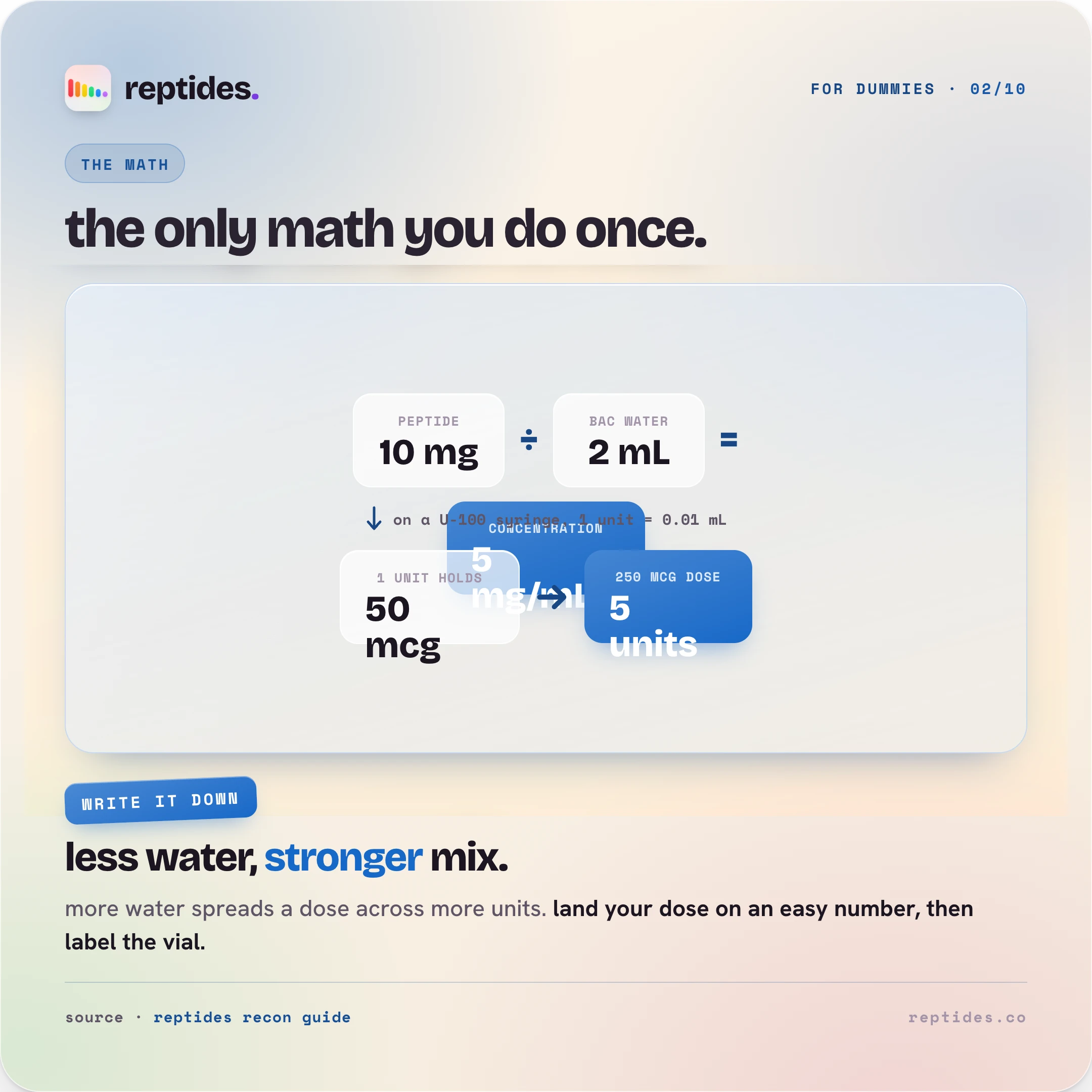
Change the water and the number of units per dose changes with it. The same 10mg peptide in only 1mL of water gives 10mg/mL, so one unit now carries 100mcg and that same 250mcg dose works out to 2.5 units. Less water makes the solution stronger, fewer units per dose. More water makes it weaker, more units per dose. Choosing a water volume that lands a target dose on an easy-to-read number of units is why the conversion gets written on the vial, so the arithmetic is settled once instead of half-asleep.
For anyone who would rather not do the arithmetic, the reconstitution calculator in the Reptides app handles it, in mg or mcg, and in IU or USP units for HCG. It returns the concentration and the U-100 readout, and it won't quietly convert activity units into mass, which is the exact trap the next section is about . It needs the net peptide mass from the COA, not the number printed on the label.
IUs, and why HGH and HCG are measured differently
Some peptides aren't measured by weight at all. They're measured in International Units (IU). HCG is the one most people meet first. Growth hormone is usually dosed this way too, and so is insulin. The "U-100" printed on a syringe is a count of volume marks. It says nothing about weight.
An IU is a measure of what a molecule does, not what it weighs. Each biological substance gets an international reference standard, agreed through the World Health Organization, that fixes how much activity counts as one unit . Weight alone doesn't cut it for these compounds, because two samples of the same protein can weigh exactly the same and still differ several-fold in real potency. Folding, modification, and degradation all change what the molecule does without changing the number on the scale .
Here's the catch that confuses everyone: there is no universal IU-to-mg conversion. 1,000 IU of one substance weighs nothing like 1,000 IU of another. The relationship is specific to each compound .
The one conversion worth memorizing (HGH). The WHO reference standard for somatropin fixes its activity at 3 IU per mg . So a 10 IU pen holds about 3.33 mg, and a 5 IU dose is roughly 1.67 mg. Where a somatropin label still prints IU, that is the ratio it uses: Humatrope's cartridges read 6 mg (18 IU) and 12 mg (36 IU) . One thing worth knowing, because it cuts against how this gets talked about: approved medicine has largely moved off IU for growth hormone. Most current somatropin labels dose in milligrams per kilogram and never print IU at all . An IU number on a pen is a legacy convention, which is one more reason the vial in front of you is the only thing that settles what a unit means.
HCG: just think in IU. HCG comes labeled in International Units, typically 5,000 or 10,000 IU per vial . In practice nobody bothers converting it to milligrams. It is bought in IU and dosed in IU. The reconstitution math is the same shape as before, with IU swapped in for mcg:
5,000 IU vial + 2mL of bacteriostatic water = 2,500 IU/mL.
On a U-100 insulin syringe, 100 units is 1mL, so each unit is 0.01mL, which here carries 25 IU. A common 500 IU dose therefore works out to 20 units, or 0.2mL.
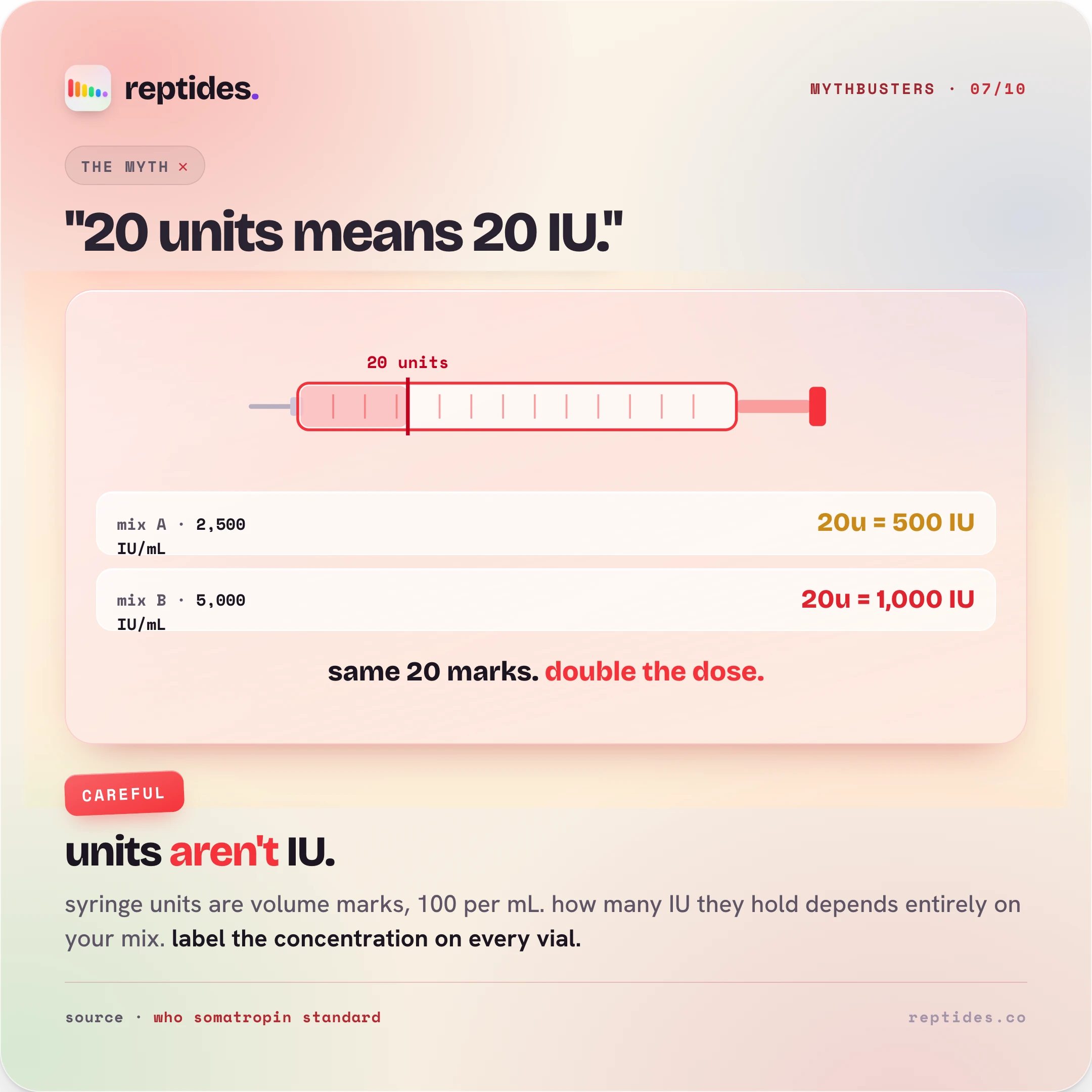
The mistake that actually doses people wrong: "units" are not "IU." The "units" marked on an insulin syringe are volume marks. There are 100 of them per mL, each worth 0.01mL. They are not International Units of hormone. When a protocol says "draw 20 units of HCG," it means 20 marks on the barrel, and how many IU that works out to depends entirely on how the vial was mixed. The same 20 marks drawn from a 2,500 IU/mL mix deliver 500 IU; drawn from a 5,000 IU/mL mix they deliver 1,000 IU. Identical marks on the barrel, double the dose.
So an IU dose means nothing without the concentration. That is why a reconstituted vial gets labeled with both: the concentration in IU/mL, and what the syringe units convert to. "20 units = 500 IU" on the cap turns a calculation into a label read once, and it is how a doubling error at six in the morning gets avoided.
the safety facts around injection
Most research peptides are given subcutaneously. Most of the panic around it is misplaced, and the few things that genuinely matter are worth knowing in advance.
Subcutaneous means the layer of fat between skin and muscle. It is the standard route for most research peptides, because the gut breaks most of them down before they reach circulation. What follows is the safety knowledge worth having, described rather than prescribed.
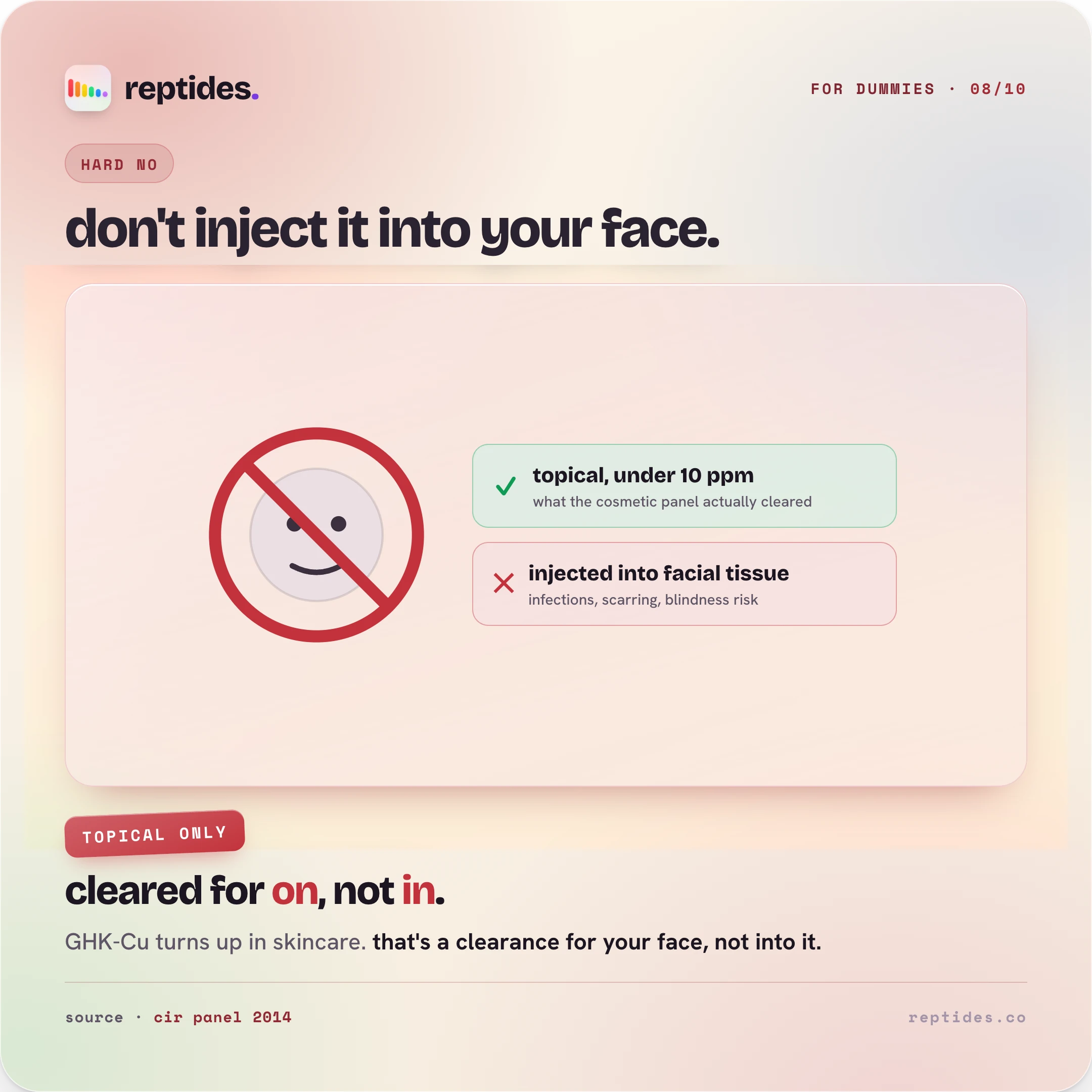
Not the face. GHK-Cu is the compound this comes up with, because it turns up in skincare marketing and the logic slides from "good for skin" to "into the skin." The cosmetic panel that reviewed copper tripeptide-1 cleared it as a topical at under 10 parts per million, a clearance for use on the surface of the skin only . Unsterile powder in facial tissue is how people end up in the mesotherapy literature with a mycobacterial infection that took months of antibiotics to clear and left scars behind . The face is also dense with arteries that run back toward the eye. The injection-blindness literature is overwhelmingly about particulate fillers rather than aqueous solutions, but it is a reminder of why facial injection is treated as a clinical procedure when it is done at all . Topical formulations exist for exactly this reason.
Aspiration was never an evidence-based step. Pulling back on the plunger to check for blood is a habit carried over from intramuscular injection, and the deeper problem is that it was never a test that worked. When it was actually studied in subcutaneous tissue, 204 aspirated sub-q insulin injections returned blood exactly zero times, and the conclusion was that aspiration had never been shown to indicate anything reliable about needle placement . It is moot in practice anyway, because every insulin and GLP-1 pen on the market makes aspirating mechanically impossible, and that is the delivery standard for sub-q drugs. The CDC lands in the same place for vaccines, saying plainly that aspiration is not recommended and that it can increase pain through longer needle dwell time and the shearing action of wiggling the needle . Worth being honest that the CDC is writing about vaccines at vaccine sites, so treat it as converging evidence rather than a ruling on peptides in the abdomen. The sub-q data carries this one. Aspirating buys a bruise.
Small air bubbles are the myth that scares first-timers most and deserves it least. The arithmetic settles it. The lethal dose of air is theorized at 3 to 5 millilitres per kilogram, roughly 300 to 500 millilitres pushed into a vein at speed to count as fatal in an adult . A whole U-100 insulin syringe holds one millilitre. Filled end to end with nothing but air it is still hundreds of times short of that, and that is before the air would have to find a vein instead of the fat around it. The only real reason to clear a bubble is mundane: air takes up room in the barrel that was meant for peptide, so on a syringe where the whole volume is a few units, a visible bubble is a real slice of the dose. The reason to clear it is accuracy.
Sharps go in a sharps container, never the trash. A loose needle in a kitchen bin is a real injury risk for whoever handles the bag next, and the FDA is blunt about it: don't put loose sharps in the trash, in recycling, or down the toilet . A purpose-made container costs a few dollars. Where one isn't available, the FDA passes along, carefully attributing it to community guidelines rather than its own recommendation, a heavy-duty plastic household container that is leak-resistant, stays upright, and has a tight-fitting puncture-resistant lid, the example named being a plastic laundry detergent bottle . The rest of the FDA's guidance: label it as hazardous so nobody mistakes it for recycling, keep it away from children and pets, stop filling at about three-quarters, seal it, and follow local rules for drop-off, which a pharmacy or local health department can point to .
Histamine reactions are a known property of some compounds. A few peptides trigger histamine release directly, without any allergy involved, because small basic peptides can set off mast cells on contact. GHRP-6 was doing it to mast cells in the lab as far back as 1990 , and this is not confined to gray-market compounds: tesamorelin is an FDA-approved GHRH analog, and its label reports hypersensitivity reactions in 4 percent of treated patients, showing up as itching, redness, flushing, hives, and rash . So redness, itching, a raised welt at the site, or a flush that spreads past it is a reported property of certain compounds rather than a sign something went wrong. A localized itchy wheal that settles within an hour is a nuisance, and an easier one to interpret when it was expected. Which compounds do this is molecule-specific, which is what the compound page is for.
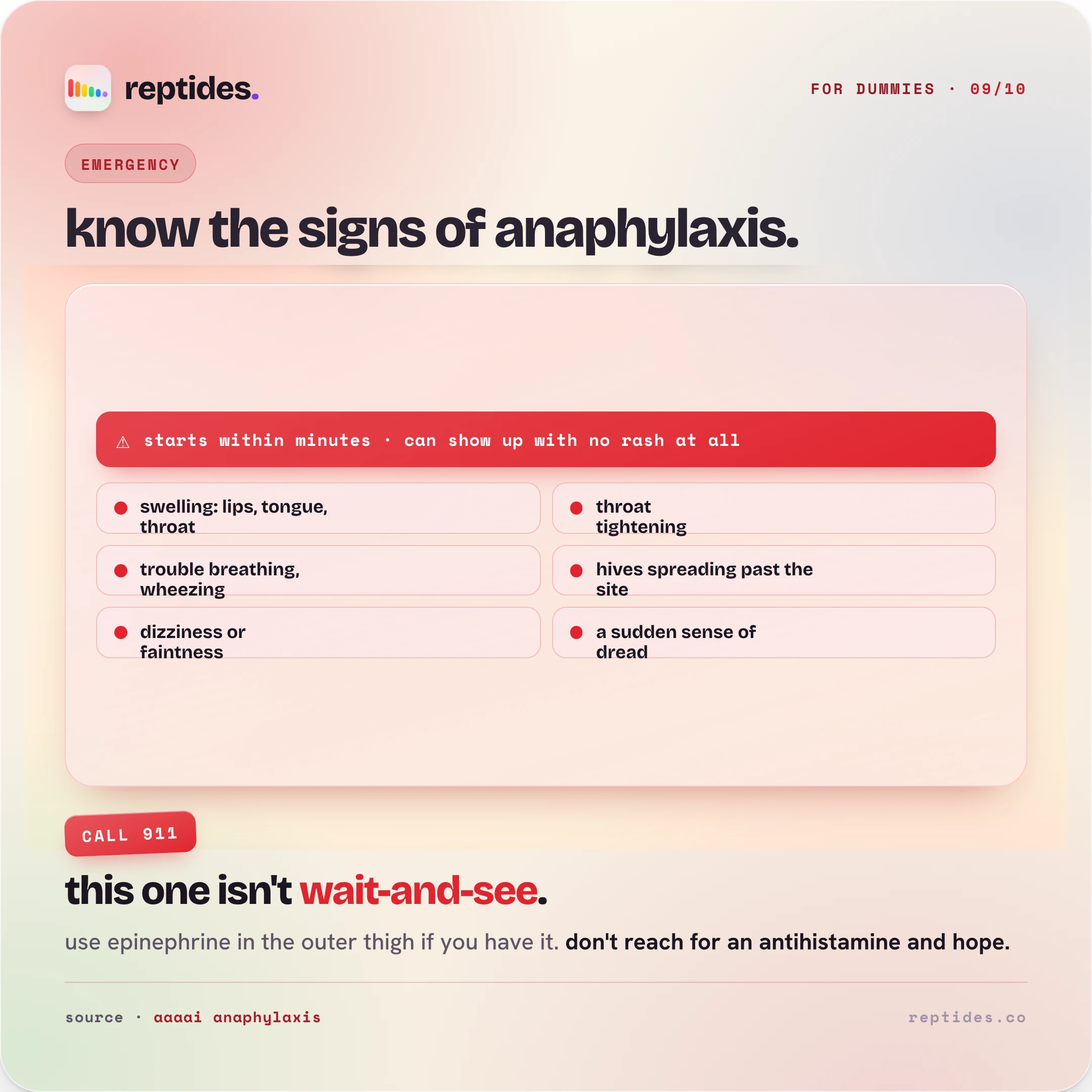
Anaphylaxis is a medical emergency, and a different thing entirely. Hives spreading well beyond the injection site, swelling of the lips, tongue, or throat, a tightening throat, trouble swallowing or breathing, wheezing, dizziness or faintness, vomiting, or a sudden sense that something is badly wrong are the recognized signs. They usually start within minutes, and they can show up with no rash at all . The response is to call 911 or a local emergency number immediately, and to use an epinephrine autoinjector in the outer thigh if one is available . An antihistamine is not the answer, and neither is waiting to see if it eases, because these reactions can come back hours after they seem to have settled .
common questions
Do I have to inject them? Most research peptides are run subcutaneously, a tiny needle into the fat just under the skin rather than a deep intramuscular shot, though some researchers do go IM for certain compounds. A handful of peptides are genuinely bioavailable orally, and some come in nasal or topical forms, but injection is the norm because the gut breaks most peptides down before they reach circulation. An oral version of something normally injected usually needs far more material to land the same signal, and some don't survive digestion at all no matter what the label promises. Route is molecule-specific, so it is worth checking what the actual evidence used rather than assuming the convenient version works.
Bacteriostatic water or sterile water? Bacteriostatic for almost everything. The benzyl alcohol in it slows bacterial growth, which is what makes it a multi-dose vial, so a mixed vial lasts weeks in the fridge instead of being one-and-done . Plain sterile water has no preservative and is a single-dose product. A small number of compounds do call for something else, usually plain sterile water or saline, and the bac water label itself defers to them: it says to dissolve drugs according to the instructions of the manufacturer of the drug being administered . So the rule is: follow what the specific compound says, and reach for bac water when it doesn't say anything, which is nearly always. And again, nothing else. Not tap, not distilled, not bottled, not saline swapped in on a guess.
My powder is clumped or looks like almost nothing is in there. Did I get shorted? Neither is a problem. Clumps, flakes, discs, and near-invisible films are all normal ways lyophilized powder dries. The mass is measured in milligrams, so a real dose can genuinely look like an empty vial. Looking empty is not the same as being empty.
Wait, what's the difference between "units" and "IU"? Units are marks on the syringe, 100 of them per mL of volume. IU are International Units of the actual hormone. They only line up by coincidence, and how many IU sit in one syringe unit depends entirely on how the vial was mixed. That is the whole reason the concentration goes on the cap. The IU section above walks through it with real numbers.
It went cloudy after I mixed it. Is it ruined? Probably not. Give it ten to fifteen minutes to finish dissolving. A haze that clears is fine. A solution that stays cloudy, discolored, or full of persistent floaters is the one to set aside.
Do they need to be refrigerated? Powder, no. The fridge is nice but not required. Once reconstituted, yes, keep it cold. And a reconstituted vial does not go in the freezer.
How fast do they work? Depends entirely on the peptide and the goal. Some produce a noticeable acute effect. Repair and body-composition goals play out over weeks. "Nothing happened in three days" is not a verdict.
Do I need to cycle? Varies by compound. Some are run continuously, others in blocks. This is molecule-specific, and exactly the kind of thing to research per peptide rather than copy off a stack screenshot.
Can I stack peptides? Researchers do, but every addition is another variable and another interaction to reason about. A few compounds you actually understand beats a long stack you can't evaluate.
How do I know if a compound is even worth it? Look at the evidence before the marketing. A tool like [Reptides](/) grades compounds by how strong the underlying data actually is and shows the sources, which is a faster sanity check than reading a hundred conflicting forum posts.
don't wing it
A clinician in the loop is the ceiling. Bloodwork is the floor.
The best version of this is a doctor who knows what the compound is and will order labs and read them with you. Plenty of people don't have that, either because their physician won't engage with research compounds or because they never actually asked. The fallback isn't to skip the whole idea. The fallback is bloodwork.
A baseline panel before anything starts, then the same panel a couple of months later, is what makes any of it interpretable. What's worth measuring depends on the compound. Anything working on the GH axis makes IGF-1 the number to watch, alongside fasting glucose and HbA1c, because growth hormone pushes insulin sensitivity in the wrong direction. Anything touching hormones means a full hormone panel. A CBC and a metabolic panel are cheap and catch things that go unfelt. Direct-to-consumer lab services will draw most of these without a physician's order in a lot of places.

The baseline is the part people skip, and it's the part that makes the rest mean anything. An IGF-1 reading eight weeks in tells you very little if the starting point was never measured. Two points make a line. One point is a rumor.
And if something feels wrong, that's data too. Numbness that persists, vision changes, swelling that doesn't go down, a resting heart rate that won't settle. None of those are push-through-it signals. They are reasons to stop and get looked at by someone who can order a test.