On July 23 and 24, 2026, the FDA's Pharmacy Compounding Advisory Committee sat for two days and took fourteen votes. Each of the seven peptides in front of it was voted on twice, once as a free base and once as an acetate salt, because those are legally two different substances. Every factual claim below is sourced at the bottom.
- ·Twelve of fourteen votes carried, every one over FDA's own reviewers.
- ·A yes vote opens a rulemaking. It puts nothing in a vial.
- ·Only DSIP failed, 6-7, on one member's single crossover.
- ·Every peptide we grade A or B passed. The failure came from C tier.
- ·FDA judged these on certificates of analysis pulled off the open web.
- ·Five more, graded S down to D, go to a vote before the end of February.
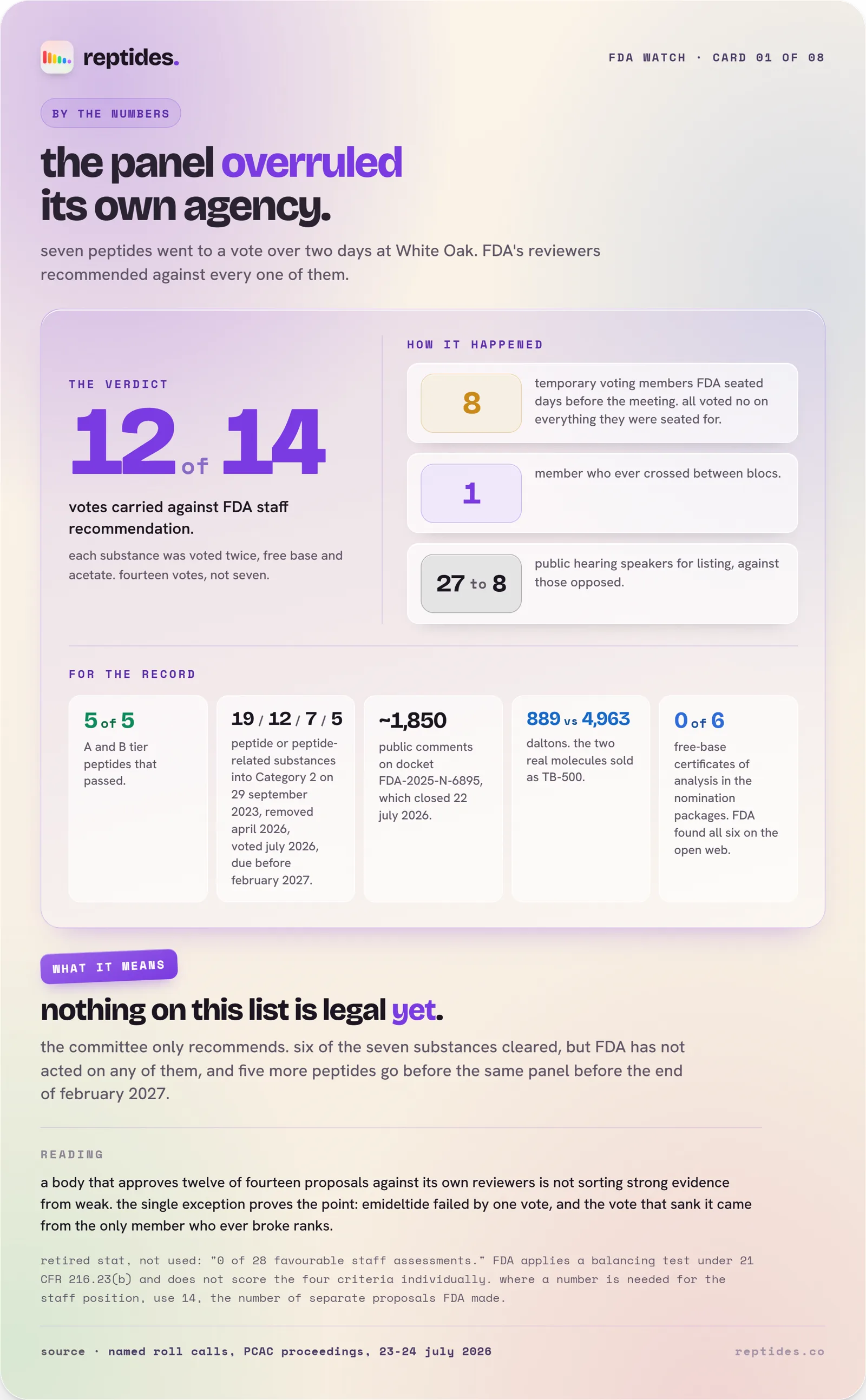
the committee said yes to six of the seven peptides in front of it.
FDA's own scientific staff had reviewed all seven and proposed that none of them be added to the list. FDA filed that as fourteen separate proposals, one per substance. The committee went the other way twelve times.
Several substances were nominated for more uses than FDA agreed to review. Free base and acetate were called separately and came out identical every time, so the table shows one of each pair. We transcribed all fourteen roll calls by name from the proceedings and re-derived every tally from the individual votes. All fourteen reconcile.
One sourcing note. These tallies come from the meeting webcast, which FDA streamed publicly on both days. FDA has published no official tally sheet, so the recording is the place to check us. Trade coverage splits on one number: RAPS reported epitalon as 7 in favor, 5 against, 1 abstention, where we and other trade coverage counted 7-4-1. We are publishing what the roll call says and will correct it the day FDA's minutes post.
Only DSIP went down, and it went down by a single vote.
a yes vote starts a process. it does not put anything in a vial.
The rule has not changed. Under section 503A, a pharmacy can compound with a substance only if one of three things is true: it is a component of an FDA-approved drug, it is the subject of a USP or NF monograph, or it sits on the 503A bulks list. None of these seven has ever been any of the three.
You will see people say the vote restored peptides to a legal status they used to have. FDA corrected that on the record twice. The acting director of FDA's compounding office put it plainly: listing these substances would create legal access for the first time.
The confusion comes from a separate system. On September 29, 2023, FDA placed 19 peptide or peptide-related bulk drug substances into what it calls Category 2, an interim enforcement-discretion framework created by guidance and entirely separate from the bulks list. A Category 2 entry meant the nomination was adequately supported but FDA had identified a significant risk, so it would not exercise enforcement discretion.
Two precisions there, because both get mangled constantly. You will see that number reported as 20, including by outlets that should know better. It is 19. And two of the 19 are small molecules: ibutamoren mesylate is a growth hormone secretagogue and dihexa acetate is an angiotensin IV analog. That is why FDA and careful sources write "peptide or peptide-related" rather than counting peptides.
The April removal gets misread as FDA reversing its own scientific judgment. All 12 came off for one procedural reason, which is that the nominators withdrew the nominations. FDA retracted no finding, and coming off Category 2 leaves a substance exactly where it was, off the bulks list and outside what a pharmacy may compound. Five other peptides came off the same way in September 2024.
One substance breaks the pattern, and it is the one topping our February predictions. GHK-Cu is a split listing. The injectable form was the Category 2 entry. GHK-Cu for non-injectable routes has sat in Category 1 since September 2023, was dropped on April 22, 2026 with everything else, then restored on May 14 after the nominator clarified it had only meant to withdraw the injectable nomination. That round trip shows what these listings actually track, which is nominator paperwork rather than new science.
The framework itself is on its way out. FDA's revised guidances of January 7, 2025 ended Category 1/2/3 for nominations filed on or after that date. Existing Category 1 listings keep their enforcement discretion; Category 2 and 3 substances gain none, whatever gets added to the file.
What comes after the vote is notice-and-comment rulemaking with no deadline attached. FDA reviews the full docket, publishes a proposed rule with its own comment window, then issues a final rule. Only at that point does anything become legally compoundable, and only in the exact form listed. That is why free base and acetate were voted separately.
Realistically you are looking at more than a year. Anyone telling you these are legal now is selling something.
every peptide we grade A or B passed. the one failure came out of C tier.
We assign evidence grades ahead of regulatory events, so this was a live test.
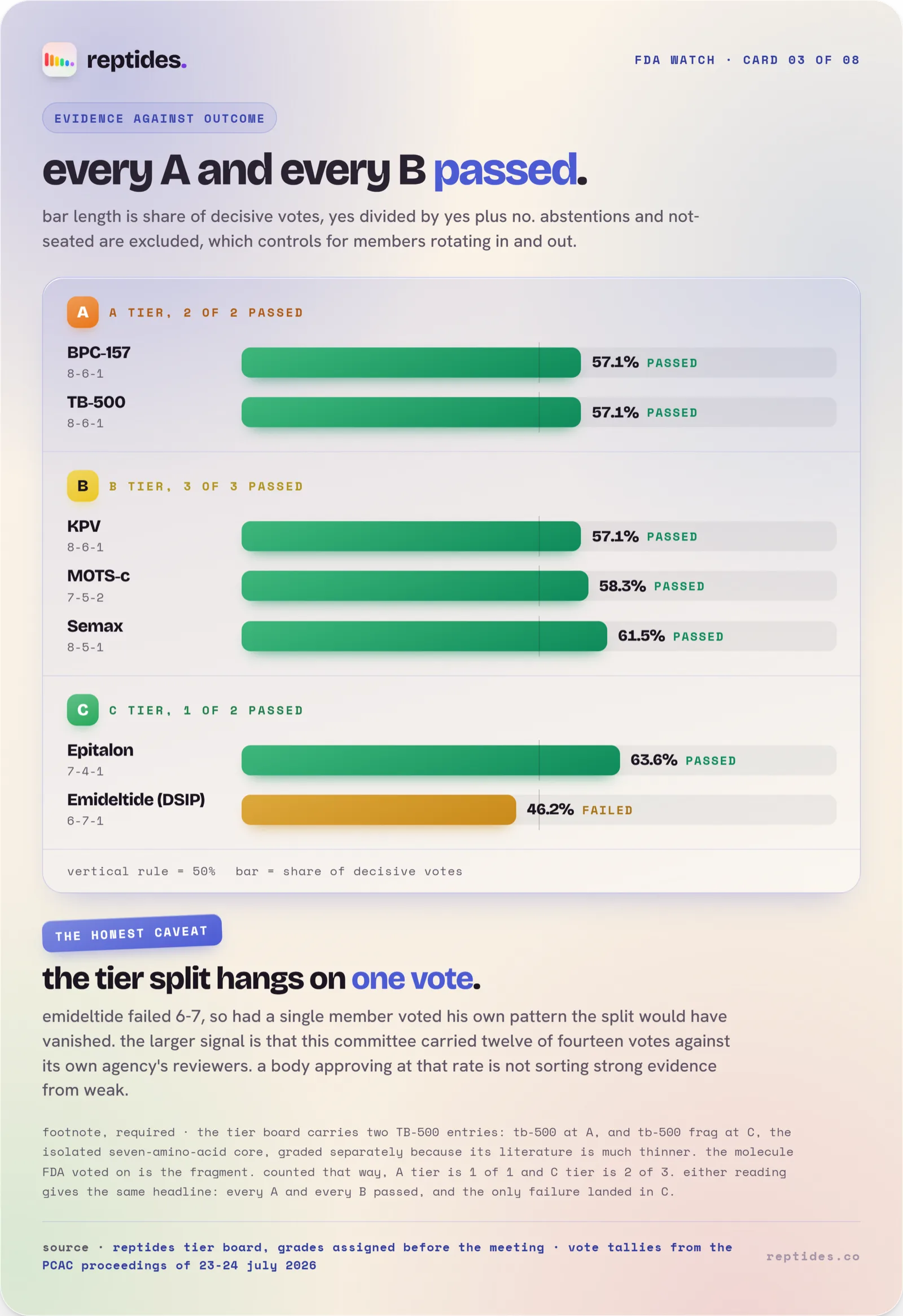
Everything with a solid evidence base behind it cleared. The compound that failed was one we had already flagged as thin, and the other C-tier compound scraped through.
One asterisk belongs on our own table, because someone will find it otherwise. Our board carries two TB-500 entries: tb-500 at A, and "tb-500 frag" at C, the isolated seven-amino-acid core, graded separately because it has its own much thinner literature. The molecule FDA voted on is the fragment. Count it that way and A tier is 1 for 1 while C tier goes to 2 for 3. The headline survives either reading: every A and every B passed, and the only no vote landed on a C. The next section explains why we grade those two separately in the first place.
DSIP failed 6-7, a margin of one vote. Had a single member voted the way he voted on everything else that week, DSIP passes 7-6 and the tier pattern disappears. Seven compounds is a small sample and one of them was a coin flip.
This committee approves almost everything. Twelve of fourteen votes carried, over the objection of FDA's own reviewers on every single one. A body that says yes at that rate is expressing a position on access and applying it broadly rather than sorting strong evidence from weak.
So a PCAC yes is not an evidence signal. It tells you a substance may eventually become legally compoundable. It tells you nothing about whether it works, how well it has been studied, or what is actually in the vial.
who was in the room, and why that decided it.
We scored every member by the share of decisive votes they cast as yes. The result is two blocs and a hinge.
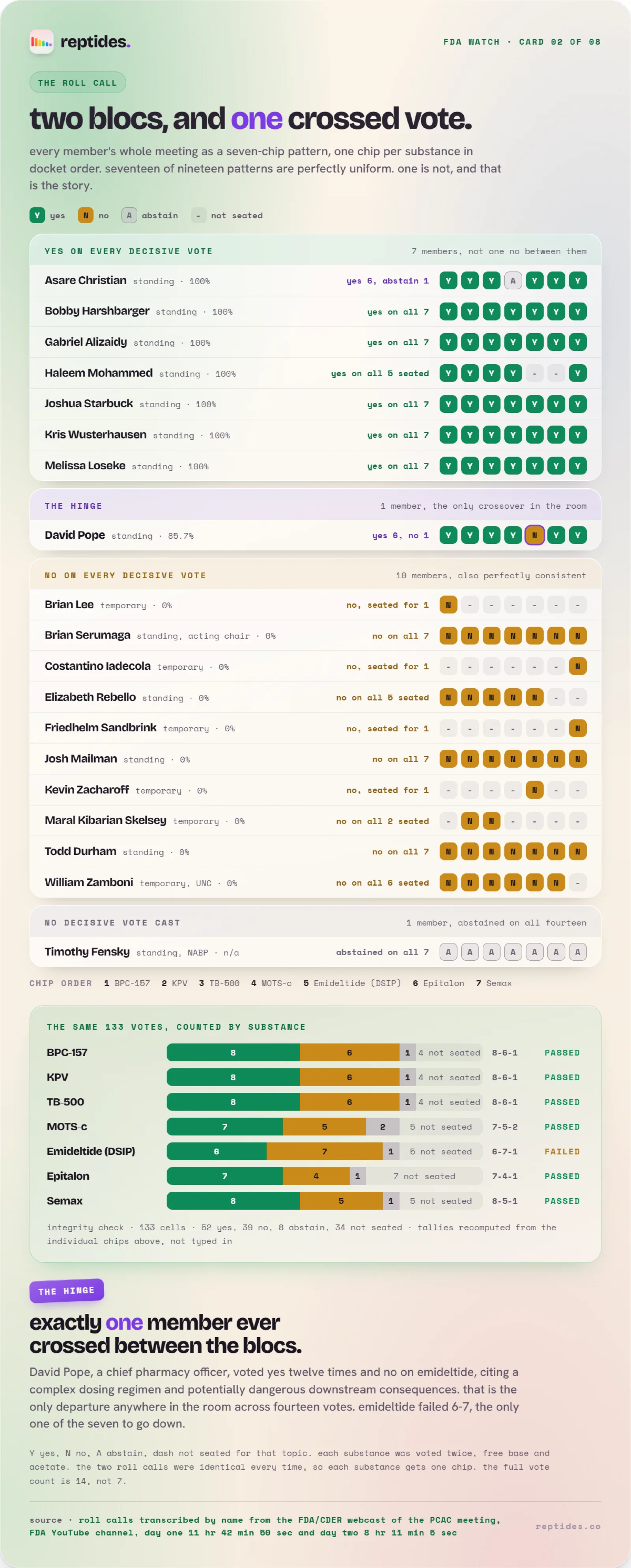
Seven members voted yes on every decisive vote they cast, without a single no between them across the whole meeting. Ten members voted no on every decisive vote they cast, equally consistent. One member, the National Association of Boards of Pharmacy representative, abstained on all fourteen and told the committee NABP takes no position either way. Exactly one member ever crossed between the blocs.
David Pope, a chief pharmacy officer, voted yes twelve times and no on DSIP, citing a complex dosing regimen and potentially dangerous downstream consequences.
Run the counterfactual. DSIP failed by one. If Pope votes his own pattern, it passes. And if you instead remove Kevin Zacharoff, the substance-use specialist seated for that one topic who voted no, the count is 6-6, which still fails. Adding the specialist did not sink DSIP. One man's single crossover did.
The blocs have a structural origin. In late June, reporting raised the objection that the panel was stacked with people tied to peptide businesses and clinics. Days before the meeting, FDA seated eight temporary voting members, most of them academic clinicians, six of them restricted to specific substances and two to the semax topic alone. Every one of the eight voted no on every substance they were seated for. Members rotated in and out by topic all week, which is why the denominators move from vote to vote.
So the two blocs are not two camps that argued each other to a standstill. They are the panel as originally constituted and the panel FDA added after the criticism, voting against each other almost perfectly.
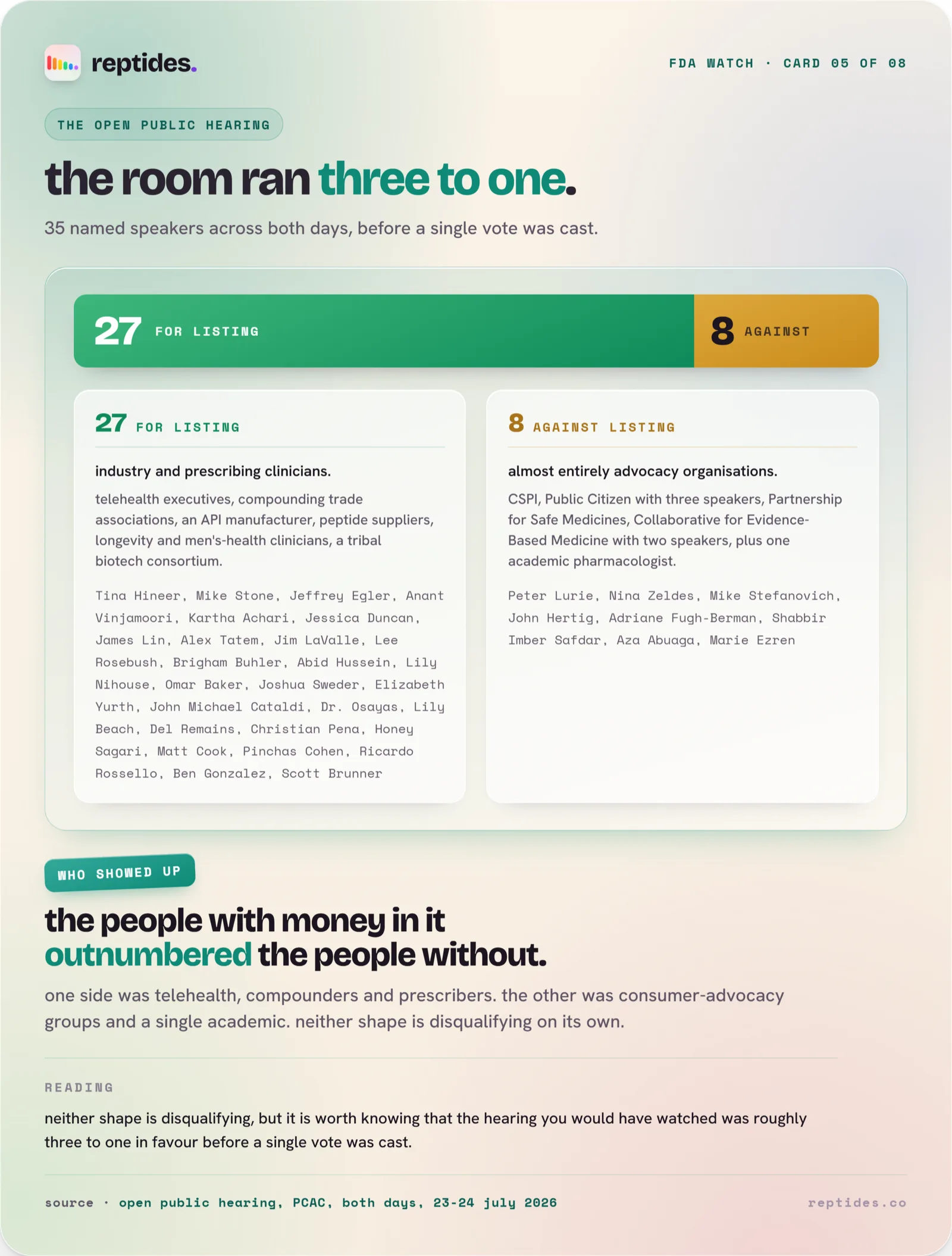
The open public hearing leaned the other way from the votes. Of the 35 named speakers across both days, 27 argued for listing and 8 argued against. The pro side was mostly industry and clinicians who prescribe these compounds: telehealth executives, compounding trade associations, an API manufacturer, longevity clinicians. The anti side was almost entirely advocacy organizations: CSPI, Public Citizen, the Partnership for Safe Medicines, the Collaborative for Evidence-Based Medicine. Neither shape disqualifies anyone, and the hearing you would have watched ran roughly three to one in favor before a single vote was cast.
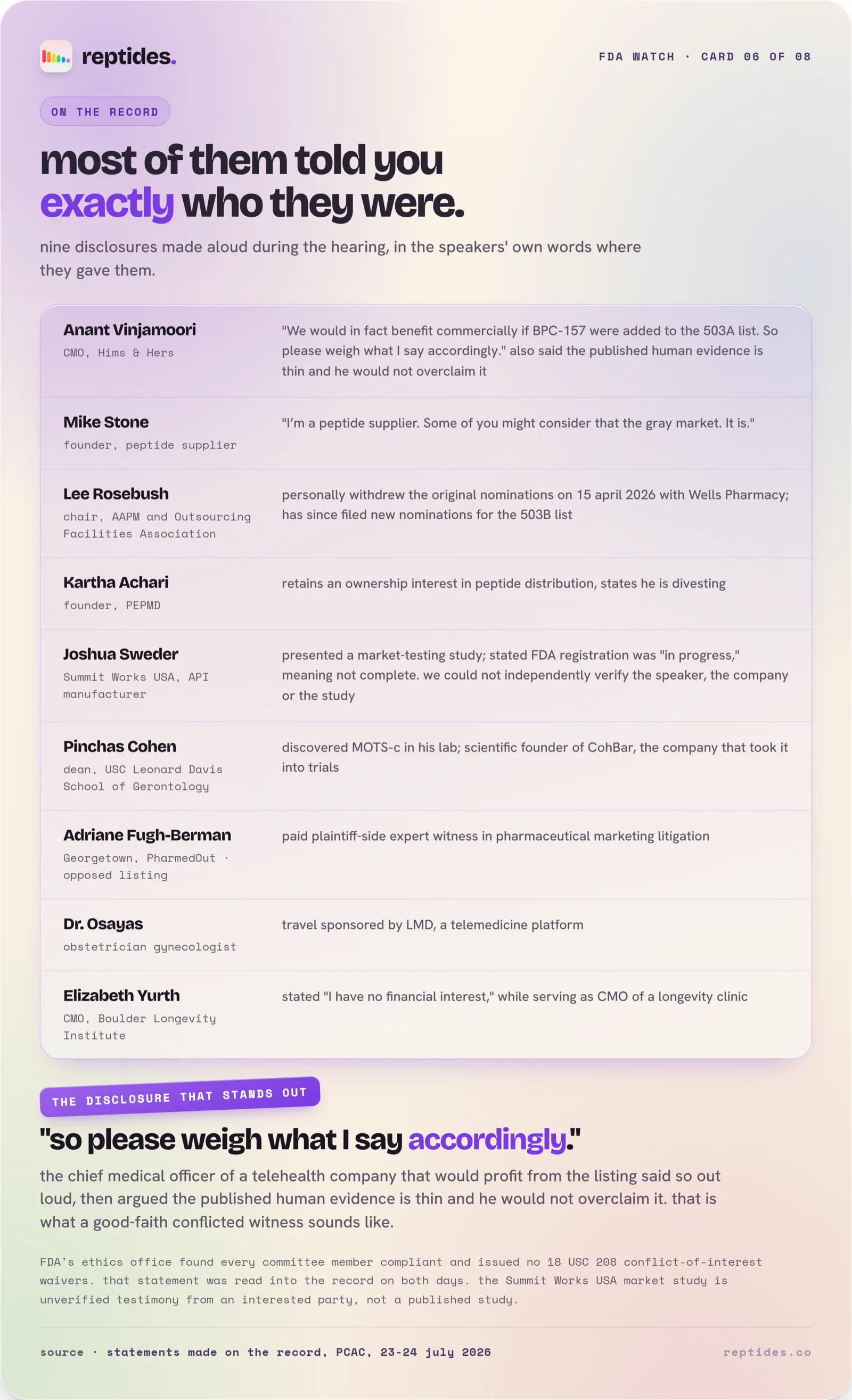
Some disclosed their interest cleanly. The chief medical officer of Hims told the committee outright that his company would benefit commercially if BPC-157 were listed, and asked members to weight his testimony accordingly. He also said the published human evidence for it is thin and that he would not overclaim it. A peptide supplier introduced himself by saying some of you might consider that the gray market, and it is.
Our pre-vote read on how this panel was rebuilt, published July 8, is in the documents say no, the room says yes.
the one question nobody in the room could answer.
It went almost unreported, and it decides what lands in a vial.
Russell Wesdyk, associate director for regulatory affairs in FDA's office of pharmaceutical quality, raised it on both days. "BPC-157," "TB-500" and "semax" are common names with no legal definition behind them: no USAN entry, no INN, no IUPAC name. Anyone can synthesize any variant and sell it under the same name, and multiple different active molecules are already on the market under each.
Then he made it concrete, and he happened to pick the one compound we had already spent months on.
The chemistry is simpler than it sounds. Thymosin beta-4 is a protein your own cells make, 43 amino acids long. TB-500, by its original definition, is a small piece cut out of that protein: the stretch running from position 17 to position 23. Seven amino acids, written Ac-LKKTETQ.
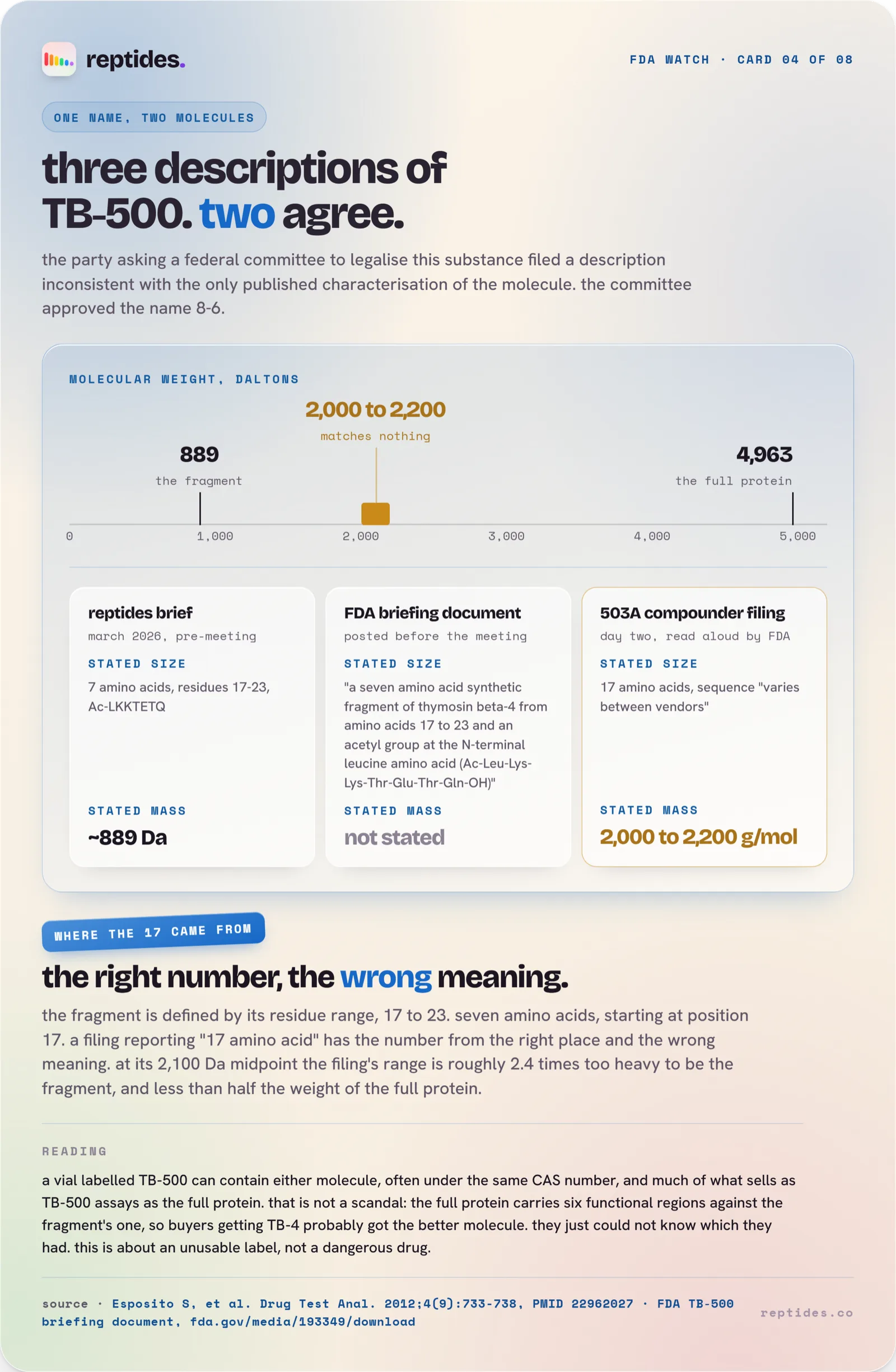
Two different molecules, and weight tells them apart instantly. The fragment weighs about 889 daltons. The full protein weighs about 4,963 daltons, more than five times heavier. A mass spectrometer settles it in seconds.
A vial labeled "TB-500" can contain either one, which is why we wrote a whole brief on this in March. Both are sold under that name, often under the same CAS registry number. When we pulled certificates of analysis on research-use-only peptide blends, the label kept saying TB-500 while the lab's own mass spectrometry kept saying thymosin beta-4, the full protein. It happened across different products and different labs.
So a great deal of what moves as "TB-500," especially in blends, is the full protein.
The full protein is the more complete of the two. The fragment carries one functional region; the full protein carries that one plus five others. If you bought TB-500 and received thymosin beta-4, you very probably got the better molecule. You just did not get the one on the label, and you had no way to know which you had. That is also why our board grades the two entries separately.
Back at the hearing, the compounding pharmacy's filing described TB-500 as a 17 amino acid fragment, sequence varying between vendors, molecular weight 2,000 to 2,200 g/mol.
FDA's own briefing document for the meeting says something different. TB-500 free base, it states, "is understood to be a seven amino acid synthetic fragment of thymosin beta-4 from amino acids 17 to 23 and an acetyl group at the N-terminal leucine amino acid (Ac-Leu-Lys-Lys-Thr-Glu-Thr-Gln-OH)".
Read that sequence off: Leu-Lys-Lys-Thr-Glu-Thr-Gln is L-K-K-T-E-T-Q. Acetylated, that is Ac-LKKTETQ. The identical molecule our March brief named, from the identical residue range, at seven amino acids.
FDA and our brief agree. The filing is the outlier, and its number matches neither real molecule. At the 2,100 midpoint it is roughly 2.4 times too heavy to be the fragment, and less than half the weight of the full protein. It describes something that does not appear in the literature.
The "17" has an obvious origin, and FDA's own wording makes it hard to read any other way. The fragment is defined by where it sits inside the parent protein, "from amino acids 17 to 23". Seven residues, starting at position 17. A filing reporting "17 amino acid" has taken the right number from the wrong place.
The label is what fails here, rather than the molecule. The party asking a federal committee to legalize the substance filed a description that does not match the only published characterization of it, and the committee approved the name 8-6.
Wesdyk's question to the room was simple: when a physician writes a script for TB-500, what does the patient actually receive? Nobody answered.
We answered it in March, and the answer has not changed. The mass tells you what you have. About 889 daltons is the fragment. About 4,921 to 4,963 is full-length thymosin beta-4. No mass spectrum, no answer.
This is what a COA is for, and nothing that happened this week changes it. If you want the walkthrough on reading one without a chemistry background, we wrote that too: how to read a COA without a chemistry degree. The two-molecule finding is in wait, so is it tb-500 or thymosin beta-4?.
the COAs FDA judged these on came off the open market.
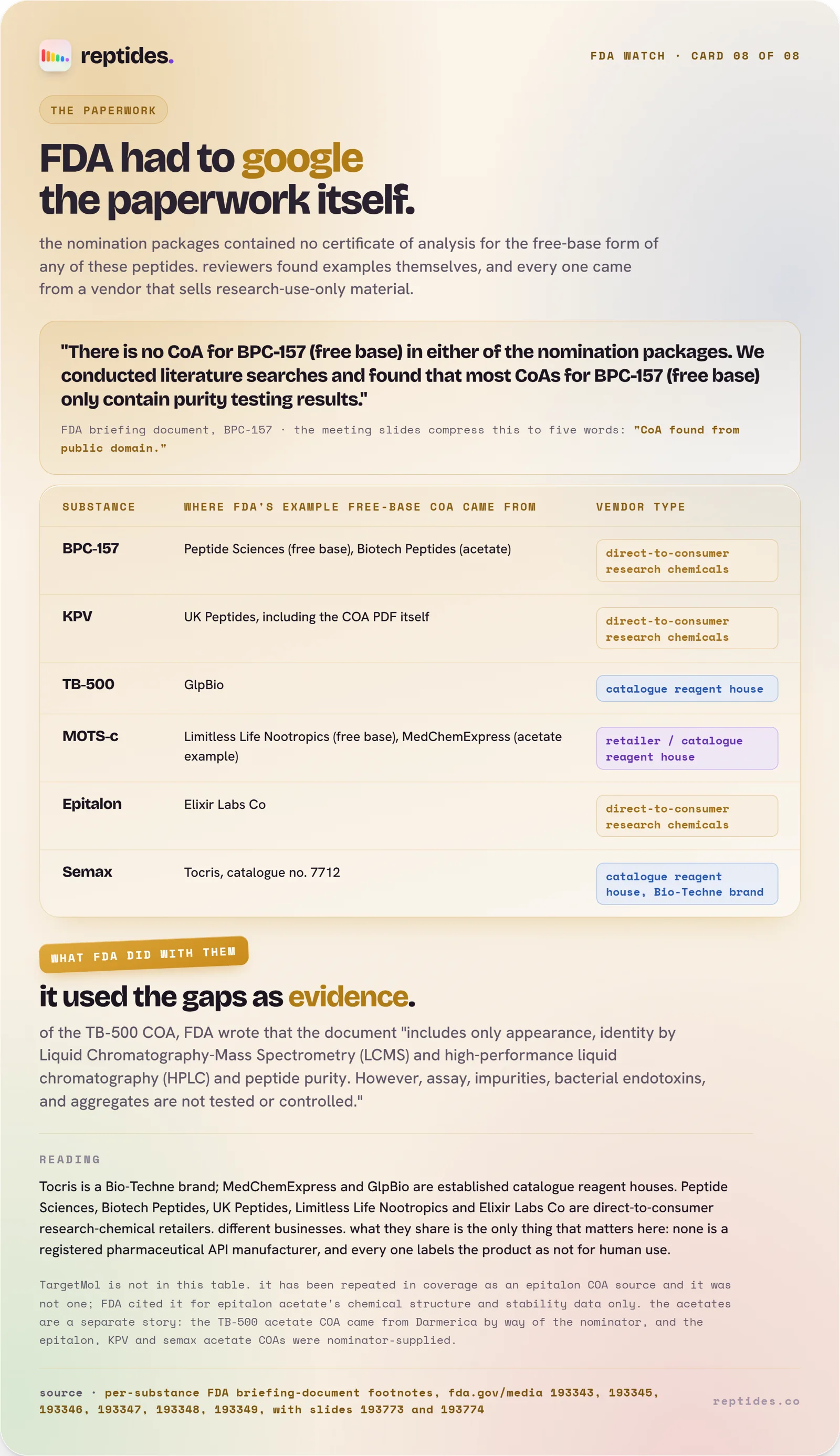
Alex Tatem, a urologist who told the committee he had paid his own way to attend, went through FDA's evaluations substance by substance and pointed out where the agency's certificates of analysis had come from. Every one, he said, a research-use-only vendor. Lee Rosebush, Jim LaValle and Elizabeth Yurth made versions of the same point. FDA did not dispute it.
We checked it against the source documents rather than taking anyone's word, and it holds up. You can read it in FDA's own footnotes. Each briefing document explains why in language that barely changes between them. For BPC-157: "There is no CoA for BPC-157 (free base) in either of the nomination packages. We conducted literature searches and found that most CoAs for BPC-157 (free base) only contain purity testing results." Same construction for the other five.
One distinction matters here, because collapsing it would be unfair to real companies. Tocris is a Bio-Techne brand, and MedChemExpress and GlpBio are established catalogue reagent houses selling labeled benchwork material. Peptide Sciences, Biotech Peptides, UK Peptides, Limitless Life Nootropics and Elixir Labs Co are direct-to-consumer research-chemical retailers. Different businesses entirely. What they share is the only thing that matters here: none is a registered pharmaceutical API manufacturer, and every one labels the product as not for human use.
Two corrections to how this has been reported elsewhere, our own first draft included. The acetates are a different story from the free bases: the TB-500 acetate COA came from Darmerica by way of the nominator, and the epitalon, KPV and semax acetate COAs were nominator-supplied too. And TargetMol, repeated in coverage as an epitalon COA source, was not one. FDA cited it for that molecule's structure and stability data, nothing more.
The criticism survives all of that. Tatem's point was that a research reagent certificate cannot stand in for bulk API made by a registered facility and dispensed by a licensed pharmacy, so FDA was judging characterization using paperwork from exactly the market it was criticizing. Matt Lash answered that the evaluations drew on the withdrawn nomination packages plus publicly available material, which was what the agency had.
Both answers are correct. The industry is right that FDA assessed these compounds on open-market paperwork. FDA is right that open-market paperwork was all that existed, because nobody had generated anything better. What that describes is a market with no pharmaceutical-grade supply chain behind it, which is the same conclusion from either direction.
One precision about what FDA did with those documents, because this is the part that bites. It treated their gaps as the evidence. The TB-500 COA, FDA noted, "includes only appearance, identity by Liquid Chromatography-Mass Spectrometry (LCMS) and high-performance liquid chromatography (HPLC) and peptide purity. However, assay, impurities, bacterial endotoxins, and aggregates are not tested or controlled". The best characterization anyone could locate does not test for most of what a pharmaceutical specification tests for.
three steps, more than a year, and then five more peptides.
First, FDA reviews the full docket. It drew roughly 1,850 comments before closing on July 22, plus a late submission from the American Academy of Peptide Medicine running about 330 pages with over a thousand pages of clinical references. FDA staff told the committee they had not analyzed that material before presenting, because the cut-off for committee consideration was July 9, two weeks before the vote. It gets read now, against no statutory deadline.
Second, a proposed rule publishes with its own comment window. This is the only stage at which route or dosage-form restrictions can actually be attached. Several members voted "yes, topical only," and were told plainly that a caveat attached to a vote is not enforceable.
Third, a final rule. Only then does anything become legally compoundable, and only in the exact form listed. FDA usually lands where its committee lands, and confirmed at least one historical case where it did not, so twelve yes votes do not guarantee twelve entries.
One more thing to watch, further along than we first thought. The CEO of the Alliance for Pharmacy Compounding told the committee that a bill requiring compounding pharmacies to report serious adverse events had moved in the Senate that week. He was right. On July 22, 2026, the day before the meeting opened, the Senate HELP Committee voted 17-5 to order S. 3794, the SAFE Drugs Act of 2026, reported favorably with an amendment in the nature of a substitute.
Read the introduced text and you will not find the reporting requirement, which is why this is easy to miss: it lives in the substitute amendment rather than the bill as filed. The trade group most affected reports that the substitute would route serious adverse event reports from compounding pharmacies through the existing FAERS and MedWatch system and mandate label language stating the product is not FDA-approved. The vote and the bill are a matter of record. The substitute's exact contents rest on that reporting until the reported text posts, because the amendment was filed as a scanned document.
If it becomes law it closes the largest gap in this entire debate. Every adverse-event denominator argued at this meeting came from voluntary industry reporting, because nothing currently requires a 503A pharmacy to report anything at all.
february spans S all the way down to D.
FDA has said the committee takes up the other five before the end of February 2027. No date had been posted as of late July.
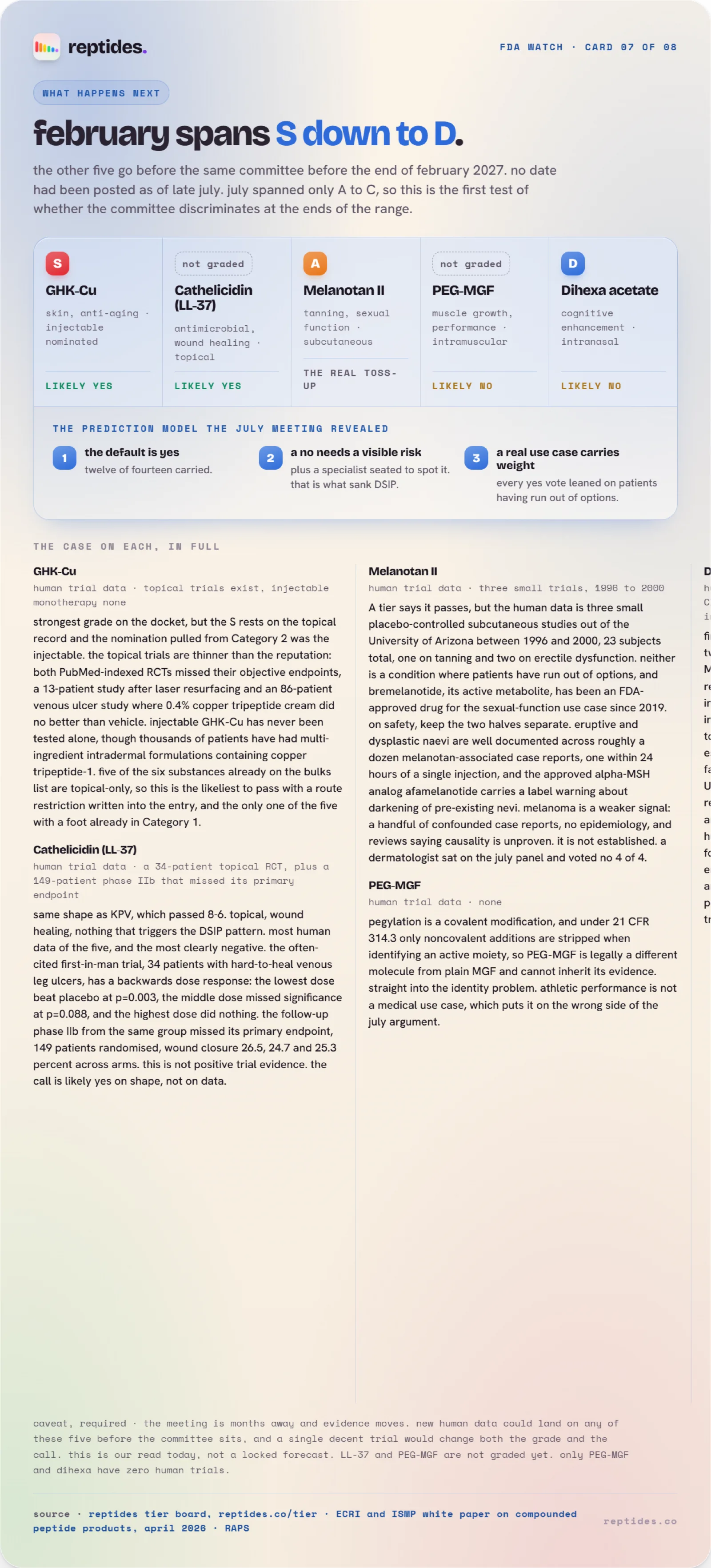
One caveat on all five, and it is not a small one. The meeting is months away and evidence moves. New human data could land on any of these before the committee sits, and a single decent trial would change both the grade and the call. Our grades get reviewed against current research, so if that happens we will regrade and say so plainly. What follows is our read today.
Every compound the committee voted on in July sat between A and C on our scale. February spans S all the way down to D. This is the first time we get to see whether this committee discriminates at the ends of the range, or whether it simply says yes.
Evidence quality did not predict the July outcomes on its own, so we are not predicting on grade alone. The meeting revealed a different model. The default is yes: twelve of fourteen carried, and absent a specific reason to say no, this committee says yes. A no requires a risk a clinician recognizes on sight, plus someone in the room who owns that specialty. And a real medical use case carries a lot of weight, because every yes vote leaned on the same argument, that these are patients who have run out of options. That argument works for a wound that will not close. It works much less well for a cosmetic outcome.
That model is exactly what sank DSIP. Opioid withdrawal makes any clinician pause, and a substance-use specialist was seated for that topic alone. Both conditions were met, and it is the only compound that failed.
GHK-Cu carries the strongest grade on this docket, one of a small handful of S-tier compounds on our board. Two wrinkles. That S rests on the topical record, and the nomination FDA pulled out of Category 2 was the injectable. And the topical human trials are thinner than the compound's reputation: both randomized controlled trials indexed in PubMed missed their objective endpoints, a 13-patient study after laser resurfacing and an 86-patient venous ulcer study where 0.4% copper tripeptide cream did no better than vehicle. Injectable GHK-Cu has never been tested on its own, though thousands of patients have received multi-ingredient intradermal formulations containing copper tripeptide-1. Five of the six substances already on the bulks list are topical-only. We call it a pass, and the most likely of the five to pass with a route restriction actually written into the entry. It is also the only one of the five already holding a foot in Category 1.
LL-37 is the same shape as KPV, which passed 8-6. Topical, wound healing, nothing that triggers the DSIP pattern.
It also has the most human data of the five, and this is where we correct our own earlier read. The often-cited study is a first-in-man randomized, double-blind, placebo-controlled trial in 34 patients with hard-to-heal venous leg ulcers, and it looks good until you notice the dose response runs backwards: the lowest dose beat placebo, the middle dose missed significance, and the highest dose did nothing at all. That was a warning, and the follow-up bore it out. An adequately powered phase IIb from the same group randomized 149 patients and missed its primary endpoint, with wound closure at 26.5, 24.7 and 25.3 percent across arms, a difference of nothing.
So LL-37 has both the best trial evidence on this docket and the clearest negative result on it. Our call is still yes, because July rewarded shape over evidence and this compound has exactly the right shape. But if this committee ever discriminates on an actual trial outcome, LL-37 is where it would show up, and we would rather flag that now than explain it in February.
PEG-MGF has two problems. Pegylation is a covalent modification, and under FDA's definition of active moiety at 21 CFR 314.3 only noncovalent additions get stripped away, so PEG-MGF is a legally distinct molecule from plain MGF and cannot inherit its evidence. That walks straight into the identity question above. And athletic performance is not a medical use case, which puts it on the wrong side of the argument that carried every yes vote in July. There are no human trials of it at all.
Dihexa is the first D-tier compound to face this committee, and it arrives with two problems. The mechanism is the first. Dihexa is an angiotensin IV analog acting as an HGF mimetic, dimerizing with endogenous HGF to activate the c-Met receptor. c-Met is a confirmed oncogene: its official gene name at NCBI is "MET proto-oncogene, receptor tyrosine kinase". FDA has approved two c-Met inhibitors as cancer drugs, capmatinib in 2020 and tepotinib in 2021. Dihexa pushes the target approved oncology drugs are built to block.
And nobody has checked what that does in a person, because it has never been given to one. ClinicalTrials.gov lists no registered study of dihexa under any of its names, and the entire published record is preclinical: rats, mice, zebrafish and cell culture. ECRI and ISMP, reviewing dihexa alongside seven other compounded peptides, found that human evidence "ranges from sparse to absent in the peer-reviewed literature".
The second problem is newer and harder to get past. The foundational paper establishing dihexa's c-Met mechanism was retracted in 2025 for fabricated data. Following an investigation by Washington State University, the journal's notice states, figures and data in the paper "have been found to contain falsified and/or fabricated data," naming two authors as solely responsible. One went on to co-found and lead the biotech built around the compound. The story that makes dihexa interesting and the story that makes it worrying rest, in part, on the same withdrawn paper.
One thing gets conflated here: that company never took dihexa into humans. It advanced a different HGF/MET modulator, fosgonimeton, which failed its Alzheimer's and Parkinson's dementia trials on primary endpoints. The only clinical readout near this mechanism is negative.
Everything the July panel approved sat at C or above. If a D with an oncology flag and a retracted foundational paper gets waved through, then evidence genuinely has no bearing on these votes, and we will say so.
Melanotan II is the one to watch, because our grade and our model disagreed. It sat at A tier when this was written, and every A and B tier compound passed in July. It has since moved to C, for the reason this paragraph gives. It also has the weakest use-case story on the docket. The human data is small and old: three placebo-controlled subcutaneous studies out of the University of Arizona between 1996 and 2000, totaling 23 subjects, one on tanning and two on erectile dysfunction. Neither is a condition where patients have run out of options, and the erectile dysfunction case is undercut by its own success story. Bremelanotide, the active metabolite of melanotan II, became an FDA-approved drug in 2019. When an approved product already exists for the use case, the compounding argument gets much harder to make.
The record of reported harms is the bigger problem, and the two halves of it carry very different weight. The pigmented-lesion signal is solid. Roughly a dozen case reports document eruptive and dysplastic nevi after melanotan use, in one instance within 24 hours of a single injection. The strongest describes new atypical nevi that darkened and grew during use, then lightened and lost those features after the patient stopped, which is about as clean a cause-and-effect pattern as case reports produce. It is a recognized class effect: FDA's label for afamelanotide, a related alpha-MSH analog, warns it "may induce darkening of pre-existing nevi" and requires twice-yearly skin examinations.
Melanoma is a much weaker signal and we will not overstate it. Roughly five case reports span 2011 to 2026, every one confounded by sunbed use, fair skin or family history, and no epidemiological study exists in either direction. The leading review counts four melanomas emerging from existing moles during or shortly after melanotan use and says plainly that "conclusive evidence linking these phenomena is lacking". A 2019 systematic review is often cited here, and its numbers are narrower than the citation implies: it covers 179 patients with eruptive nevi from all causes, of whom only ten were melanotan-associated, and of the five melanomas across the whole series only two were melanotan-linked, both arising in pre-existing moles. Its own conclusion is that the data "precluded assessment of risk of malignant transformation". What keeps dermatologists interested is that the mechanism is so straightforward: a synthetic alpha-MSH analog drives melanocyte proliferation, and in a predisposed person that is the wrong cell type to be stimulating.
Then add the foreseeable off-label behavior, which no case series will ever capture. A compound taken to tan invites more sun exposure, in exactly the population already carrying elevated risk. A dermatologist sat on the July panel and voted no four times out of four. Pigmented lesions are the most legible risk in this entire space to that specialty.
Tier logic says melanotan II passes. The use case, an approved competitor and the DSIP pattern say watch the seat chart. We are calling it a coin flip.
what people are asking about the vote.
Can I legally buy these now? No. Nothing changed on July 24, and a final rule is more than a year out.
The complication is that plenty of clinics and telehealth platforms are selling them anyway, and a widely reported yes vote will encourage more of that. Understand what you are looking at in that window: a compound with no legal compounding pathway, from a supply chain nobody is inspecting for this purpose, on the strength of a vote that has not become a rule. The floodgates open on the final rule. Until then, the COA is doing all of the work.
Does a yes vote mean the peptide works? No. The committee was asked whether these are appropriate for a pharmacist to compound under 21 CFR 216.23, which is a different and lower bar than drug approval. FDA's own reviewers concluded the evidence did not support effectiveness for any of the seven.
Does a yes vote mean it is safe? Also no, and this is the one that will end up in marketing copy. A compounded drug is not FDA-approved, is not required to carry a label telling you how to use it, and is not required to be made under current good manufacturing practice.
So what actually changed today? Nothing about what is in a vial or where it came from. What changed is the direction of travel, and the fact that every non-compliant seller now has a talking point they did not have on July 22.
Will FDA follow the committee? Usually, but not always. FDA confirmed at the meeting that the vote and the final decision typically match and that they have diverged at least once. Given that FDA's own staff recommended against all seven, this is a less predictable rulemaking than most.
Is there a reason to stock up before a rule lands? That logic assumes a final rule makes today's supply better, which it would not. A rule would legalize a specific form of a substance, made by a registered manufacturer, dispensed on a prescription. It does nothing for material already sitting in a warehouse. The COA is the only document that speaks to what is in the vial in front of you.
What about the other five? They go before the same committee before the end of February 2027, on a date FDA has not yet posted. Three are already on our tier board: GHK-Cu at S, melanotan II at A, dihexa at D. LL-37 and PEG-MGF are not graded yet, and we will publish both before the meeting.
Educational content, not medical advice. Every compound named here is a research compound with no FDA approval for general human use, and none is currently legal to compound under section 503A. Protocol conversations belong with a knowledgeable clinician.